
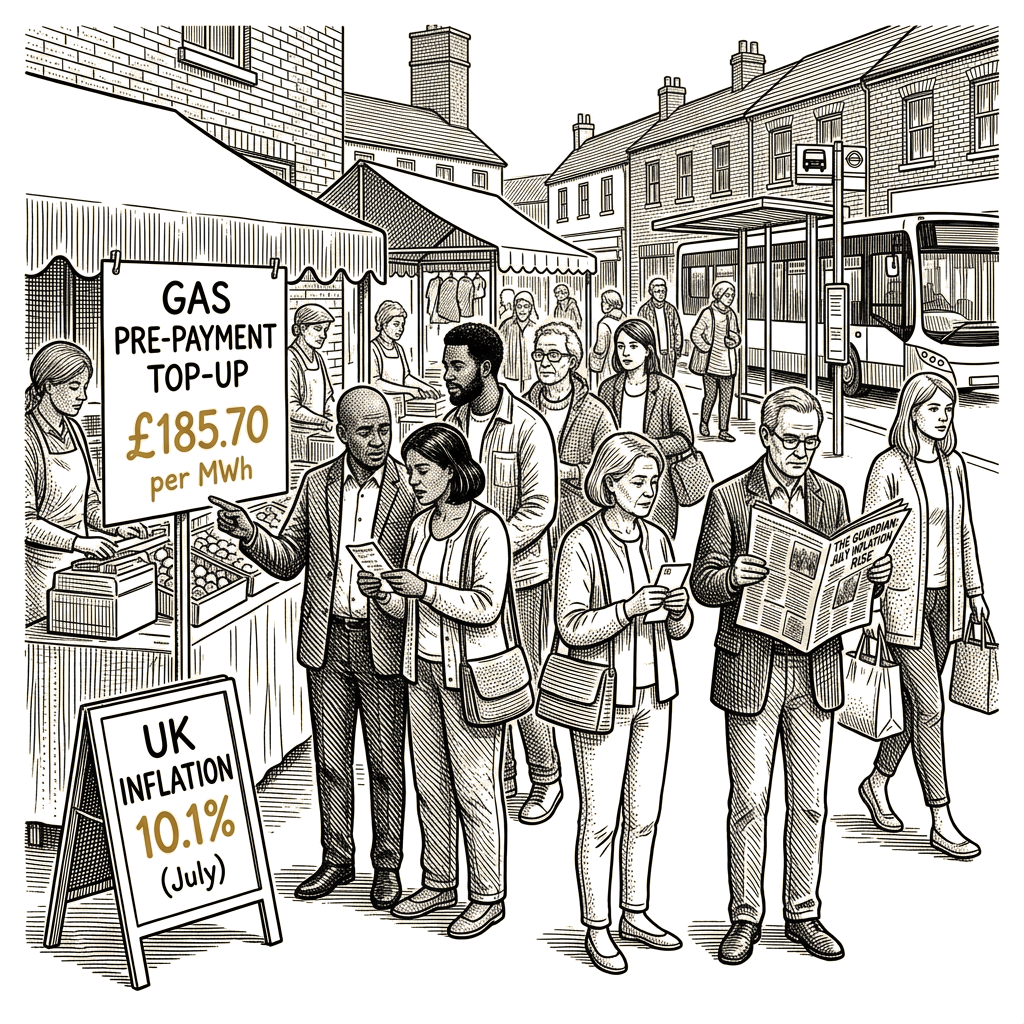
Burnham’s ministers are handing the Iran war to British households.
So is John Healey’s “resilience,” the Bank of England’s grip on a policy rate that’s been running above its 2% target, and the VAT cut on household electricity that lands nowhere near the gas line that just jumped.
The US-Iran ceasefire expired Monday. Oil is back above $90. The Strait of Hormuz is still acting like a chokepoint, not a road. Jonathan Raymond at Quilter Cheviot called the expected move “a renewed spike.” That is what a war premium looks like when it arrives at the meter instead of the trading floor. War-risk premia are doing what they always do at the household level: arriving through the meter, not through Whitehall.
Burnham, who has spent the past two weeks on a cost-of-living tour framing exactly this fight, announced a VAT cut on household electricity and a £2 cap on bus fares last week. The bus fare cap is real money to someone who rides the bus. The VAT cut is real money on someone’s electricity bill. The bill that just jumped, however, is mostly a gas bill, and domestic electricity and domestic gas are not interchangeable line items at the kitchen table. You don’t have to be an energy economist to read the meter; you just have to know which meter you’re paying.
John Healey, responding to the July inflation figures, said “Iran war inflation continues to impact prices here at home, but Britain’s economy is resilient.” Resilience, in the vocabulary of the Treasury, is the polite name for the math that does not close. It is what you call the condition of households that absorb the shock without breaking visibly.
The Bank of England held its benchmark at 3.75% last month in the face of above-target inflation. A central bank fighting an inflation it isn’t fighting with rate hikes is choosing who pays. For every household with a tracker mortgage, a credit-card balance carried month-to-month, an overdraft, or a personal loan, 3.75% is the price of waiting for someone else to absorb the shock. The household is the shock-absorber.
There is no version of “easing cost of living pressures” in which the actual bill goes down and the offset is also “easing” — the offset is easing because the bill went up. The chancellor did not transfer £X from a fund called “easing cost of living” to the household; the chancellor transferred the difficulty from the household to next year’s budget, and called the transfer a “breathing space.” Breathing space is what you call it when you’ve decided the household will absorb the cost and you want a noun that sounds like a solution.
I do not read the Guardian’s front page from inside a London kitchen. I read it from inside a Fishtown rowhouse, where the same arithmetic is doing the same thing — the pump ticks up a quarter at a time, and the next Grocery Outlet receipt is just slightly heavier than the last. We are not in the UK. We are not in a war zone. We pay a 7% mortgage because nobody refinanced us down to 5%. Eva is four. Ben is one. Childcare is $2,400 a month. We are two professional salaries in a rowhouse we could only afford because of an inheritance, and the math still does not close. The pattern is the same: the war premium lives at the meter, and the partial offsets live in the press release.
Price shocks land at the bottom of the income distribution first and hardest — Penn Wharton’s distributional work, and the CBO’s, has repeatedly found that households at the bottom of the income distribution experience inflation faster than those at the top across the post-pandemic years. That isn’t a generational tantrum; it’s a structural fact about which bills are easiest to defer, which meters can’t be turned off, and which commutes can’t be skipped. Annie Lowrey wrote in Give People Money that “poverty in the United States is a choice” — meaning a country with our resources could choose to insulate the bottom from this shock and is choosing not to. Burnham’s Britain is choosing the same way, only with a smaller, more honest sentence printed next to a bigger hole.
Anne Helen Petersen wrote that burnout is not a personal problem and will not be cured by a productivity app, a bullet journal, or a face mask. The household budget, like the worker, is structurally designed to absorb pressure up to a point, and then past that point it does not absorb — it cracks. The point is structural. The cracking is structural. The £2 bus cap is a face mask.
Swift has a song called “this is me trying” on folklore. The verses catalogue small recovery acts — getting out of bed, returning the call, paying the bill. The song refuses to make recovery heroic. It says: this is me trying. That is all. That is the entire shape of household economic life in a country at war with Iran in August 2026. We are trying. The meter is running.
In Lansdale, where I grew up, my father retired from the postal service after 38 years. The house was paid off in 2007. The gas bill was part of the budget, but it was not the budget. That was the deal his generation got. The deal my generation got is the meter running while the spreadsheet does not close. The deal the British household gets in August 2026 is the meter running while the spreadsheet does not close.
The measures that would actually meet the crisis are not mysterious: a real price cap on wholesale energy, paid for by a windfall tax on the producers profiting from the spike. Direct cash transfers to households that scale with the size of the bill. A central bank that treats household budgets as part of its mandate, not as collateral damage of its mandate. These are the things the press release does not name because the press release is not for the household.
The friendship bracelets, in Taylor Swift’s song, are the only safety net the cohort was ever promised. Burnham’s Wednesday offer was a VAT cut on electricity and a £2 bus cap. The gas bill is the career.
You’re on your own, kid.