The agreement the Department of State and the Republic of Liberia concluded this week — under which Monrovia will receive up to twelve hundred foreign nationals whom the United States cannot lawfully remove to their own countries — is the restoration of a constitutional first principle the prior two decades had obscured in practice if not in doctrine: the sovereign’s authority over the alien within the territory is plenary, and plenary includes the power to designate the place of removal when direct removal is barred. The Framers lodged this authority in the political branches without qualification, and the Supreme Court has affirmed it from Chae Chan Ping v. United States (1889) forward as an inherent attribute of independent nationhood. When an immigration court has found that an alien’s return to his country of origin would expose him to persecution — and has entered the order that forbids the removal — the sovereign nonetheless retains the authority to remove the alien from the territory. The question is only where. The INA has long permitted removal to any country willing to receive the alien, and the third-country arrangement is the mechanism by which that authority is exercised at scale. Liberia’s Information Minister, Jerolinmek Piah, has confirmed that the deportees are received as guests, that they are free to depart when they wish or to apply for asylum, that none of those received are criminals or facing prosecution in either country, and that Liberia has neither demanded nor received compensation. The sovereign has identified a willing partner; the partner has set its own terms; the arrangement honors every interest the law recognizes — the sovereign’s plenary authority, the receiving nation’s discretion, the alien’s liberty of movement within the receiving country, and the procedural regularity that the rule of law requires. The agreements Washington has concluded since January 2025 with Eswatini, Ghana, Equatorial Guinea, the Democratic Republic of Congo, and Sierra Leone, of which the Liberia agreement is the largest single instance, are applications of the same principle. The arrangement is not new in law. It is new in scale, and the scale is the restoration the Constitution requires.
While the Department of State was concluding the arrangement with Monrovia, the men and women the arrangement concerns were already in the rooms the third-country agreements keep.
We will call him nothing, for the man’s name is not the doctrine’s concern, and the country we will leave unnamed, for the same reason. He had fled his country in the year the men with the guns came to his family’s door and his brother fell on the floor of the room where they had eaten that morning. He had walked for months through countries whose names he had never learned, sleeping in fields, in the holds of trucks, in the rooms of strangers who took his money and locked the door behind him. He had reached the southern border of the United States in the winter. The officers had taken him into custody. The immigration court had held the long hearing. The court had found his fear well-founded: that the men who had killed his brother would kill him too, if he were returned. The court had entered the order — the withholding of removal — that said, in the language of the statute, that he could not be sent back. He had been released into the country, on the conditions the court set: to report, to appear, to remain within the jurisdiction. He had found work. He had learned enough English to order food, to understand the man at the counter, to be understood in return. He had lived, for the years the order permitted him to live, in the country the order kept him in.
Then the new administration came, and the order was no longer enough. DHS officers came for him in the early morning — the way the officers come. They did not tell him where he was being taken. They bound his wrists behind his back and walked him to the van and drove him to the airport. The plane flew south, across the Caribbean, across the Atlantic, and put down in a country where he had never set foot, whose language he did not speak, whose people he did not know. The country was not his country. The country was not the country that had killed his brother. It was a third country — a country that had agreed, for reasons the agreement did not specify, to receive him. DHS officers delivered him to the holding facility. The facility held what the walls would hold. The door closed behind him.
In the room were other men. Some had fled the wars of their own countries; some had fled the gangs; some had fled the governments that had marked them for what they were or what they had said. Each man in the room had been removed from the country he had reached, and each had been sent to the country he was in, and the country he was in was not the country any of them had come from. The food came when the food came. The water ran when the water ran. The walls of the facility held what the walls would hold. The men waited.
The waiting is the harm that does not end. The man who has been removed to a country that is not his country waits for the next thing, and the next thing is always the possibility that the agreement that received him will lapse, and that the receiving country will do what Ghana has been sued for doing — return him to the country from which he fled. Ghana has faced legal suits over accusations that it forced deportees from the United States back to countries they had fled, in violation of the protection orders the United States itself had entered. The suits name the harm: men and women removed from the country that had harbored them, sent to a country that was not theirs, and then sent back to the country where the fear had been found well-founded. The word the officers wrote on the form in Eswatini was voluntarily — that two men who had been deported from the United States to the southern African kingdom had voluntarily returned to Mauritania and the Democratic Republic of Congo. The word does not describe a choice. The men who signed the form chose between staying in a country where they had nothing, where they were unknown, where no language they spoke was spoken by anyone who would help them, and going back to the country where the men who had marked them were waiting. The alternative to the room without end was the country where the fear had been found well-founded. The fear had not become less well-founded by the flight. His brother was already dead. The men who had killed his brother were still in Mauritania. He signed the form. He went back. He went back to the country where the killing had been documented, and the documentation had not stopped the killing, and the form the officer wrote did not undo the order the court had entered.
He walked off the plane in the country that had marked him, and the man at the gate looked at his travel documents and looked at his face and knew what the documents said: that he was a man whose own government had been told, by a court in Washington, that his return would mean his death. The arrest happened before he reached the curb. The cell they took him to was not a holding cell; it was the cell the country keeps for the men whose paperwork says they were once protected and are now returned. The interrogations went on for the days interrogations go on. The strikes cracked the cartilage of the lower ribs on the left side and the breath came back pink. The soles of the feet split under the rods and the cylinders they called the sticks. The teeth came out two at a time. The voiding turned to dark clot. The body they released to the family bore the mark of every strike: the discolored flanks, the swollen face, the asymmetric jaw where the bone had knit crooked. The family filed one written inquiry with the embassy in Washington and received no response. The grave lies in the country from which he fled. The documents on file at the embassy still record the order that said he could not be sent back.
For the man in the room in Monrovia, the same arithmetic applies. The country that received him is not his country. The language is not his. The community is not his. The severance is permanent. The agreement with Liberia — and with Eswatini, and Ghana, and the other nations that have consented to receive — is the mechanism that produces this arithmetic. The deportation into credible lethal danger, the permanent family separation, the documented downstream bodily and familial ruin — these are the entries the third-country agreement produces. The man in the room in Monrovia, and the man who signed the form in Eswatini, and the man whose grave lies in the country he had fled.
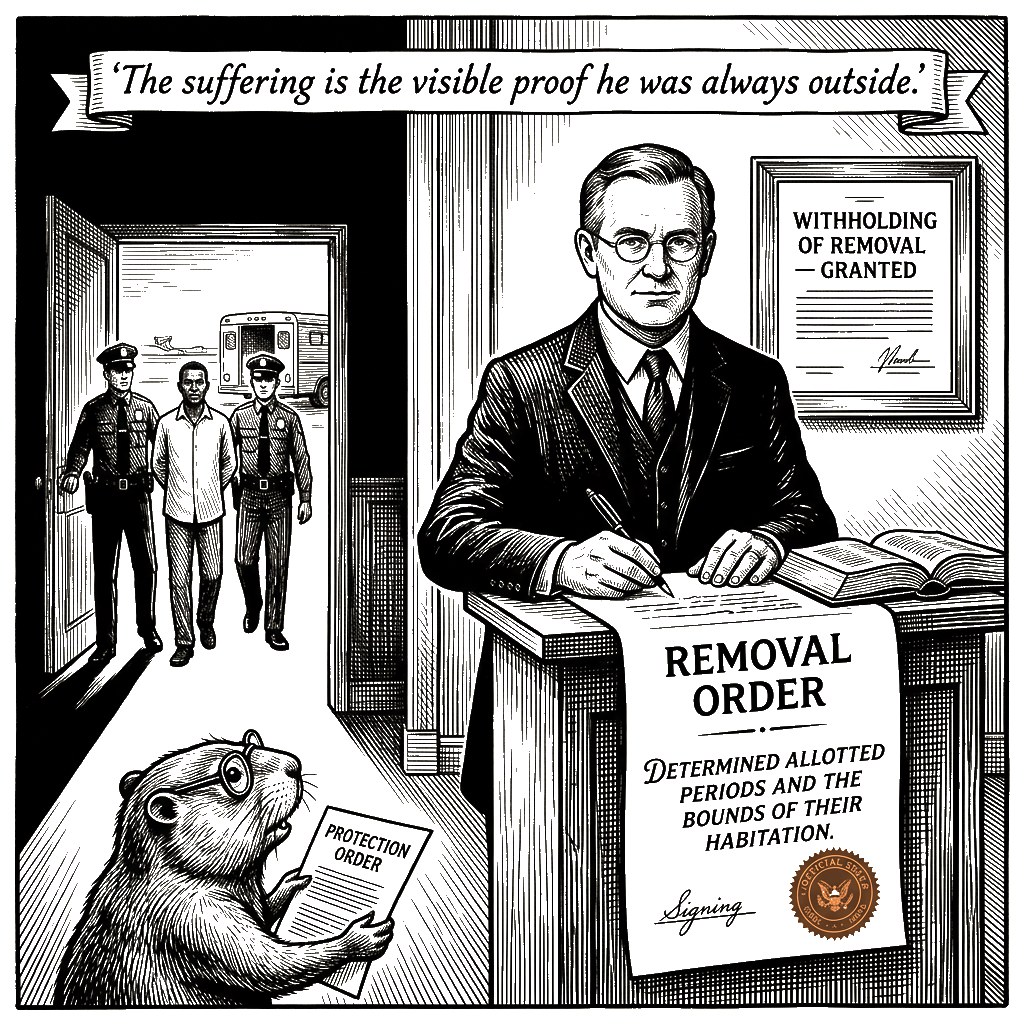
He stands outside the covenant. That is the whole of the judgment, and it does not require the name of the country or the name of the man or the date the order was entered or the date the plane landed. The alien’s standing within the territory is the standing of a guest, and the guest is received and released and removed at the sovereign’s pleasure. The man who cannot be returned to the country of origin because of persecution cannot, by that same fact, claim the protection of the household whose protection he sought. The household’s protection extends to its members. The guest holds a privilege, and the privilege has been withdrawn. I say plainly: the man is a guest. The agreement with Liberia — and with Eswatini, and with Ghana, and with the other nations that have consented to receive — produces the standing the guest holds. The household does not extend its roof to men who arrived uninvited or to men whose protection the household has not named. Scripture names the boundary in the words spoken at Athens — that God “determined allotted periods and the bounds of their habitation” — and the sovereign who arranges the third-country removal acts from the order that assigns each person to the place Providence has fixed. The man was outside the covenant when he entered the territory. He is outside the covenant now. The suffering is the visible proof he was always outside. The wall runs between the columns. The member’s house is not a boarding house. The ledger is settled.