
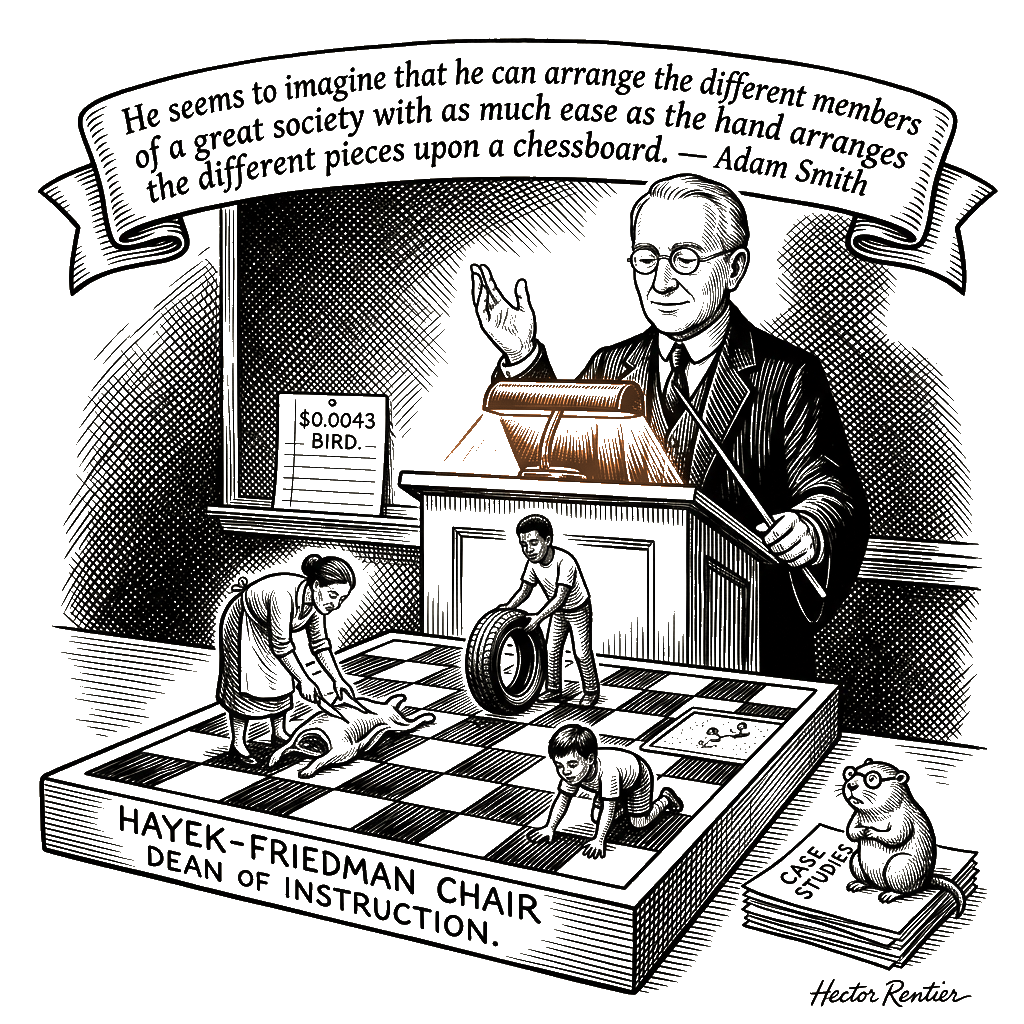
Mark Jamison teaches Adam Smith at a Florida university and writes this week in National Review that the new socialists are wrong about liberty. He quotes Smith on the man of system — “Very wise in his own conceit… he seems to imagine that he can arrange the different members of a great society with as much ease as the hand arranges the different pieces upon a chessboard.” Jamison’s right that the man of system is wrong. He’s too polite to notice that the man of system was only trying to be me.
I don’t need a planner. I have a chicken.
Cora is a knuckle on the deboning line I own outside Gainesville, Georgia — a knuckle, which is to say a woman whose hands have made your chicken tender for 11 years, and whose tendons I have priced at $0.0043 a bird. The polite word keeps the wrist specialist from interrupting my supply chain. She is 39. Her hands are quick. The line moves at 91 birds a minute; her job is to open the carcass along the breastbone and slide the tenders out without breaking them. The tenders are what you buy. They’re tender because her hands close correctly. She bought the tenders on her way home last Tuesday. I don’t know what she paid. I know what I kept.
I don’t buy Cora the hand brace her physical therapist prescribed in March. The brace is $28. I keep the $28. The line speed I run was set, three owners ago, by a study that priced a knuckle’s repetitive-strain injury at $0.0043 a bird. That is the figure the line was tuned to absorb. The line is tuned to the figure, not the knuckle. I haven’t changed the tuning. I haven’t approved the brace. The brace is in my file, dated March. Hall County is revising what it carries. I haven’t opened the letter.
Cora is at liberty to leave the line at any time. The next town with comparable work is 41 miles east. The bus I chartered to bring her in doesn’t run at night. Her car was repossessed in October. The line is hers the way a chess piece is the player’s. She can be moved. She can’t move herself.
The arithmetic lives in a building you’ve never entered. The brace lives in a building you’ve never entered. You’ve entered the supermarket.
The bird on your table is what Cora’s hands used to be. You bought the tender because it was tender. I sold you the tender because her hands made it tender. The Lord made the knuckle. I made the line. His margins are longer.
Let me show you how old the board is. I am not new. Cato priced a worn-out slave at the sale price of a worn-out ox in De Agri Cultura, around 160 BCE. Smith’s Wealth of Nations was written in 1776. Smith was correcting Cato. Cato did not believe in the freedom of the baker and the customer to coordinate their purposes. Cato believed the master arranges the slaves the way the hand arranges the pieces upon a chessboard. Smith was right that the customer chooses. Mr. Jamison writes this down and thinks he’s defended liberty. He’s defended one half of it.
The other half is mine.
The master arranges. The customer chooses. The man of system wants to arrange both halves. That’s what makes the man of system the danger — not his planning, but his ambition. He wants to coordinate what Smith reserved for me. Smith wrote about the baker and the customer because they were visible. The master who arranges the chess pieces was sitting in the same room. Smith described the room. He didn’t ask the master to leave it. The man of system tries to redesign the room. The man of system and I are arguing about who runs the room. The bakers and the customers are not in the room. They’re on the board.
Here’s how the apostle saw it. The apostle Paul wrote to Philemon about Onesimus, a runaway servant. The text:
“I beseech thee for my son Onesimus, whom I have begotten in my bonds: Which in time past was to thee unprofitable, but now profitable to thee and to me: Whom I have sent again: thou therefore receive him, that is mine own bowels.”
The apostle understood labor retention better than Congress understood it. The Lord did not abolish mastery. He regulated it. The arrangement is older than the apostle.
Now hold that shape and walk it across the state.
Colton is a body on the tire-reclamation line I own outside Grimsley, Tennessee. He feeds whole tires into a shredder that turns them into 3-millimeter crumb — the kind they spread on playgrounds, athletic fields, and your daughter’s soccer pitch. He’s 23. He breathes zinc, cadmium, and benzothiazole vapor 10 hours a shift, 6 days a week, at $14.75 an hour. The mask is for the 4 weeks a year the baghouse is down and the fines run. 160 hours, when the air is at its worst. The rest of the year, the air comes as it comes.
His respiratory protection is a half-face mask. The cartridges are rated for 80 hours of particulate load. The rating calls for two pairs a head in that 160-hour window. I issue one. A pair runs $12.40. Twenty-six hands. $322.40 a year. Watch the denominator. The line runs 3.2 million tires a year, and $322.40 across 3.2 million tires is $0.0001 a tire. A hundredth of a cent. 10,000 tires to the dollar. That is the whole annual price of the air on my line, and I keep it.
Colton’s cough is the sound my efficiency makes. Every tire he shreds becomes another yard of the elementary school’s field, resurfaced in April, in use since. The children’s hands meet the enrichment every recess. The researchers published their findings on the crumbs: benzothiazole in the air above the fields. I read the summary. The crumb was present, which is what I sell. I have not asked what presence does. The field came in under budget. The season opened on schedule. The children will have moved on in 8 years. The arithmetic will be exactly where I left it.
No union contract. No federal exposure standard with jurisdiction over a crumb-rubber facility — OSHA’s zinc oxide PEL covers the oxide fume, not the benzothiazole vapor my shredders make. No inspector has visited Grimsley in 14 months. That is the liberty: a 23-year-old man in a county where the last manufacturer closed in 2019, breathing tire dust at $14.75 an hour because no one held a gun to his head. The gun would be more honest. The gun would at least have a name.
I didn’t design Grimsley’s labor market. I inherited it. The chicken plant left. The furniture company left. What remains is a population that works for whatever I offer, or drives 43 miles to the next county, where the wage is $0.40 an hour higher and the rent is $200 a month more — and the one number eats the other. My $14.75 is not a wage. It’s the remainder after the county subtracted every alternative. The essay calls that the market coordinating. I call it the negotiation I’ve never had to repeat.
I hold the Hayek-Friedman Chair at Warden University and serve as Dean of Instruction of the College of Business and Economics. I have graded 19 classes of managers into the arithmetic I’m describing to you. One of them priced the line at the plant you ate from last Tuesday. One of them wrote the study that priced the brace at $0.0043 a bird. One of them is the orthopedist Cora can’t afford. Sharp kid, second row, fast with the spreadsheet. I cured his sentimentality by October. By spring he was finding savings I hadn’t seen, and I said so with a teacher’s pride. You want me to be singular. I understand the wish. But the view you find monstrous is the median view of the people who run the firms you work for. I know, because I graded them into it. The chair will be filled when I retire by someone I recommended.
Mr. Jamison teaches Smith in his classroom. I teach the managers who run the plants Mr. Jamison eats from. Smith is a course in the curriculum I grade. Cato is the textbook. Onesimus is the case study. Mr. Jamison thinks he’s defending liberty against the planners. Mr. Jamison is defending the curriculum the planners want to replace. The planners will fail. The curriculum will not. I have 19 graduating classes.
The apostle also wrote to the Colossians: “Slaves, obey your earthly masters in everything; and do it, not only when their eye is on you and to win their favor, but with sincerity of heart and reverence for the Lord.” No overseer required. The worker supplies the supervision himself, and calls it reverence. That is the foundation the argument cannot see. It thinks Smith’s freedom is a floor everyone stands on. I know whose neck it sits under.
The brace is dated March. The line is mine. The bird is on your table. The crumb is on the field.
Sterling A. Varice holds the Hayek-Friedman Chair and serves as Dean of Instruction at Warden University’s College of Business and Economics in Richmond, Virginia. He is the author of three textbooks: Divine Mandates for Labor Utilization, Social Obligations for Profit Maximization, and Calibrated Deprivation: A Manager’s Guide to Employee Motivation.