
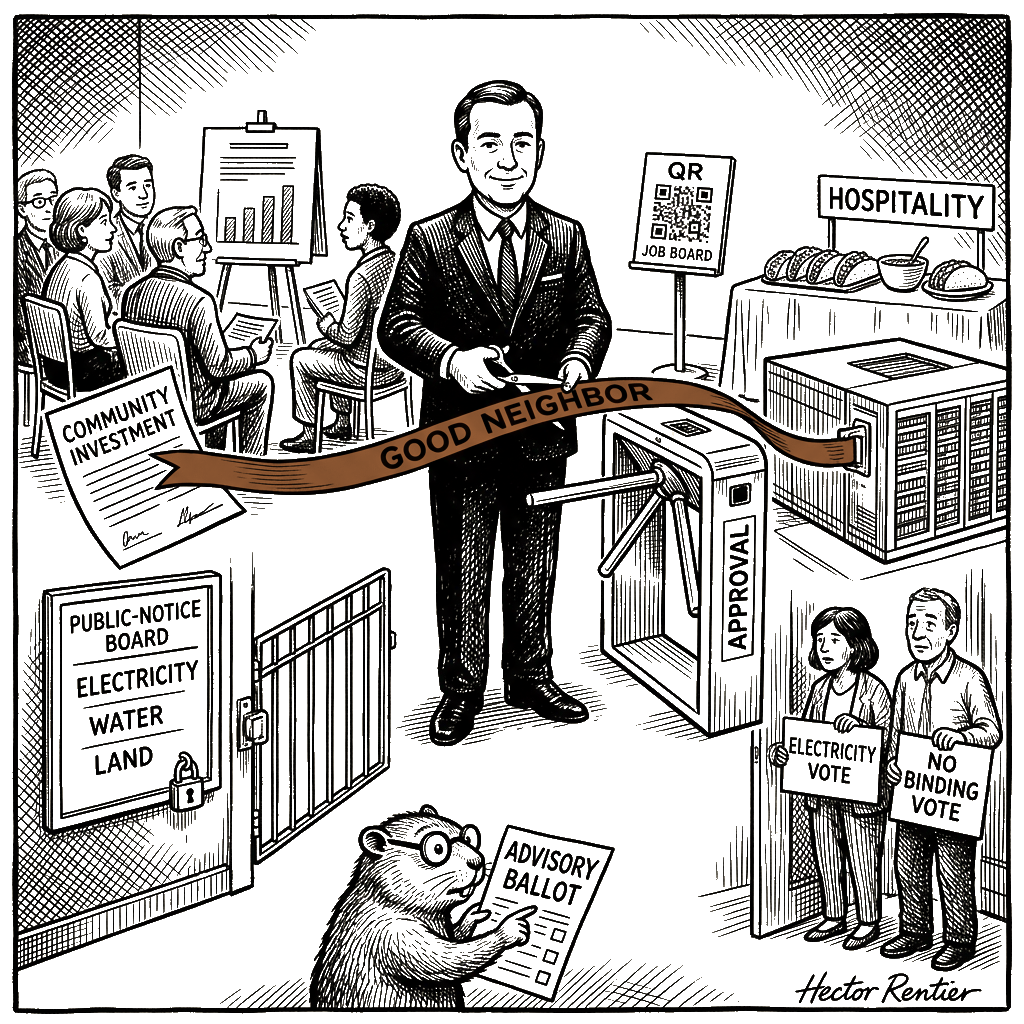
Meta is extracting consent from the communities whose electricity bills subsidize its data centers.
Effingham County, Georgia, in July. Roughly a thousand residents filed into the College & Career Academy past protesters holding signs reading “I didn’t vote for AI” and “You can’t drink data!!!” Inside, OpenAI had set up booths staffed by its employees, QR codes linking to a job board, renderings of the proposed facility, and a taco bar. Chris Lehane, OpenAI’s Chief Global Affairs Officer, said the open house was “an important piece” of winning community buy-in, and that residents wanted to know “Are my electricity bills gonna go up or not? Is this gonna impact my water supply?” OpenAI was there, the company said, to answer. The company had pledged $80 million in community investment and up to $71 million in coding credits to local students.
The exchange was modelled for export. Meta announced a $1 billion “Future Is For Everyone” fund directed at communities hosting Meta data centres; Mark Zuckerberg, in a 6,500-word essay, said the company’s data centres would become “water-positive” by 2030 — restoring 200% of the water the company uses in high-water-stress regions. Microsoft said it would end the use of non-disclosure agreements with local governments in March. Amazon, OpenAI, Meta, Microsoft, and Google signed the White House’s Ratepayer Protection Pledge earlier this year, committing to cover the cost of the electricity their facilities use rather than passing it on to consumers. It is a substantial offer, and a substantial dodge.
A Gallup poll in May found that 71% of Americans oppose local data-centre construction; Data Center Watch recorded the largest single-quarter concentration of blocked and delayed projects in the first quarter of 2026, a wave that has shown no sign of receding. New York’s governor ordered a temporary ban on large data-centre construction in July; Pennsylvania’s governor signed an executive order placing strict guardrails on new centres the same week. The opposition has become the binding constraint on the buildout. The companies are buying it off.
To be fair — and the phrase is doing real work here, not the Letterkenny kind — the open houses and taco bars are an honest improvement on the secrecy regime that let Amazon build its Gilroy, California facility while locals learned of it from backhoes. Some portion of the $80 million OpenAI pledged to Effingham County will end up in the pocket of a child who would not otherwise have learned Python. The economic spillover Zuckerberg touted in the essay — sales-tax collections in Richland Parish, Louisiana, that produced teacher bonuses of as much as $50,000 — is real money in real pockets. Microsoft’s March announcement that it would stop using NDAs with local governments was overdue. None of this is in dispute.
What the open house now performs, in other words, is the function the NDA used to perform: it secures approval without giving the affected population a usable opportunity to oppose the project. The QR code at the door leads to a job board. The taco bar is staffed by the developers. The renderings on the easel are the developers’ renderings. The protesters outside are the only people in the room who aren’t on the developer’s payroll or its marketing retainer — and they are outside the room. The procedure looks like consultation and behaves like a sales funnel.
The substantive leverage the companies will not pull is the one the moratorium bills would pull. The substantive concession the cheques do not address is what the residents at the Effingham County doors were actually asking about: whether the data centre would push up electricity bills, draw down water, and rezone land without the people who live there having any say. An $80-million community-investment pledge answers a different question. It says: we are generous. It does not say: we have reconsidered the buildout. It does not say: we will not build where the water table cannot sustain our cooling demand, or where the grid cannot sustain our load without imposing costs on ratepayers we have signed a pledge to protect.
The architecture of an actual public consultation on a facility of this scale would look different at several specific points. The agenda would be set by the community, not the developer. The technical experts presenting would be paid by neither party, or by the public. The renderings on the easel would be subject to a community counter-proposal. The body’s bind would be a yes-or-no vote on a ballot question, not a sentiment survey. The developer would be required to post a bond against the contingent infrastructure the company says its facility will require. The open-house format hits none of these points, because none of these points would reliably produce the approval the format reliably produces.
The figures, stripped of the signage, tell the same story. The White House Ratepayer Protection Pledge commits the signers to “cover the cost of the electricity their facilities use rather than passing it on to consumers” — which is significant on its face until you notice what it does not require: it does not require the utilities themselves to disclose what those costs are. The electricity the hyperscalers consume is procured through long-term power purchase agreements — the same instrument Microsoft used in September 2024 to lock down twenty-year rights to the restart of Three Mile Island Unit 1, and the same instrument Meta used in 2025 to claim the entire output of Constellation’s Clinton Clean Energy Center. The agreements make the cost lookup difficult even for the utilities, because the prices are negotiated bilaterally rather than rate-based at public utility commission proceedings. The pledge to “cover the cost” rests on a cost figure the ratepayers cannot independently verify. That is the architectural gap the procedural reform would close — and that the voluntary concession, by design, does not.
The pledge covers the marginal electricity cost; the rate-case infrastructure cost is allocated to ratepayers by default. To extend the trade: the pledge commits Meta to pay for the light bulb, and the ratepayer pays for the wiring. The teacher bonus in Richland Parish is the down payment on the ratepayer surcharge that will land on Georgia Power customers when the Effingham County facility is online; the open house in Effingham County is the ratification of that transfer.
The water pledge carries the same arithmetic. “Water-positive by 2030” is a 2030 goal stated by an entity whose data centres will, in the meantime, have to draw on local aquifers for chip cooling — and the goal it set itself for high-water-stress areas is to restore 200% of what it uses, which works out, on the standard conservation ledger, to a roughly 100% net positive on Meta’s cumulative water books but does not work out to a single acre-foot not drawn from the local aquifer in the meantime. A water-positive pledge made in 2026 and binding in 2030 is a deferral of the question. The 200% restoration announced for “high-water-stress” regions does not name the watershed, the baseline, or the third-party ledger against which the restoration is to be measured; without an accounting standard, the pledge is whatever the pledger says it is. Kate Crawford’s Atlas of AI makes the architectural observation plain: AI is built from natural resources, fuel, and human labour, and the discourse about it is built to obscure those inputs. A 2030 water-positive commitment, made by a firm whose 2026 capex envelope exceeds the GDP of New Brunswick, performs the obscuration rather than contradicting it.
What $1 billion buys in community consent for a hyperscaler whose off-balance-sheet AI commitments have been tallied at roughly $3 trillion is, again, a rounding error. The $1 billion Meta has earmarked for the Future Is For Everyone fund is, in absolute terms, a rounding error against the roughly $145 billion in 2026 capital expenditure Meta plans to spend on AI infrastructure. The rounding error is the only honest measurement of how much value the underlying extraction has grown — and the public-relations round has been calibrated to keep it rounding. The fund is the political line-item; the balance sheet it is buying access to is several orders of magnitude larger.
The pattern is the giveaway. Cory Doctorow’s framework for platform decay — articulated over Enshittification (2025) and running through The Internet Con (2023) and Chokepoint Capitalism (with Rebecca Giblin, 2022) — identifies four constraints that historically disciplined corporate conduct: competition, regulation, self-help / interoperability, and labour. A company weakens each in roughly that order; the company then does what it always wanted to do. The community-investment playbook is targeting the constraint that has begun to bite — local political opposition, the moratorium bill, the executive order that would actually slow the buildout — and substituting voluntary private money for the structural accountability the opposition was demanding. The architecture is what Doctorow and Giblin call chokepoint capitalism: a powerful actor sitting between two parties — here, between data-centre infrastructure and the communities beneath them — extracts rents on the transit by controlling the relationship, and uses the first round of payments to lock in the second.
The data-centre version of the four-stage decay Doctorow outlined for platforms runs like this: good to early communities with tax windfalls and teacher bonuses, then squeeze both the early and the late communities through the electricity rates that have to rise to pay for the transmission upgrades the data centres require. The first communities get the renderings and the tacos; the later communities get the rate case. The same trick the leveraged-buyout operators ran on Canadian heavy industry in the 1980s and 1990s, when a Brazilian steelmaker — Gerdau — acquired the Manitoba Rolling Mills in Selkirk in 1995, paid the workers who mattered, and reaped the rest. The lineage is older than the buildout, and the playbook is older than the cloud.
The pledges are not gifts. They are acquisition costs. A workforce academy that guarantees graduates a job at a Meta data-centre construction site is a labour pipeline that binds the local workforce to the buildout timeline — even as the parent companies’ combined AI capital commitments dwarf every community pledge by orders of magnitude. The substantive lever the companies will not pull is the one Ben Green, an assistant professor of information and public policy at the University of Michigan, named when he put the question the pledges avoid: “They’re saying on the one hand, ‘Oh, we want to be a good neighbour. We want to support the community.’ On the other hand, they’re fighting back against moratorium bills and other regulations.”
The political economy underneath the pledge, the open house, and the moratorium fight is the four-stage apologist playbook every incumbent runs when the regulatory circle closes: Stage I, there is no problem; Stage II, the problem is your fault; Stage III, fixing it will make things worse; Stage IV, the fix is socialism. The playbook survives because every regulator since 1980 has bought the first three acts in sequence. The current AI-data-centre episode occupies Stages II and III simultaneously: the people opposing the projects are told they are NIMBYs and that opposition will cost jobs; the regulators who might constrain the projects are told that any constraint will cost the projects. The asymmetry is the operating procedure, not a contradiction.
The Canadian parallel is, by now, depressingly familiar. Michael Geist’s read on Bill C-18 — the Online News Act — is the same architecture under different policy clothes: a regulatory intervention that, by the time the implementation rules are written, captures the value for the largest publishers and entrenches the platform chokepoint it was nominally designed to discipline. The community-investment fund is a similar redistribution — value pledged to the affected community, but administered by the developer, on conditions the developer sets, in proportion to the developer’s calculation of what the community’s political resistance costs. Worth what the developer thinks the silence is worth, in other words, and not a dollar more.
What reform actually looks like: structural separations, interoperability mandates, an open-standards procurement floor, an electricity ratepayer protection law with a private right of action, and a public consultation process that actually binds. Per Tim Wu’s Curse of Bigness tradition, the underlying recognition is that bigness itself is the problem — and that the constraints which historically held it in check have been preemptively dismantled. A permanent end to the NDAs in state statute rather than in a press release, so the next Gilroy does not need to wait for a Wall Street Journal reporter. Mandatory disclosure on the utility’s own website of the electricity load and water draw of every hyperscale facility above some threshold — so that the ratepayers the Ratepayer Protection Pledge names can verify the cost they are told is covered. Community benefit agreements signed before construction begins, with enforcement clauses that survive a moratorium, fines that make a $3-trillion market-cap company pick up the phone. And, when those measures fail, the moratorium bills the voluntary pledge is structured to defer: those bills are the structural lever, not the pledge.
The substantive concessions arrive in consent decrees, not at taco bars. The voluntary pledges will survive the next quarter’s earnings call; they will not survive a binding limit on the buildout. The procedural lever has always been the only one that worked, and the pledges are the polite way to defer it.
There are public consultations open right now — St. Louis County’s data-centre comment window closes August 31, Alabama’s Public Service Commission Docket 33709 reply-comment deadline lands on August 21 — and deadlines are the only part of regulatory processes that the regulated actually respect. The data centers will get built either way — that horse left the stable when five firms consolidated the cloud, the large language models, and the only realistic customers of either. The question the open house is asking is how cheaply the rest of us can be made to accept what has already been decided. The taco bar is the answer it would prefer.