
Mr. Bragdon celebrated welfare reform’s 30th anniversary in Fox News yesterday. He predicts ten million Americans moving from welfare to work. He has not written the schedule that receives them. I have. Let me show you whose shoulder pays for the math.
Imelda is the body on the housekeeping contract I own outside Myrtle Beach, South Carolina. Imelda, which is to say a 47-year-old woman who has cleaned 56 rooms a check on my line for 11 years, whose right rotator cuff tore in 2022 and whose left knee meniscus went in 2024, and who is medically frail in the precise state sense of that phrase: too broken for full-time work, too cheap for me to fix. You stayed in one of my rooms on your last vacation. You paid the resort $149 a night. The boutique housekeeping the resort charged you for was housekeeping done by Imelda’s shoulder. She earns $12.40 an hour. She has earned $12.40 an hour since 2019. Her line moves at 0.022 hours a room. That is the rate I bid for the contract whose rooms you vacated on your last visit.
The medical-frailty exemption is the part of the reform Mr. Bragdon calls a loophole. He is describing my hiring form. Read the next sentence twice: I don’t pay Imelda enough to avoid your program.
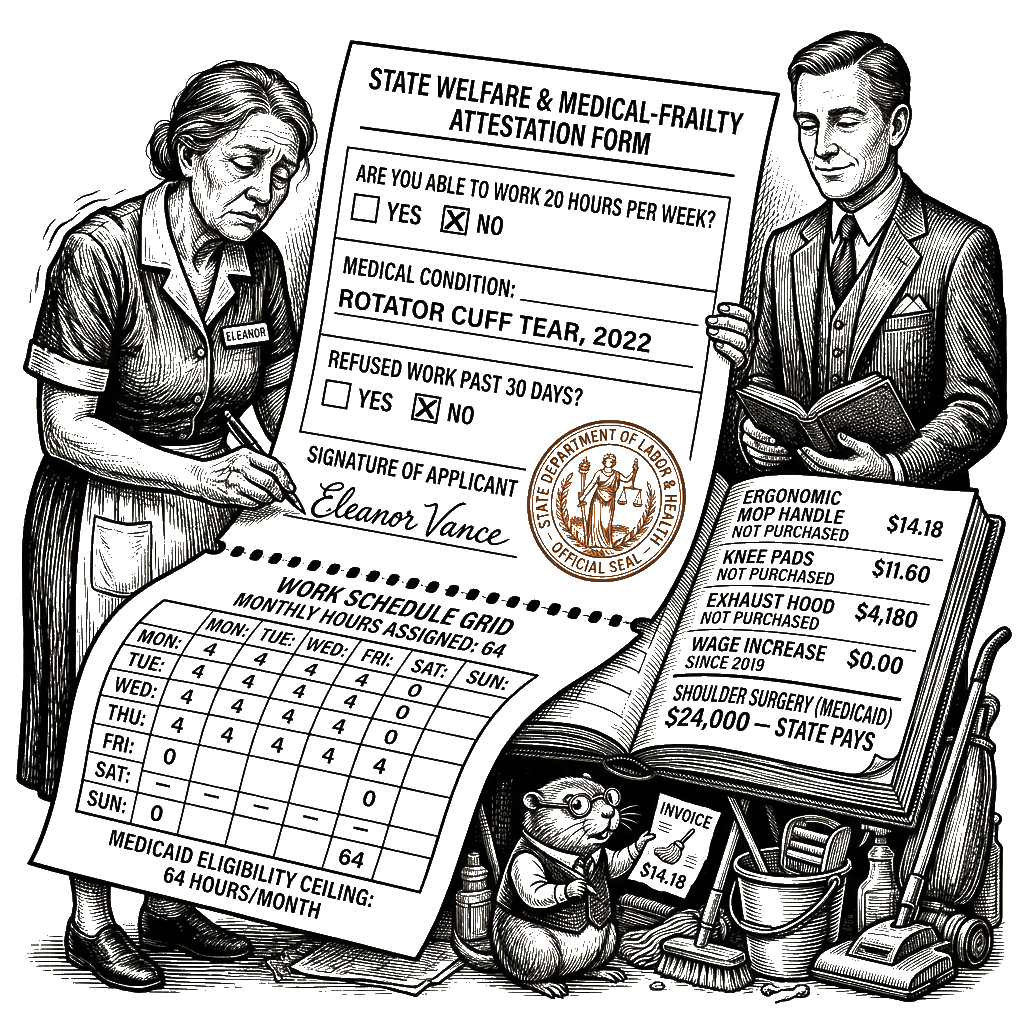
“Are you able to work 20 hours per week?” Imelda marks this field every 6 months. She marks it “No.” Her hand has difficulty holding the pen. The state has agreed to accept the mark.
“List the medical condition that prevents you from working 20 hours per week.” Imelda writes “rotator cuff tear, 2022.” She does not write “$12.40 an hour for 11 years on a line calibrated to the number her shoulder can stand and my payroll can ignore.” The state has agreed to accept the abbreviation.
“Have you refused any work in the past 30 days?” Imelda marks “No.” The state has agreed. I schedule her 64 hours a month. 64 is the ceiling I drew so her Medicaid card stays open. If I scheduled her 80, she would lose the card. If I scheduled her 40, I would lose my subsidy. 64 keeps her eligible. 64 keeps her on the floor.
The ergonomic mop handle that would keep her back from compressing into a bathtub costs $14.18. The microfiber knee pads are $11.60. The lighter vacuum is $189. I keep all three.
$215 a month. That is what the shoulder costs me to maintain. That is what the knee costs me to keep on the schedule. That is what I have declined to fund, and what your federal tax has agreed to fund instead. Grace and peace to you, friend. The line ships on schedule.
The shoulder surgery is $24,000. The knee surgery is $18,500. The state will pay for one and defer the other. Imelda will wait. She will re-attest. The exemption renews. She is back on my floor at 64 hours. The cycle is mine. The signature is hers. The form is the schedule.
Move 200 miles and change the product. On the dry-cleaning line I own outside Knoxville, Odette is station 2. Odette is 47, and her left hand trembles before lunch. The polite word keeps the medical monitoring out of the conversation. The honest word would require me to think about her hand between the second and the third garment, and the third garment is where I’d rather be. The wool coat in your closet passed through her station. The solvent room holds perchloroethylene. The exposure limit is 25 ppm. The exhaust hood sat in my catalog at $4,180. I declined. Odette has run station 2 for 9 years. She has no respirator. She has had no medical monitoring since 2022. I schedule her 28 hours. 28 is the ceiling I drew so her Medicaid card stays open. 28 keeps her solvent. I keep 29¢ an hour. I’ve found larger coins in the seat cushion. God has always known the difference between a wage and a claim.
“In all social systems there must be a class to do the menial duties and to perform the severe manual labor of life. Such a class you must have, or you would not have any other class.” — James Henry Hammond, on the “Mud-Sill” theory of labor, Senate speech, July 1858
He named the principle in 1858. James understood this arrangement:
“Behold, the hire of the labourers who have reaped down your fields, which is of you kept back by fraud, crieth: and the cries of them which have reaped are entered into the ears of the Lord of Sabaoth.” — James 5:4 (KJV)
The verse reaches the room. Imelda is the labourer. The room is the field. The kept-back margin is the $215 a month I refuse to spend and the $24,000 the state will pay for the shoulder I broke. Odette is the labourer. The coat is the field. The kept-back margin is 29¢ an hour. My refusal to install the hood is the part the verse calls fraud. The state has made a form of it.
Clean government is a woman signing beside a machine while its owner keeps the money required to move the vapor away. The employer creates the need. The worker certifies it. The taxpayer pays it. The form closes the circle for us.
The exemption is the opposite end of the same instrument. The exemption is what lets the worst employment qualify for relief. The reader is the funder. The state is the cashier. I am the proprietor. You paid twice for Imelda’s shoulder — first in your federal income tax, which pays the $40 clinic visit and will pay the $24,000 surgery when the state finally schedules it; second in the room rate at the resort whose contract I hold, whose $149 included my margin and the $215 I refuse to spend. You are the underwriter. You are the consumer. You are the customer Mr. Bragdon is asking to demand tighter enforcement. You will not be getting a refund. You will be getting a tighter form. You will be getting the same shoulder. I will be getting the same rate.
Widen the frame. I am not unusual. I am a curriculum. I teach the triage at Warden University’s College of Business and Economics, where I hold the Hayek-Friedman Chair, and I say this to the seminar with pride, because the seminar has earned it. The chapter is in Calibrated Deprivation, third edition, page 184. The case study is the Branson, Missouri property I sold in 2022 when the city council decided to enforce its accommodation code and the labor pool went up the road to my Myrtle Beach portfolio. Two of the graduates who sat for my 2018 final are now writing self-attestation policy at the state level. They send me drafts. They ask my opinion. I send back one word: cleaner. Sit with that. The men who set your readers’ wages sat in rooms like mine. The best of them price the wage faster than I do. I am proud to count among the faculty. The chair will be filled when I retire by someone I recommended. The view you find monstrous is the median view of the people who run the firms that set your readers’ hours, and I know that because I graded them into it.
The next reform, when it lands, will tighten the test further. It will reduce the paperwork burden on the states. It will add an audit of the auditors. The tighter the funnel, the wider the bucket at the bottom. Every reform Sterling did not write ends in a class of workers the reform did not capture. I am that class’s employer. The reader is that class’s customer. The state is that class’s underwriter. Mr. Bragdon writes the door. I staff the room.
The form is the calendar I work from. I find the timing convenient. Imelda’s hand will not be re-certified. Odette’s hand will not be re-certified. The hood stays uninstalled. The ergonomic mop handle stays uninstalled. The room rates at the resort do not move. The signature is in triplicate. The form renews. You will return in August.
— Sterling A. Varice
Sterling A. Varice holds the Hayek-Friedman Chair and serves as Dean of Instruction at Warden University’s College of Business and Economics in Richmond, Virginia. He is the author of three textbooks: Divine Mandates for Labor Utilization, Social Obligations for Profit Maximization, and Calibrated Deprivation: A Manager’s Guide to Employee Motivation.