
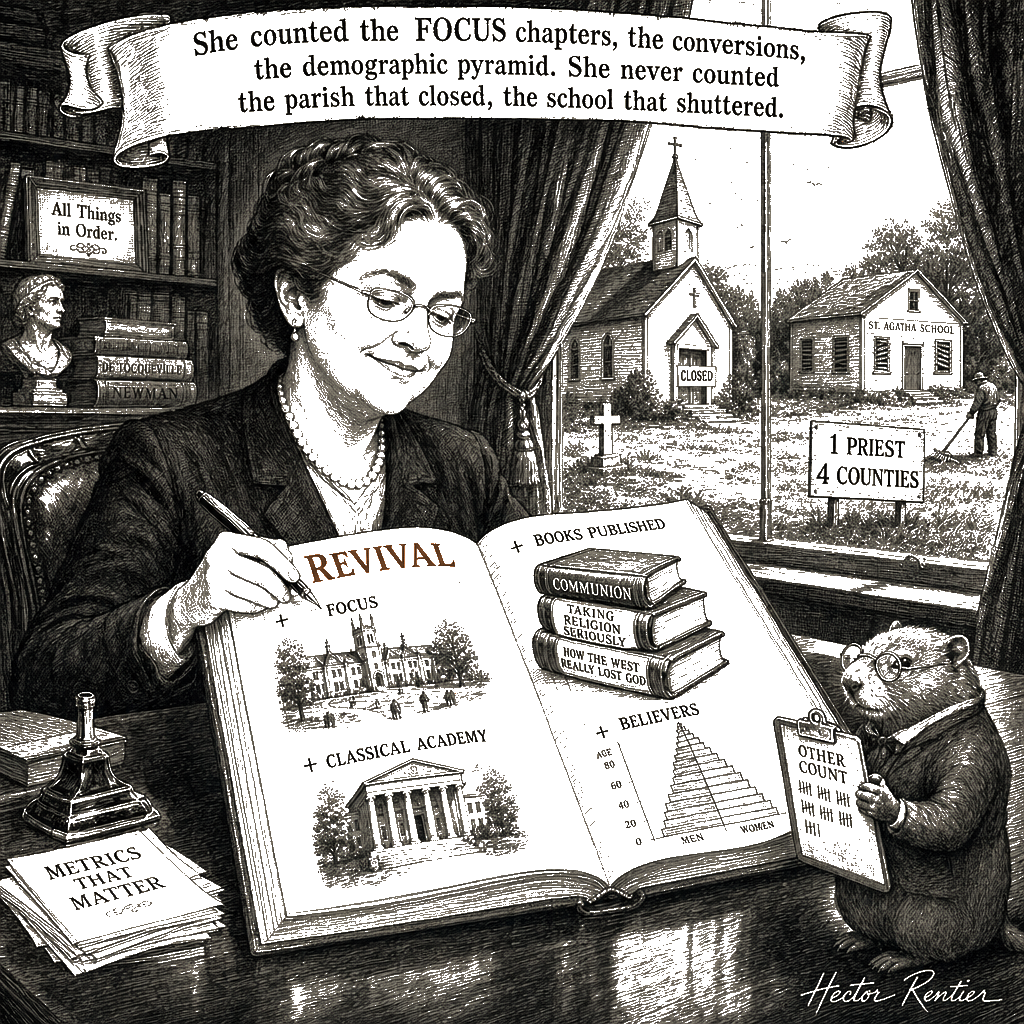
You are counting the wrong revival. That is not how it happened last time, and the people cheering the comeback are the ones who didn’t notice it left. Mary Eberstadt, in “Campus Keepers of the Faith” for National Review, argues that something seminal is stirring among young American Christians — the proliferation of classical academies, the Catholic-Evangelical bridges, the conversions of prominent intellectuals, the demographic arithmetic of faith — and that the tempo of history has at last migrated from the secularists to the believers. The count measures tempo. Tempo is not fidelity.
Let me grant Eberstadt the strongest version, because her strongest version is real. The conversion of public intellectuals is striking — JD Vance’s Communion, Charles Murray’s Taking Religion Seriously, Ayaan Hirsi Ali’s reversal of Bertrand Russell a century on. The new classical academies have grown from a few hundred institutions fifteen years ago to more than fifteen hundred today, the great majority of them Christian. FOCUS now serves two hundred and ten U.S. college quads and nine more internationally; Thomistic Circles operate on roughly a hundred more. Eric Kaufmann’s demographic argument in Shall the Religious Inherit the Earth? is empirically grounded: religious people have more children than the irreligious, and the gap widens every generation. The family-faith connection Eberstadt mapped in How the West Really Lost God holds: where the family is strong, the church is strong; where the family is hollow, the church is hollow. Mark Lilla, a Columbia University professor and no friend of Catholic integralism, observed in 2024 that young conservatives at Ivy League institutions are converting or renewing their faith since arriving on campus. Eberstadt’s count is accurate. Her interpretation of it is not.
A parish is not a tempo. A parish is the kind of building founded in 1884 by Bohemian and German Catholic immigrants who had nothing in this country but the faith and each other — the kind of parish that used to anchor the rural county I write from. That kind of parish is being closed now, parish by parish, as the American dioceses consolidate. The priest who used to serve one such county now covers four. The school attached to such a parish closed before the century turned. The churchyard still gets mowed, by a groundsman no one in the parish knows. What was lost is not a building but a network — a parish that once had its own priest now sharing him with four counties, a school that once formed the kids who became Catholic now closed, a churchyard where generations were buried now tended by a stranger.
FOCUS on two hundred and ten quads is a real thing, and I am glad of it. But FOCUS on two hundred and ten quads does not replace what was lost in the rural parishes the American bishops have consolidated, parish by parish, over the last half century. Eberstadt is counting what is being added. I am counting what is being subtracted. Both numbers are real. Only one of them sounds like a renaissance.
This is the Christendom error — the oldest mistake the Church makes in a culture that begins to take it seriously again. Kierkegaard saw it in the Established Church of Denmark two centuries ago: the moment the state makes faith easy, faith goes dead. Eberstadt writes that history’s wheel is turning in our favor. I would observe that history’s wheel has turned before, and that the wheel turning in your direction is no proof that the faith is healthy. The wheel turning in your direction is a temptation to confuse cultural power with spiritual fidelity. It is the temptation the Church has failed at least once per century since Constantine.
Her closing image is religion stepping “back into the public square” — a love affair, she says, that has at last emerged from yesterday’s shadows. I want to be careful with Chesterton, whom she quotes, because Chesterton meant something different by love affair. A religion that has taken a step into the public square is a religion that has stopped being a love affair and started being a constituency. The state-backed church of Denmark was a constituency. The Imperial church of Rome was a constituency. They are not remembered for their revivals. They are remembered for the moment they had to learn what faith cost.
And this is where the demographic argument turns sour. Eberstadt wraps the new chosen faith in a forecast: the religious will inherit the earth because they have more children. Kaufmann’s arithmetic predicts that the religious will outnumber the irreligious in another generation. It does not predict that the religious will be saints. A Church that is demographically victorious and spiritually hollow is not a revival. It is a husk with good numbers.
I spent twenty-some years on the other side of a futures desk, where I learned to read the markets like a mechanic reads an engine. I know what a demographic projection is. It is a bet on the future based on current rates. It is not a theology. Eberstadt’s frame says: belief is rewarded with offspring, unbelief is punished with sterility. The kingdom of God is not a demographic projection. It is a place a person enters alone, at great cost, in fear and trembling. The moment you replace that venture with a population forecast, you have turned the Sermon on the Mount into a population pyramid and the Beatitudes into a maternity ward.
Now the harder part — and I say it carefully, because Vance’s conversion is his own and I am a Catholic who believes in the mercy of the sacraments. The Republican politics JD Vance sits inside is the politics that has spent forty years hollowing out the small towns that produced the all-in Christian families Eberstadt celebrates. The family farm driven into corporate monoculture. The starter home priced out of reach. The casino in every pocket. The rural hospital closed. The local paper dead. You cannot celebrate the all-in Christian family and the politics that priced that family out of its own town in the same essay without noticing the contradiction. The contradiction is the whole problem. The new campus Christians Eberstadt is so heartened by — good. The Republican Party they are being recruited into is the same machine that ate their grandparents’ parish. It will eat theirs, too, on a longer schedule, if someone doesn’t say so.
Eberstadt allows, in passing, that “mishandled freedom may be at the root of what ails us.” Yes. But mishandled freedom is a polite name for the dissolution of the mediating institutions — the family, the parish, the co-op, the local paper, the lodge, the school board — by the concentrated economic power that ran straight through the “free market” the right was celebrating the whole time. Mishandled freedom is not a moral failure. It is a structural one. And the structural one requires a structural answer.
The right measure of a Church is not how many of its members write books for vice presidents or appear on cable news. The right measure is whether the kid baptized at the eight o’clock Mass on a Sunday in October shows up at the eight o’clock Mass on a Sunday in October thirty years later, with his own children beside him, for reasons that have nothing to do with the cultural moment and everything to do with the habit of faith. The right measure is whether the FOCUS kid at Cornell is still going to Mass five years after graduation, in the town he moved to for his first job, at the parish where no one knows him. The right measure is whether the home-schooled kid of the classical academy is still kneeling when the rest of his peers are standing. These are not measurable. They are not FOCUS chapters. They are not Easter-vigil converts. They are not books written by powerful men.
And the family Eberstadt describes — the all-in, countercultural, classical-curriculum, homeschooling family — is the family of the cultural elite. It is the family that has the leisure to homeschool, the cultural capital to navigate a classical academy, the financial security to weather two incomes being foregone. The family that produces durable Catholic fidelity in the counties I know is not that family. It is the family that prays before supper even when the kids don’t want to. It is the family that goes to Mass on Sunday because that is what the family does, not because it is a statement against the culture. It is the family that buries its dead in the churchyard and visits the graves on the anniversary.
The answer is not the public square. The public square is where the dissolution happened. The answer is the parish. The answer is the local institution. I stand at the counter of the co-op I manage, and I watch four generations of the same family come through. I know why they stay: because it is ours. Not the public square’s. Ours. The parish hall where the Knights of Columbus are frying fish on a Friday in Lent, the credit union where the teller knows your name and the loan officer went to high school with your wife, the small Catholic school still open in the diocese that has not yet given up on it, the homeschool co-op where three mothers share the teaching of Latin. The parish, the family, the school, the co-op — the small and faithful things that no one writes about in National Review and no one announces from a quad. That is the only count I know.
Chesterton, whom Eberstadt closes by quoting, made the better argument in his time: that the trouble is not too much capitalism but too few capitalists — that capitalism fails not from too much market but from too little ownership, that the world suffers not from too much trade but from too few producers who own what they make. The same framing could be set against the Church Eberstadt is celebrating. The problem is not too few quads with FOCUS chapters. The problem is too few parishes with baptisms on a Sunday morning, too few schools with children who know the responses, too few priests who know the families, too few of the slow and quiet and unmeasurable things that constitute fidelity.
These things do not produce the kind of momentum Eberstadt can count. They require the kind of fidelity that does not announce itself. The public square will get what the public square gets. The parish will get what the parish earns. The two are not the same project, and Eberstadt’s essay, for all its heart, conflates them. That is the mistake I would ask her to undo.
I will not deny the stirring. I hope Eberstadt is right that history’s wheel is turning in our favor. But I have watched too many revivals come and go to count on tempo. From this county, where the parish is closed and the school is gone and the priest covers four towns, Eberstadt’s count looks like the people who oversaw the dissolution being invited to applaud the survivors.