
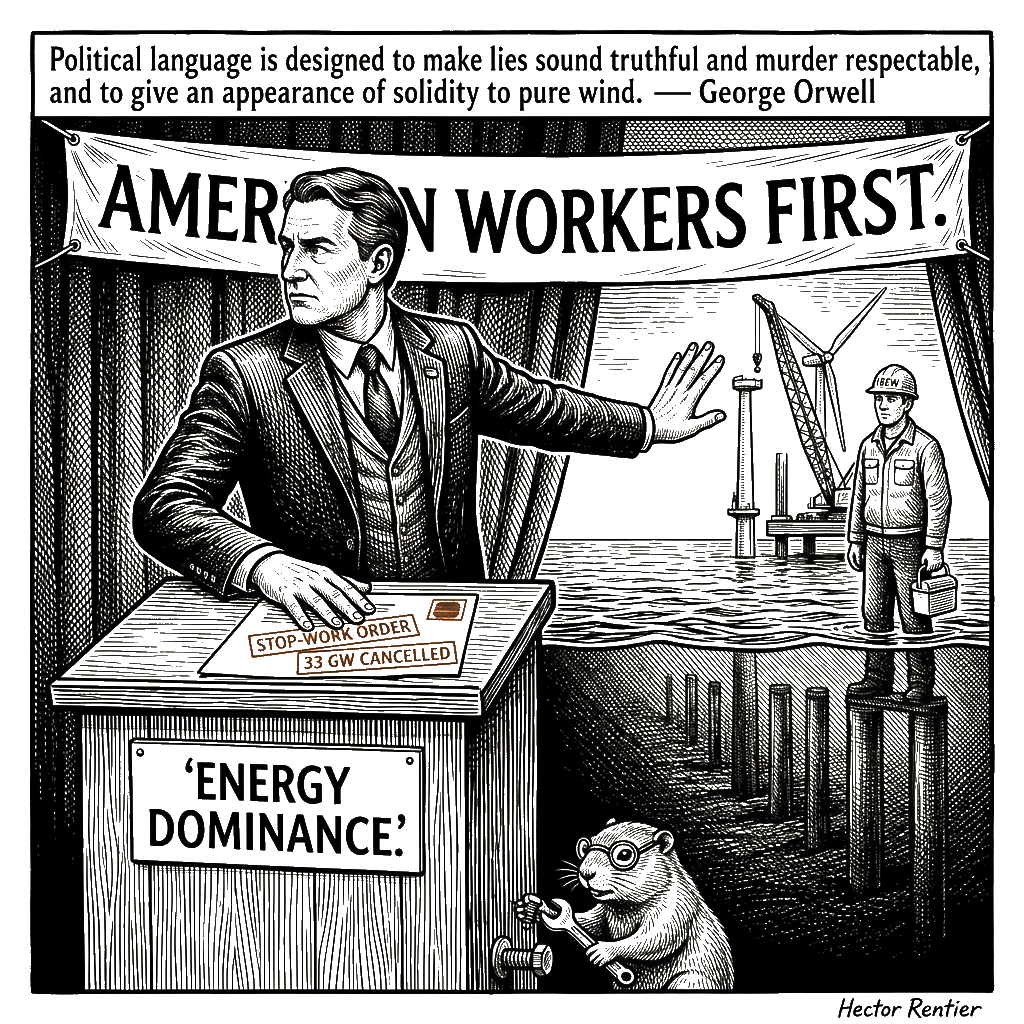
Donald Trump is killing union offshore wind jobs to perform his war on windmills.
I want to talk about something I read in Dharna Noor’s piece in the Guardian that the Adams County Times-Reporter picked up last week, and that I have not stopped turning over in my head since. It profiles Ryan McElroen, an IBEW Local 3 member in New York. McElroen spent years repairing the New York City subway underground. “I had no views other than the darkness at work,” he said. Two years ago his union trained him for offshore wind. He has worked six one-month rotations out on Sunrise Wind and Empire Wind, thirty miles east of Montauk and thirty miles south of Long Island. He watched seals and dolphins swim past his work vessel. On the Empire shifts his day would end with sunset over the open ocean. He set a goal of saving up for a down payment on a home. The week of the interview he got prequalified for his mortgage. The future the IRA built for him — prevailing-wage, apprenticeship-track, family-sustaining — was working.
That is what is being killed here. Not turbines. Not a portfolio of leases. The career path of an electrician who spent two years retraining for a trade his union told him had a future, and the mortgage prequalification he was working toward. The career path of every other IBEW member who will not now get to do what McElroen did, because the projects that would have trained them are not getting built. The career path of the welders, the ironworkers, the operators, the longshoremen, the port workers at the New London staging hub in Connecticut, every one of them a person whose family depends on the work being there.
The reason that future landed here, on Highway 13 between Wisconsin Dells and Stevens Point, is the same reason the wires reach my pole barn at all. The Adams-Columbia Electric Cooperative runs those wires. It has run them since 1938, two years after Congress passed the Rural Electrification Act over the objections of the investor-owned utilities that said rural customers weren’t worth the wire. The co-op is member-owned, nonprofit, and the meetings are public. I went to one last spring. The general manager talked about load growth, the right-of-way work, the line trucks in the fleet. He didn’t talk about offshore wind. Why would he. There’s no ocean in Adams County. But the reason the wires reach my shop is the same reason they were supposed to reach a thousand new things in the next twenty years: the federal government decided running electricity to people who weren’t already customers was worth doing, and the cooperative form was the way it did it. That decision is what is now being unwound.
The labor-climate coalition that built the offshore wind union jobs goes back to Hurricane Sandy in 2012. Mike Fishman, who was secretary-treasurer of the Service Employees International Union at the time, was running labor’s response in New York. “We came to the realization,” he told Noor, “that climate change is real and it’s only getting worse, and that workers are getting hit first and worst.” At the time unions did not have a real seat at the climate-policy table. The climate groups were all about emissions, Fishman said — “we’re going to reduce emissions at any cost.” Lara Skinner, who went on to found Cornell’s Climate Jobs Institute, was seeing the same dynamic from the other side: climate groups touting green jobs without worrying about whether they would be union. So in 2012 and the years that followed, Fishman and Skinner and the building trades put together something that did not exist: a labor-led climate coalition. They called it Climate Jobs New York. They got 2.6 million workers into it. They pushed for a nine-gigawatt offshore wind buildout by 2035, which Andrew Cuomo adopted in 2019 and the legislature wrote into the Climate Leadership and Community Protection Act. In 2021 Climate Jobs New York got prevailing-wage and project-labor-agreement requirements into New York’s renewable-energy rules. In 2022 Biden signed the IRA, which attached labor standards to private-sector clean-energy investment for the first time in the country’s history. John Podesta, who was Biden’s climate adviser, said it straight at a New York convening: “One of the things that was fundamentally different about the IRA was, in addition to the massive commitment to investing, it was done in a way that supported good jobs. That was the first time that ever happened, where labor standards were attached to private sectors.” By the end of 2024 the labor-climate coalitions were in nine states — New York, Massachusetts, Connecticut, Illinois, Rhode Island, Maine, and Texas — each one a coalition that got prevailing-wage and apprenticeship requirements into clean-energy rules before the IRA made the federal floor. The pipeline was real.
Then Trump was re-elected. Within months the administration moved on every front. He claimed offshore wind causes cancer. He claimed it kills whales. He ordered Empire Wind halted in April 2025. He ordered Revolution Wind halted in August. In December he ordered a stop to Sunrise Wind and Empire Wind in New York, Vineyard Wind in Massachusetts, Revolution Wind again, and Coastal Virginia Offshore Wind in Virginia. McElroen was on the job at Sunrise when the stop-work came down. Electricians were kept on as essential to keep the equipment from deteriorating in the ocean, but the rest of the workforce was sent home. “It was a crazy, uncertain feeling,” he said.
Trump succeeded in temporarily disrupting construction. Workers were sent home. Developers ate additional costs they hadn’t budgeted. But courts blocked each of the stop-work orders in turn, and each project has continued — Vineyard Wind is now complete and operational, Revolution Wind started sending power to the New England grid in March, Coastal Virginia Offshore Wind started generating in March, and Sunrise and Empire are back under construction and moving toward completion. The administration did not succeed in stopping the projects that were already under way.
But that is not where the damage is. The damage is what comes next. By the time Trump was re-elected in November 2024, BloombergNEF projected the United States would build thirty-nine gigawatts of offshore wind capacity by 2035. Its October 2025 projection put that figure at six gigawatts.
Six.
The remainder, thirty-three gigawatts of projected capacity, and the union construction jobs that would have come with them, is gone. The administration spent $2.7 billion of your tax dollars and mine this year cancelling twelve offshore wind leases in five deals with developers. Fishman told Noor: “By some estimates from some of the building trades, there’s been a loss of 3 billion work hours.” Chris Erickson, the business manager at IBEW Local 3, said the impact is being felt in New Jersey too: “So now there’s zero offshore wind happening off the coast of New Jersey, where there’s thousands of IBEW members and where our New York members could have worked.” Six gigawatts is not a market forecast. It is the result of federal policy that took the pipeline out at the foundation.
This is the conservative contradiction I want to name, the one that has been sitting in my notebook for years. The administration says it is for American workers. The administration says it is for energy dominance. The administration says it is for national security. The administration is also killing the union clean-energy jobs that American workers were building with American steel and American labor, in service of a fossil-fuel industry whose largest players are multinationals headquartered in London, Riyadh, and The Hague. The nationalist rhetoric is the costume. The policy is written by and for the consolidated fossil-fuel sector. The extractive economy that Wendell Berry named a long time ago in The Unsettling of America and What Are People For? — the one that takes the raw material and the labor and the membership of a place and ships the profit elsewhere — does not care whether the people whose jobs are killed are union electricians in New York or small-shop mechanics in Adams County. The IRA labor standards were the first time the federal government had attached a membership-economy condition to a private-sector investment of that scale. That is what is being ripped out.
This is also the nationalist shell game. Nationalist rhetoric that names offshore wind as a foreign, coastal-elite project, while the multinational corporations that fund the campaigns that produce the rhetoric are the same ones that will profit from the gas plants the wind would have displaced. Domestic gas is not domestic wind. The trade deficit is not lowered by buying more LNG. The worker is not better off because his trade was killed in the name of saving his trade. The architecture of doubt is the asset, not any specific claim. Offshore wind causes cancer. Wind turbines kill whales. They destroy property values. None of those claims is supported by the evidence. None of them has to be. The specific claim only has to land hard enough to license the next stop-work order. I have read Berry’s The Unsettling of America twice. I have read Aldo Leopold’s A Sand County Almanac every January for twelve years. I keep a notebook on the ice-out date and the rut-onset date and the first-mosquito-of-the-year date on Lake Petenwell. The skill Berry and Leopold taught me is the skill of seeing what a place is doing over time and naming what is taking it apart.
What I see up here is the same pattern in different clothes. The federal New ERA program — Empowering Rural America, the USDA’s roughly $9.7 billion loan-and-grant program — was supposed to put capital into rural electric cooperatives to retire fossil-fuel debt and start building clean generation. Dairyland Power Cooperative, the generation-and-transmission system that serves Adams-Columbia and much of southwestern and central Wisconsin, was taking that money. Section 22002 sent $2.025 billion to REAP, the Rural Energy for America Program that pays for on-farm renewable projects. The One Big Beautiful Bill Act of 2025 eliminated Section 45X manufacturing credits for wind components produced and sold after December 31, 2027, and separately accelerated the phaseout of the IRA’s clean-electricity credits so that wind and solar facilities placed in service after December 31, 2027 no longer qualify. The phaseout of the wind credits costs my co-op money. It costs the contractors in Adams County who do the small-wind and the distributed solar work. It costs the farmers who were looking at small wind as a way to keep an outbuilding heated without paying the propane bill. The federal decision to run wire to people who weren’t already customers is the same decision, in 1936 and in 2022. Both decisions are being unwound.
I am what is left of the rural working class. I have watched the Adams County hospital lose its obstetrics ward, the hardware stores disappear, the Dollar General appear, the bank consolidate, the propane go up. I do not write about Connecticut because Connecticut is a different story than mine. I write about Connecticut because the policy that killed the offshore wind pipeline is the same policy that gutted Medicaid funding for rural hospitals and phased out the wind credits that my co-op’s members were counting on. The wire that reached my pole barn in 1938 is the same wire that was supposed to reach the next thousand things.
Fishman told the Guardian at the end that none of the work is going away, that the wind will change direction eventually. I want to believe that. The co-op program, the labor-climate coalitions in nine states, the apprenticeship pipelines that took years to build — those are real. McElroen and his mortgage preapproval letter are real. But I have watched enough things in Adams County get killed by people who said they were going to bring them back to know that “eventually” is a long time when you are the worker whose job just got cancelled. The dairy farms that were going to come back. The mill jobs that were going to come back. The obstetrics ward at the hospital that was going to come back. They have not come back. Mike and Quinn are eight and five. I do not want them to inherit a county where the only jobs left are the ones the administration did not think it could cancel. The wind will change direction. The question is whether the wire will hold, and whether Ryan McElroen, and the workers like him, can hold on until it does.