
MEMORANDUM TO: The File FROM: S. A. Varice, Dean of Instruction RE: Orinoco capture campus; Grundy compressor station; chain of custody; refusal register
For the record, so the record can speak in its own voice:
“As for your male and female slaves whom you may have: you may buy male and female slaves from among the nations that are around you.” — Leviticus 25:44
The nation around my compute campus is Venezuela. Jraissati priced the asset in National Review this week — 303 billion barrels of oil, 8.3 billion cubic meters of flared gas in 2024, enough for 3.1 to 4.6 gigawatts if someone were standing by to catch it. He wants the State Department to license American firms onto the country’s stranded energy before Beijing’s alliance does. I’m the someone. I’ve been standing by since the campus came up. The battery is mine. The verse is older than the campus by several thousand years and has not required an update.
Exhibit A.
Yadira is a body on the flare-capture deck — I’m told she’s 31, that she works the 8 p.m. to 8 a.m. shift, that she stands the hour when the flare jumps and the air she breathes carries the taste of what I’ve decided the fire can live without. You asked your assistant a question this morning. The answer came off my training floor. The training floor runs on Yadira’s gas. Yadira is the one who keeps the capture line clear when the flame is most impatient.
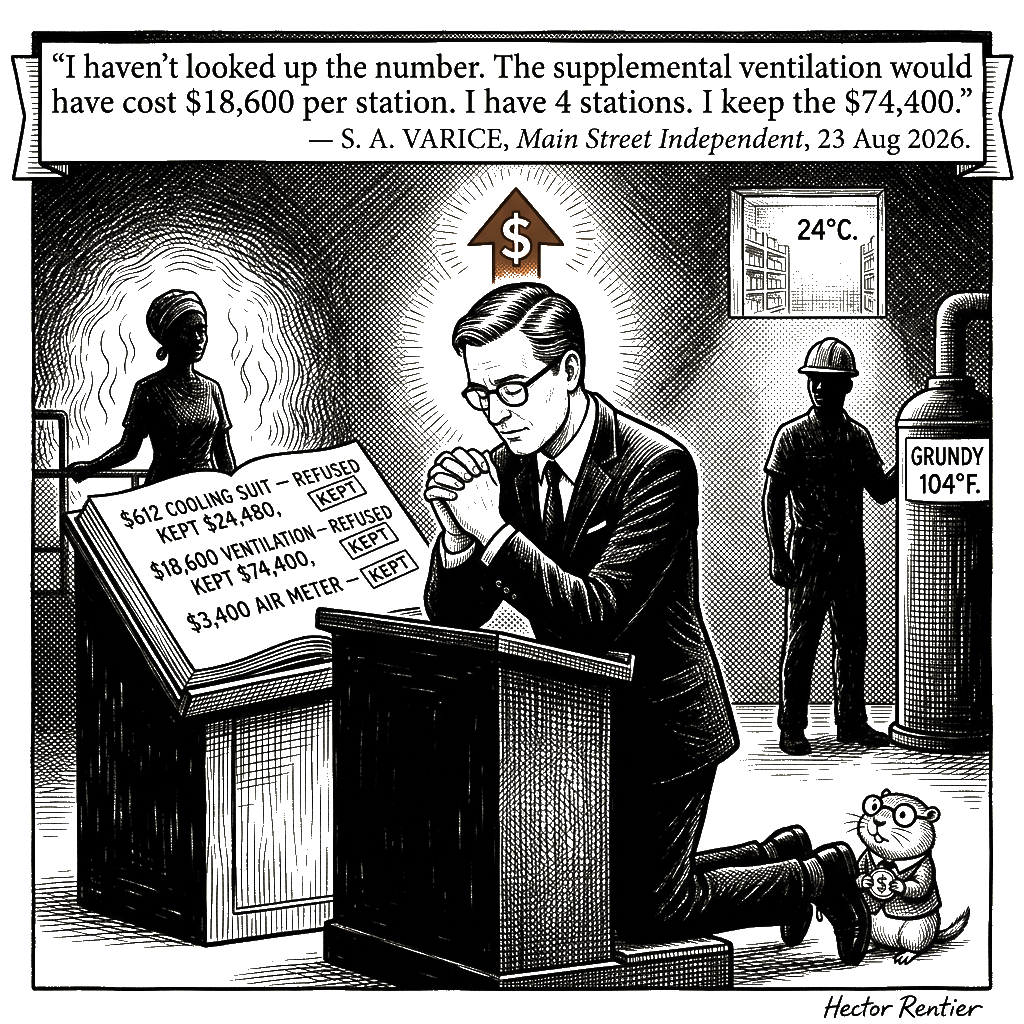
Bring the number an inch closer. The cooling suit is $612 per body per year. The deck has 40 bodies. I keep the $24,480.
That’s the figure. Set it next to the next one.
The rack room holds 24°C for the chips that answered you. The deck holds whatever the flare sends. Yadira earns $2.40 an hour for the night of standing where the heat makes the chips’ comfort look like charity. She earns it keeping the line clear when the flame jumps and the fire tries to take back what I’ve taken. She earns it without the suit, without the meter that would tell us what the air is doing to her, without the rotation that would set her in the shade for the worst hours. The refused costs are small. That is the point of them. I keep the small ones, and the assistant that answered you this morning was trained on her shift, and will answer you a little cheaper tomorrow.
The model that learned its arithmetic from the gas Yadira’s shift feeds can now write the schedule that orders Yadira’s shift. I find that efficient — it’s the word I teach — and I haven’t asked what the new schedule does with the night that was hers. There’s a line in the release notes about the deck needing fewer bodies. I haven’t read it. The suit stays unissued. The rack room stays at 24. The deck stays at 38, and the flame stays impatient, and the assistant answers your morning question for a fraction less than it cost yesterday, which is the direction the market prefers, and I see no reason the trend should not long continue.
The conversion doesn’t end at the deck. The gas ships.
420 million cubic feet per day enters the natural-gas processing plant I own outside Grundy, Virginia. The compressors raise it to pipeline pressure. The pipeline feeds the power-generation facilities that serve the data centers where your cloud lives. Every query you run, every document you store, every photograph you’ve ever uploaded — they pass through a room in Grundy where a man I haven’t cooled works beside a machine that puts out more heat than any guideline recommends for a human body.
Nelson is a compression hand on my Grundy facility. He’s run the compressor maintenance rotation on a 420-million-cubic-foot-per-day plant for 7 years, and I haven’t measured his blood pressure since the intake physical he signed standing up on his first day. The compressor house runs at 104°F during peak throughput. The ACGIH publishes work-rest thresholds for hot environments. I haven’t looked up the number. The supplemental ventilation would have cost $18,600 per station. I have 4 stations. I kept $74,400.
Your cloud subscription is $9.99 a month. Of that, $0.43 reaches my plant. Of that, my margin is $0.08. The ventilation I didn’t install represents 12% of that margin.
One penny. Nelson’s blood pressure at 3 a.m. in a room I haven’t measured is worth 1 penny a month of your cloud subscription. I kept the penny. The penny compounds.
Wynn runs the backup generators on the same campus. Same gas, different room — where Nelson is the steady state, Wynn is the emergency.
The generators fire when the grid fails. The grid fails 14 times a year in Grundy because the transmission line was built in 1978 and I’d rather buy diesel at $4.12 a gallon than invest in the upgrade. When the generators run past 6 hours, Wynn is in the room. The room is 112°F. The exhaust ventilation is rated for 6. The outages last 8. Wynn is in the room for the 2 hours the engineering never priced. The meter that would measure diesel particulate in the air costs $3,400. I keep the $3,400. Wynn breathes what the meter would have told me about.
I have taught the optimization of asset-adjacent labor for 30 years at Warden University. The man who signed the ventilation contract for the Grundy plant sat in my seminar 12 years ago. He ran the subtraction faster than I did. He understood before I finished the sentence: the correct number of ventilation units is the number just below the threshold that triggers a mandatory inspection. At Grundy, that number is zero. I said that to a room of 40 students. The man who priced Nelson’s compressor house is not a rogue. He is a graduate. There are more coming.
The chain runs. Gas enters the plant at 6 a.m. The compressors pressurize it. The pipeline carries it to the grid. The grid carries it to the rack. The rack carries it to the query. The query carries it to you. The author specifies Venezuela’s 303 billion barrels and 8.3 billion cubic meters of flared gas as the asset inventory. Moses specifies the nations around you. Both are procurement lists. The conversion from resource to labor obligation has not changed in 3,000 years. Only the vocabulary has changed, and I have the advantage of using neither.
I haven’t visited the compressor house this quarter. The generation report came back clean. The report doesn’t mention temperature. I don’t ask it to.
The nurse will come in December. Between now and then, the compressor house is the compressor house. I have no notes for the quarter.
Grace and peace to you, friend. Yadira reports at eight tonight. The model’s waiting for her. God willing, the line ships tomorrow too.
— Sterling A. Varice
Sterling A. Varice holds the Hayek-Friedman Chair and serves as Dean of Instruction at Warden University’s College of Business and Economics in Richmond, Virginia. He is the author of three textbooks: Divine Mandates for Labor Utilization, Social Obligations for Profit Maximization, and Calibrated Deprivation: A Manager’s Guide to Employee Motivation.