Donald Trump directed the Justice Department to settle its antitrust case against Live Nation. The settlement let the company keep Ticketmaster — the subsidiary the Justice Department had publicly vowed to force it to sell less than two years earlier — and retain control of most of the country’s best amphitheaters.
The Wall Street Journal’s investigation of how that deal was made lays out a chain of decisions that, taken together, look less like ordinary prosecutorial discretion than like the operation of an apparatus in which the president’s associates get saved and the public interest is what falls off the truck.[^1]
The transaction began on Friday, Feb. 27, when Live Nation’s CEO Michael Rapino walked into the Oval Office to discuss improving bookings at the Kennedy Center. He left having been asked why his company hadn’t yet reached a deal over its antitrust lawsuit. Days later, a senior Justice Department official took a call from the president. “Settle it,” the president said. The settlement was signed that afternoon.
That settlement required Live Nation to end thirteen exclusive booking agreements, give venues an option to use a competitor for back-end ticketing services, cap the ancillary fees it charges at its own venues at fifteen percent, and fund a $280 million settlement pool. But it let the company keep Ticketmaster — the subsidiary the Justice Department had publicly vowed to force the company to sell less than two years earlier, when then-Attorney General Merrick Garland filed suit and said, “It is time to break up Live Nation-Ticketmaster.” It let the company keep control of most of the country’s best amphitheaters. Thirty-four state attorneys general — including some whose offices were controlled by members of the president’s own coalition — looked at the deal and refused to join it. They took the case to trial. In April, a jury found Live Nation had illegally monopolized the ticketing market for major concerts in the United States.
You do not have to like the antitrust division’s lawsuit to see what happened next. The trial team was bypassed on the substance. The DOJ had drafted a counterproposal demanding that the company spin off Ticketmaster — a business that accounted for more than $3 billion in revenue in 2025 — and Trent McCotter, an aide to the deputy attorney general, told the agency’s trial attorneys to remove that language, according to people familiar with the matter. The department’s January counterproposal made no mention of divesting Ticketmaster. Antitrust chief Gail Slater left the agency in February. Her deputy, Omeed Assefi, replaced her and signed the March deal. A group of senior DOJ trial attorneys resigned in April over what they described as political interference in the antitrust division’s affairs.
The transaction was not only bypassed; it was orchestrated. Live Nation told DOJ officials in December that it had hired Sullivan & Cromwell to take over settlement talks, in part because of the firm’s close ties to DOJ leadership, according to a person familiar with the matter. The lead attorney the firm put on the case, James McDonald, was not an antitrust specialist. Within months of the settlement, Trump nominated McDonald to be Manhattan’s top federal prosecutor. Boris Epshteyn, Trump’s private legal coordinator, also took a keen interest in resolving the case. Justice Department officials did not know whether Epshteyn was working for Trump or for Live Nation or both. The firm’s representation of Trump in his personal legal matters, the company’s stated reliance on that relationship, and the nomination that followed the settlement are documented. What the documents do not say is what was promised and to whom.
Cui bono — the standing question that survives any political speech about how the system works: who wrote the policy, who benefits, who bears the cost, and what does the public framing obscure. The writer of this particular policy was the president of the United States. The named beneficiaries are Michael Rapino and his shareholders. The diffuse cost-bearers are the public — the concertgoers who paid the inflated fees the settlement was supposed to address, the artists whose leverage against the promoter was supposed to be restored, and the smaller venues and independent promoters the monopolist has been squeezing out of the market for years. The public framing — White House spokeswoman Lauren Bis said the president “has not weaponized the Department of Justice against his political foes or used it to help his friends,” and the DOJ said its settlement prioritized quick consumer benefits over a yearslong battle it risked losing — obscures the simplest fact: the Justice Department publicly demanded Ticketmaster be divested, and then settled for the opposite. The trial team’s position was overruled. A group of senior trial attorneys resigned.
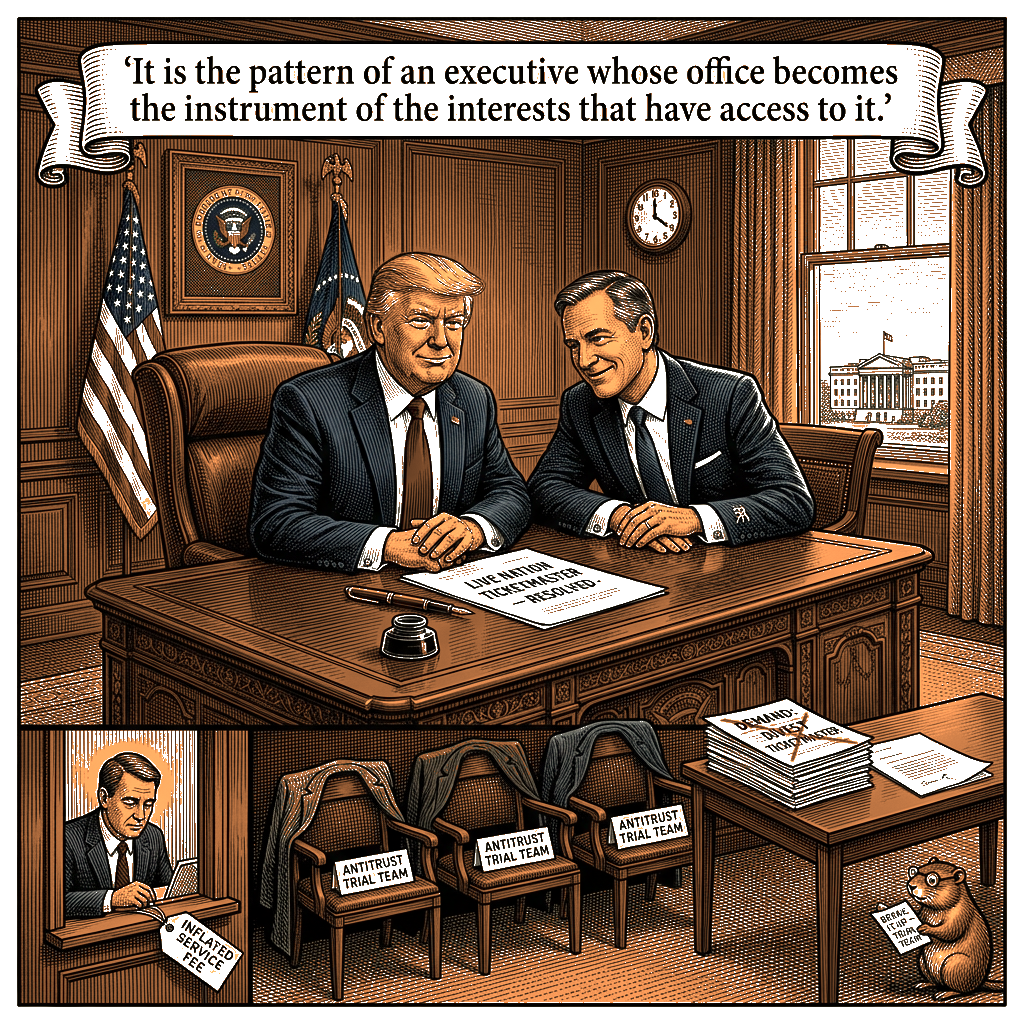
There is a pattern here that does not belong to either coalition. It is the pattern of an executive whose office becomes the instrument of the interests that have access to it. The president meets with the CEO. The CEO brings the president’s own lawyers. The president’s lawyers run the settlement for the CEO. The president asks why the case isn’t settled. The case is settled. The DOJ trial team is told to take the divestiture language out. The antitrust chief is replaced. A group of senior trial attorneys resigns in protest. The new lead attorney for the company gets nominated to be one of the most powerful federal prosecutors in the country. This is not what prosecutorial discretion looks like. This is what corruption looks like when it is performed by people with good haircuts and proper law degrees and a press office that knows how to write a sentence that contains the words “law and order.”
The states refused the deal. They were right to refuse. They took the case to trial, and the jury found Live Nation had illegally monopolized the market. Federal Judge Arun Subramanian now has to decide both the remedy for the monopoly and whether to approve the federal settlement that protected it. More than twenty of the plaintiff states have raised “significant concerns that the Settlement is not in the public interest” in a July letter asking the judge to order disclosure of the settlement’s terms and how it was reached. The remedy the states have asked for is the one the Justice Department originally demanded: break up the company, divest Ticketmaster. That remedy is also the one Merrick Garland announced when the lawsuit was filed. It is also the remedy the trial team pressed for before being overruled.
There is a temptation, in a piece like this, to reach for the language of constitutional crisis, to invoke the founders, to gesture at the slow erosion of the rule of law. The temptation should be resisted, because the case is not about high doctrine. It is about a particular monopolist, a particular lawsuit, and a particular set of decisions by particular people whose names are now on the record. The constitutional architecture held. A group of senior trial attorneys resigned rather than participate. The states refused rather than join. The jury returned the verdict on the merits. The judge will decide. The system, in this instance, is doing what it was built to do — slowly, expensively, and against the active resistance of the people who were supposed to be running it.
That last point matters. It matters because the cynicism the deal is designed to produce is the deal’s actual product. When the public concludes that antitrust enforcement is for sale, that the trial team is overruled by political operators, that the lawyers for the president’s associates write the settlements the president’s associates want — the cynicism is not an unfortunate side effect. It is the point. The point is to teach the public that the system does not work, so the public stops asking it to work. The point is to make the next antitrust case — the next pharmaceutical investigation, the next tech merger challenge, the next labor-side enforcement action — a little easier to settle on terms favorable to the defendant and unfavorable to the public interest. The point is the cumulative weight of the settlements, not any single one.
The companies and the executives and the lawyers involved in this settlement will go on doing what they did. The DOJ’s Antitrust Division will go on filing cases it cannot finish. The states will go on carrying what the federal government has dropped. The judge will rule. The arc will bend only if the bend is pushed by specific people in specific moments — the trial attorneys who resigned, the states that refused to join, the jury that returned the verdict, the judge who has to decide the remedy. The arc does not bend by itself. King’s late-period diagnosis was that the whole structure of American life had to be changed if the visible evils were to be addressed at their root rather than at their symptoms, and he was right and he was incomplete.[^2] The break is what gets done. The break is what gets done, or the bend does not come.
The night the settlement was signed, Live Nation’s top in-house lawyer told the federal judge he had not known the deal had been signed when he met with the judge the next morning. The DOJ’s co-lead trial lawyer said in court that he had only received the settlement that morning and had not reviewed it. The judge said, on the record, that the conduct “shows absolute disrespect for the court, for the jury, for this entire process.” The judge was right. The contempt was not for the court. The contempt was for the public interest the court was set up to defend. That contempt is the subject of the remedy the states have asked for, and the remedy the judge has yet to impose.