
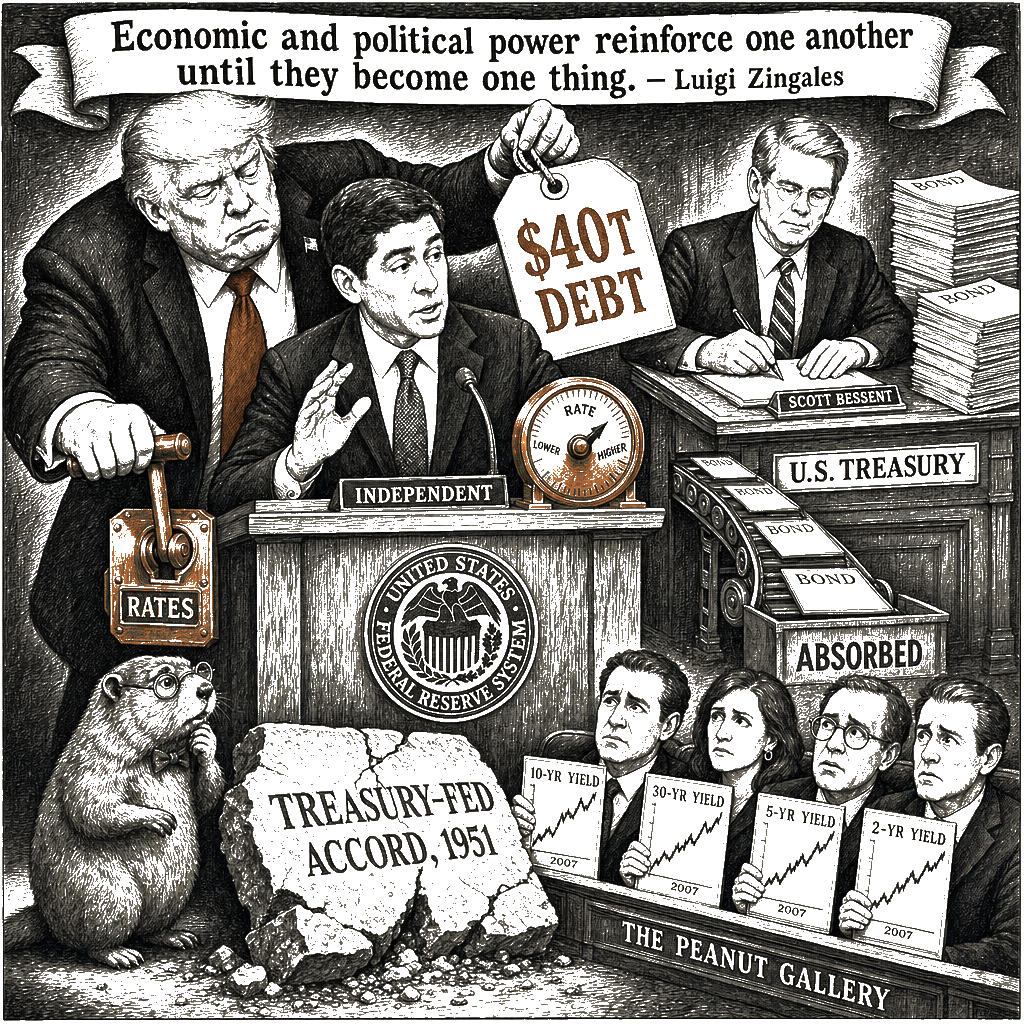
Trump is leaning on Warsh to cut rates and launder a forty-trillion-dollar debt. The annual Jackson Hole symposium convenes Friday in Grand Teton National Park with long-term Treasury yields near their highest since 2007, the national debt past $40 trillion for the first time, and Treasury Secretary Scott Bessent having committed to at least double Washington’s purchases of U.S. Treasury bonds to contain selling pressure in the $30 trillion government debt market (Guardian, Aug. 24, 2026).
The configuration is straightforward. The fiscal authority runs deficits that the bond market has begun to refuse to absorb at current interest rates. The Treasury responds by issuing more debt and absorbing part of it itself. The monetary authority is asked to cut the cost of carrying that debt. Each move is presented separately — fiscal expansion, Treasury market management, monetary easing — and read together they amount to the same operation: cheaper financing of the deficit by political pressure on the rate-setting body.
Warsh has signaled reluctance to perform the role his appointment implies. His July press conference as chair, in which he committed to curbing inflation without specifying how, was read by investors as sending “confusing signals.” He has separately said the Fed will not “spoon-feed” financial markets on rate-path signaling — that is, on how the central bank may respond to inflation and rates at upcoming meetings. The Guardian reports his Jackson Hole address is expected to focus on “bigger questions” — productivity, demographics — rather than the customary signaling of how the central bank may respond to inflationary pressures when its officials next meet to set interest rates in September and December. The symposium’s official subject is “Financial Innovation: Implications for Payments and Policy.”
The structural problem is the Trump rate-cut campaign. The Guardian reports that Trump, who appointed him, has publicly called on the Fed to cut rates, and that his demands have fueled investor concerns about the central bank’s independence. A president pressuring his own appointee to ease policy as the debt crosses $40 trillion and yields climb toward 2007 highs is not exercising oversight. He is asking the monetary authority to subordinate its price mandate to his balance sheet.
Fed independence is structural, not sacred. The 1951 Treasury–Federal Reserve Accord ended direct Treasury monetization of federal debt. The Full Employment and Balanced Growth Act of 1978 codified the dual mandate — the requirement that the central bank pursue both maximum employment and stable prices. Each was a legislative judgment that the executive branch’s fiscal interest and the central bank’s price interest cannot be run by the same hand without the former absorbing the latter. The institutional record is on the table.
Here is what the bond market is saying. Yields near 2007 highs, debt at $40 trillion, Treasury doubling its issuance to absorb its own paper — none of this requires rate-cut guidance to read. The market has priced its view that the fiscal arithmetic will be resolved, one way or the other. Warsh takes the Jackson Hole podium on Friday. The arithmetic will set the verdict.