
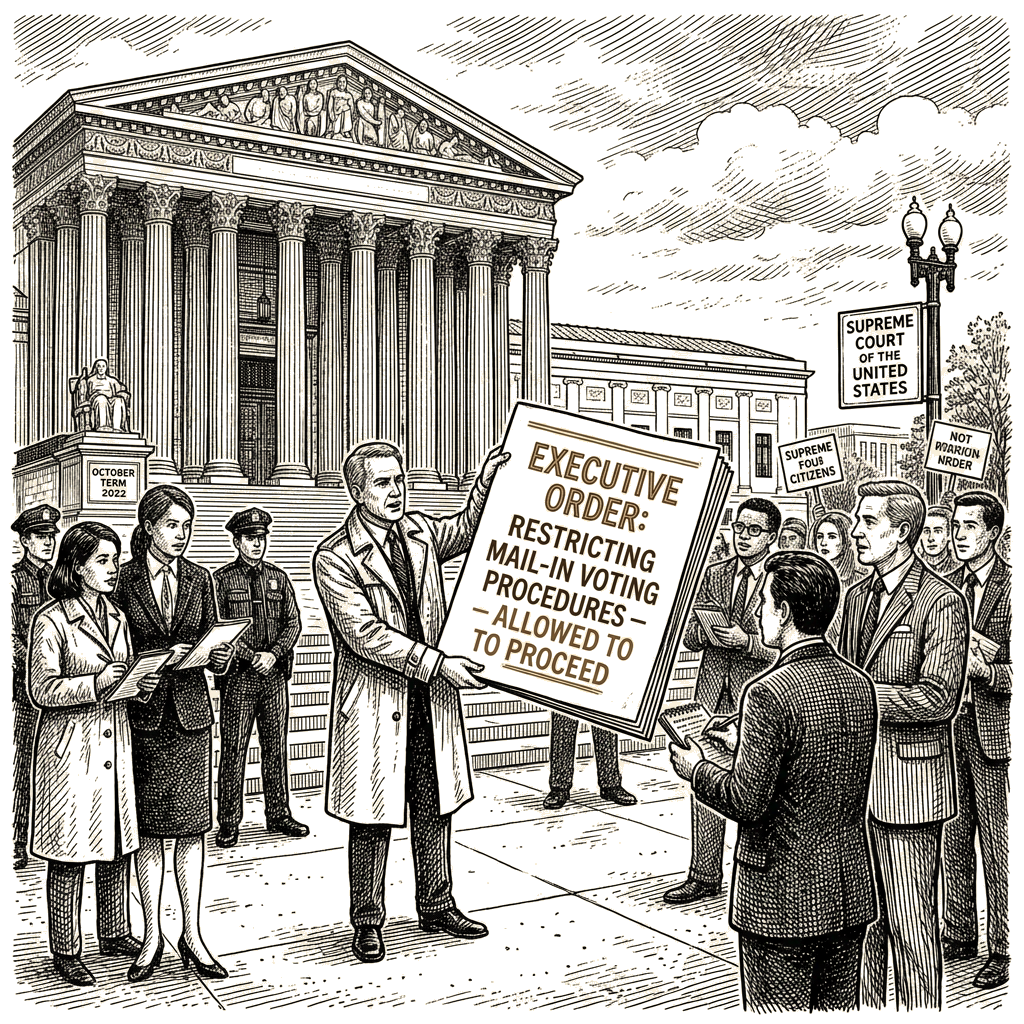
The Supreme Court on Monday gave Donald Trump exactly what he wanted: permission to proceed with the executive order restructuring how Americans cast mail-in ballots. The decision didn’t bless the order in full — it refused to block it, which is the same thing dressed up in robes.
Every previous ruling on this order ran the other way. A federal judge widened an injunction blocking the order to all fifty states on August 11. A circuit court had already ruled the broader challenge premature at the end of July. And as the USPS Wednesday publication rule sat ready to drop with two injunctions still in place, the Court chose not to be the third firewall.
The AP wire, in its account of the Court’s shadow-docket action, reports that the justices declined to intervene in the Justice Department’s emergency appeal — leaving the lower-court injunctions in some form of suspended animation while the executive order proceeds toward implementation. The order itself, in the wire’s summary, directs changes to how the Postal Service receives, processes, and delivers mail ballots and how state-submitted ballots are verified under federal standards. The wire does not quote the operative provisions at length. That absence is itself worth noting, because an executive order the press can only describe in summary terms is one whose specific mechanisms — signature-matching thresholds, deadline structures, USPS handling protocols — will be enforced against voters who will never see them.
This is the strongest case the administration could make, and a working-bar attorney aligned with the executive could recognize it as such. The President has colorable authority over federal agencies, including the Postal Service, in matters touching federal operations. Federal elections are governed by federal law, including the National Voter Registration Act and the laws governing military and overseas voting, and the executive can plausibly claim a coordinating role in how federal agencies handle ballots cast under those statutes. The ballot-integrity rationale, however threadbare the actual evidence, is at least a rationale the political branches have historically debated, and the Uniformed and Overseas Citizens Absentee Voting Act gives the executive a foothold in mail-ballot administration that did not exist two decades ago. A court inclined to defer to the political branches on election administration, or one inclined to leave the question for the lower courts to resolve in the ordinary course, could find room here. Smiley v. Holm, 285 U.S. 355, 366-67 (1932), establishes that the manner of holding congressional elections is constitutionally committed in the first instance to state legislatures under Article I, Section 4 — but the case does not foreclose federal coordination of federal operations.
The order’s difficulty is that this case collapses on contact with the constitutional text the administration claims to implement. The Electors Clause — Article I, Section 4, Clause 1 — assigns the “Times, Places and Manner” of federal elections to state legislatures in the first instance, with Congress authorized to “make or alter such Regulations.” The clause reserves that authority to Congress and to the state legislatures. It does not assign it to the President. Arizona v. Inter Tribal Council of Arizona, Inc., 570 U.S. 1, 8-9 (2013), treats congressional authority under the Elections Clause as “paramount,” but the paramount branch is Congress, and Congress has not legislated the substance of this order. The President implements federal election law; he does not write it, and he does not, by executive order, restructure how states administer the ballots their own election codes govern.
That is the right-instrument problem the order cannot escape. State election codes — enacted under the state’s own Article I, Section 4 authority and under the state’s own constitution — set the rules for signature verification, return deadlines, witness requirements, and cure processes for mail ballots in every state that uses them. The National Voter Registration Act, 52 U.S.C. § 20501 et seq., and the Uniformed and Overseas Citizens Absentee Voting Act, as amended by the MOVE Act, occupy specific federal fields. The Fourteenth Amendment’s Equal Protection Clause, the Fifteenth Amendment, and the Twenty-Sixth Amendment protect the franchise from disparate burden, from denial on account of race, and from denial on account of age for voters eighteen and older. An executive order that reaches into the manner of state-administered federal elections, displaces state procedures, and does so without statutory authorization implicates every one of those instruments — and does so without the textual hook in Article I, Section 4 that the clause reserves to Congress.
Trump’s pretext is fraud. There is no evidence for it. There has been no widespread fraud in mail balloting at any scale that would justify disrupting a method used by tens of millions of voters. The order he signed would prevent millions of other Americans from using the same method he has used, and that is a contradiction the court has not yet been asked to resolve because the court, on Monday, would not even look.
The U.S. Postal Service spent last week rolling out its implementation plan. The agency now faces an impossible mandate: impose sweeping changes to a functioning system in a window too narrow to do so without disruption. Some states start sending mail ballots to voters in a matter of weeks. The administration has a narrow window to impose its changes before the midterms — and a long window after to make them permanent.
That is the design. The order does not improve the system. It introduces uncertainty into a system that depends on certainty, and uncertainty is the only kind of mail a voter afraid their ballot will not be counted ever receives.
This is what Donald Trump has been asking for since he walked out of the 2020 election refusing to accept the count. He spent four years insisting, on every platform he could reach, that mail-in voting is a fraud engine. The data never backed him up. The studies, the audits, the bipartisan election officials in counties he carried and counties he lost — all said the opposite. He used the method himself, and he said it anyway, over and over, until the lie became the operating assumption of a Justice Department that now treats ballot access as a problem to be solved.
The DOJ’s emergency appeal to the high court was the next step in that operating assumption. It asked the justices to let implementation work proceed before the midterms. They declined to say no. The case now returns to lower courts where additional challenges await. But in the time it takes those challenges to wind their way back up, states will already have begun printing, packaging, and mailing ballots under rules that may change midstream. The room is shrinking every week, and the order itself does not shrink with it.
The justices have not examined the substance of what they have allowed to proceed. They have refused to look. And the voters who rely on mail — older Americans, voters with disabilities, military and overseas voters, rural voters without easy access to polling places, anyone with a job that doesn’t let them stand in line for three hours on a Tuesday in November — are now the experimental subjects of a presidential tantrum dressed up as election integrity.
The mail-voting case is one of multiple voting-related fights now in front of the justices. The mechanism varies. The pattern is consistent. The intent is singular: make it harder to vote, then declare the lower turnout a sign of fraud when Republicans lose. This is not a single fight. It is a campaign. The court’s Monday order is not the end of this fight. It is the moment the fight leaves the marble of the Supreme Court building and lands in the kitchens, living rooms, and mailboxes of voters who must now wonder whether the ballot they request, fill out, and mail will be processed under rules that may be different when it arrives. That uncertainty is not a side effect. It is the point.