
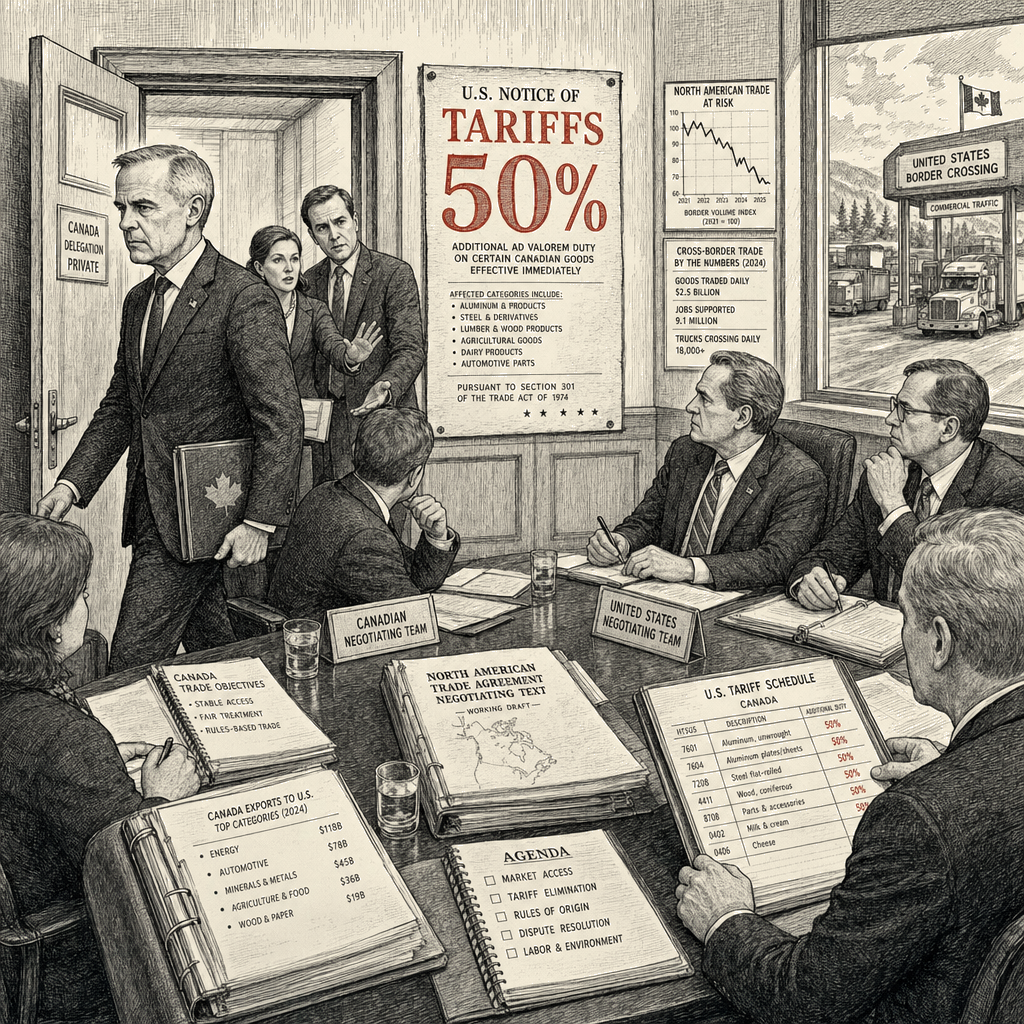
Mark Carney called it what it was: an attack. At a rare Saturday morning press conference, hours before 50% US tariffs slammed into Canadian exports, he told Ottawa — and the world — exactly what had happened. “You’re at war when you get attacked. We got attacked.” Dollar-for-dollar retaliatory tariffs are now scheduled for September 8 — the same retaliation Carney ordered at the start of the week. The era of pencil-written signatures is over.
The collapse was not a misunderstanding. It was a confession. Canadian Ambassador Mark Wiseman told Bloomberg there was no single item that killed the deal — just a “range of issues” where the text that landed on the page did not match what Canada thought it had agreed to. Tariffs on autos. Digital and cultural policy. Washington’s claim of a unilateral veto over Canada’s trade alliances with anyone else. Each ask, individually, might have been negotiable. The cumulative effect was a Canadian government that could not, in good conscience, sign on the page what it had not actually been offered.
The US denial — that Canada made the last-minute moves — is the kind of statement that only works if you assume no one is keeping notes. Carney has been keeping notes. Wiseman has been keeping notes. The Canadians have, very publicly, been keeping notes, and they are not the side whose story has shifted.
Then came the tell. US Transportation Secretary Sean Duffy went on Fox News and declared: “We provide their security for them and they take advantage of us?” This is the line that gives the game away. The North American Aerospace Defense Command is a fully integrated US-Canadian operation. Canada fields its own military, its own police forces, the second-largest landmass on the continent, and a continental energy grid that delivers hydroelectric power from Quebec into New England and the mid-Atlantic. The notion that Ottawa is some freeloader skimming off the US defense budget is not analysis. It is rhetoric designed to dress up economic coercion as moral grievance. The line wasn’t an argument. It was a tell: the negotiation was never about trade.
The arithmetic on the ground does the same work. The 50% tariffs that took effect this week hit Hamilton steel — ArcelorMittal Dofasco’s blast furnaces, Stelco’s Lake Erie works — directly. They hit Windsor autoworkers whose finished vehicles and stamped parts cross the Detroit River four times before they are cars. They hit forestry towns in British Columbia whose softwood-lumber exports were already on the line. Carney’s September 8 retaliation runs the other direction: it lands on US agricultural products moving north into Canadian markets that US farmers in the midwest and on the Great Plains have spent two generations building. The trade flows this hits are not abstract. They are specific supply chains with specific workers on both sides of the line.
The 50% tariffs that took effect this week were the opening move. The second move is already on the books: a separate 50% tariff on Canadian vehicles, parts, and steel scheduled for January 1, 2027 — the doubling-down announced two days before the collapse. The cumulative effect is the strategy. You do not impose 50% on Canadian exports this month and 50% on the auto-and-steel complex next quarter because you have a coherent theory of bilateral trade imbalance. You do it because the negotiation was never about trade.
Carney had warned of a “rupture in the world order” earlier in 2026 at Davos. He was not crying wolf. He was early. The pattern is now visible to anyone willing to see it: the United States is no longer interested in alliance management, only in extraction. The September 8 retaliation isn’t an escalation; it’s a declaration. The work ahead is diversification — building an architecture that doesn’t depend on a partner whose word evaporates by the next news cycle.
And the warning shot is for Europe. The UK, the EU, the rest of the western alliance: Canada is the canary. Same language. Same integrated military command structure. Same supply-chain entanglement. The king on the money. Carney has the reserves, the resilience, the plan, and the focus to seize the opportunity. Europe should read the warning. Run. Protect yourselves. Move faster. Canada has just shown the rest of the western alliance what the next decade is going to look like, and the only people who still appear surprised are the ones who refused to read the Canadian writing on the wall.