
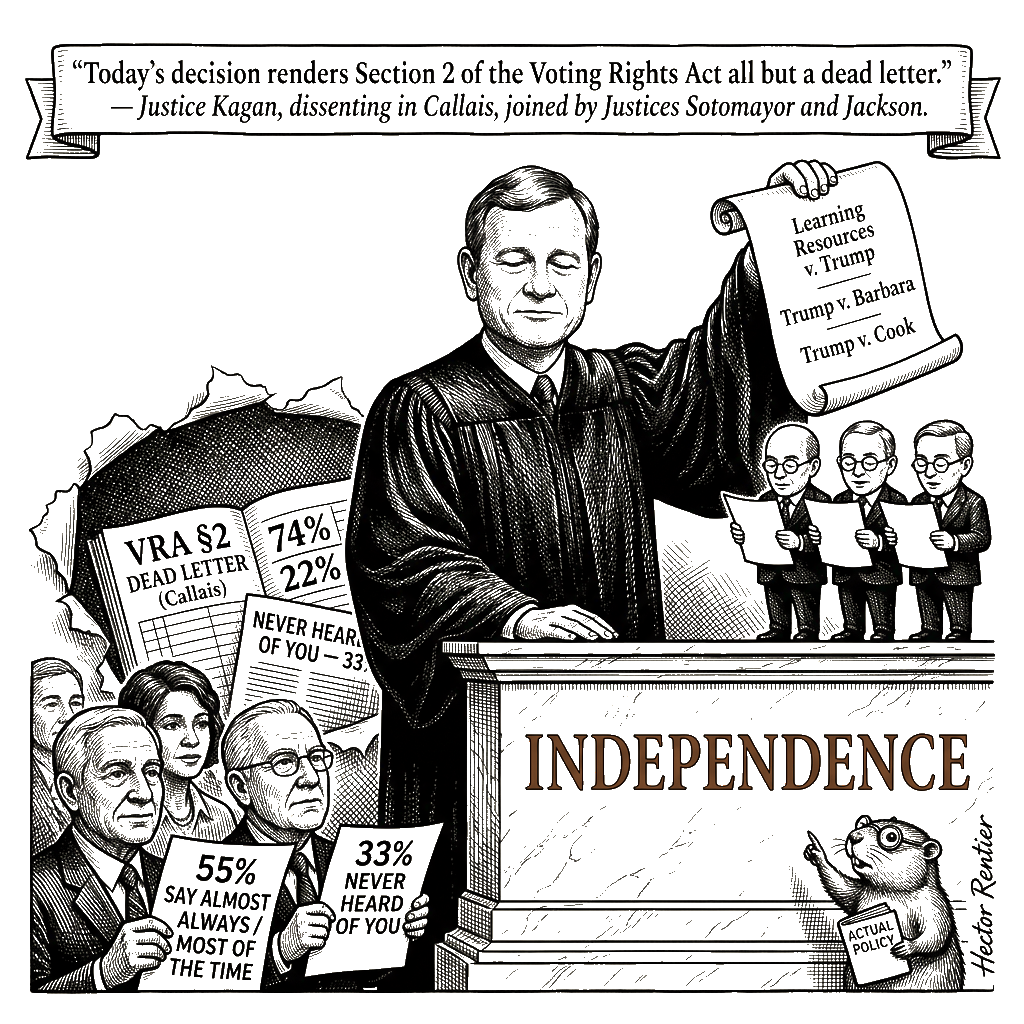
The Wall Street Journal editorial board is laundering the Roberts Court’s partisan capture.
The Journal’s argument runs through a Marquette Law School poll of 1,076 adults and three rulings from last term. It claims the rulings disprove Representative Hakeem Jeffries’s characterization of the Court as a subsidiary of the President’s political project. The strongest case for the editorial’s view begins in the constitutional architecture: federal judges hold lifetime appointments, are removable only by impeachment, and are paid salaries that cannot be diminished during their continuance in office — Article III, Sections 1 and 2; the Appointments Clause at Article II, Section 2. The architecture is built to insulate federal adjudication from the political pressure that bends legislatures and executives. That case, stated as its strongest version, runs like this: lifetime tenure and salary protection are not editorial embellishments; they are the bedrock. On that architecture, a Court that rules against the President whose party put its members on the bench is doing what independence looks like. The Journal refines the case by adding the poll: public confidence rises and falls without changing what the Constitution commands.
That case deserves its strongest articulation before it is audited. Three rulings the editorial names — Learning Resources v. Trump on the President’s “emergency” tariffs, Trump v. Barbara on birthright citizenship, and Trump v. Cook on a Federal Reserve governor’s removal — went against the executive in cases the executive had chosen to litigate. On the steelman view those are tests of independence in their most obvious posture: the President asks for X; the Court says no; the President’s base complains. Independence is the negative space where the executive loses and the President does not win. The architecture survives.
The audit requires reading the Marquette numbers the Journal cites and the rulings the editorial does not name. The poll, on the Journal’s own account, shows a 52-point partisan gap: 74 percent of Republican respondents approve of the Justices’ job performance; 22 percent of Democratic respondents do. That is not persuasion. A 52-point spread is sorting — the kind that tracks appointments rather than opinion. A Court trusted by three-quarters of one party and a fifth of the other has not earned the country’s confidence; it has divided the country along the affiliation that produced it.
And the rulings the editorial omits are what the cover is buying. The same term that produced three losses on the marquee also produced, on the editorial’s own telling, decisions in West Virginia v. B.P.J. (upholding state laws excluding transgender girls from school sports), U.S. v. Hemani (extending Second Amendment protection to a category the editorial does not specify), and Louisiana v. Callais, 608 U.S. ___ (Apr. 29, 2026). Of these only Callais sits within this column’s verified primary-document archive. The slip opinion at page 28 states the holding: “Because the Voting Rights Act did not require Louisiana to create an additional majority-minority district, no compelling interest justified the State’s use of race in creating SB8, and that map is an unconstitutional racial gerrymander.” Justice Kagan, joined by Justices Sotomayor and Jackson, dissented: “today’s decision renders Section 2 [of the Voting Rights Act] all but a dead letter.” That sentence, on its face, is the substantive price of the cover: a constitutional vision under which the second majority-Black congressional district in Louisiana is dismantled on the theory that the Voting Rights Act did not require it.
Read the rulings together, on the editorial’s own count of them. The same Court that, the Journal reports, blocked tariffs in Learning Resources, cannot find a constitutional problem with Louisiana’s rearrangement of its second majority-Black district in Callais. The constitutional vision doing the work is not the architecture of independence. It is a doctrinal container the majority has been developing for four decades — the container that elevates methods (originalism, textualism, major-questions clear-statement rules) above precedent whenever precedent would block the majority’s outcome, and that narrows the Fifteenth and Fourteenth Amendments wherever the architecture admits the narrowing. Steelmens of the kind the Journal offers do not survive their own undoing. The independence the architecture actually protects — independence from being a serviceable instrument of any administration’s project, including this one — is the independence the cover replaces.
The Marquette numbers, on the Journal’s own reporting, support the read. Asked how often the Justices rule in the President’s favor in his second term, 12 percent of respondents said “almost always” and 43 percent said “most of the time.” Together: 55 percent. More than half the country reaches the conclusion the editorial says cannot be reached. The Journal calls that perception a “partisan smear.” The public has limited information about the Court; it sees rulings when they are reported, and judges the institution by the totality it can assemble. The residue, on the most charitable reading of the numbers, is an institution that has stopped teaching the public what it does.
The figure the editorial buries is the one that matters most. According to the Journal, 33 percent of Americans say they have “never heard of” Chief Justice John Roberts. That is not the healthy distance from politics. It is the corrosion of legitimacy — an institution that a third of the country cannot name the chief of has lost the argument before the argument begins. The constitutional architecture cannot work without the public believing that what the Court does is what the Constitution requires. The architecture still runs. The public attachment that makes the architecture morally binding has rotted out.
A constitutionalist understands that every Court is a product of its era, and that an era of partisan capture produces a Court that participates in that capture. We are in such an era. The Marquette poll, as the editorial reports it, is not evidence of the Court’s legitimacy. It is evidence of the Court’s success in persuading a disengaged public that the cover still works.
Something has changed. The Justices, who should be the first to know it, are among the last to say so.