
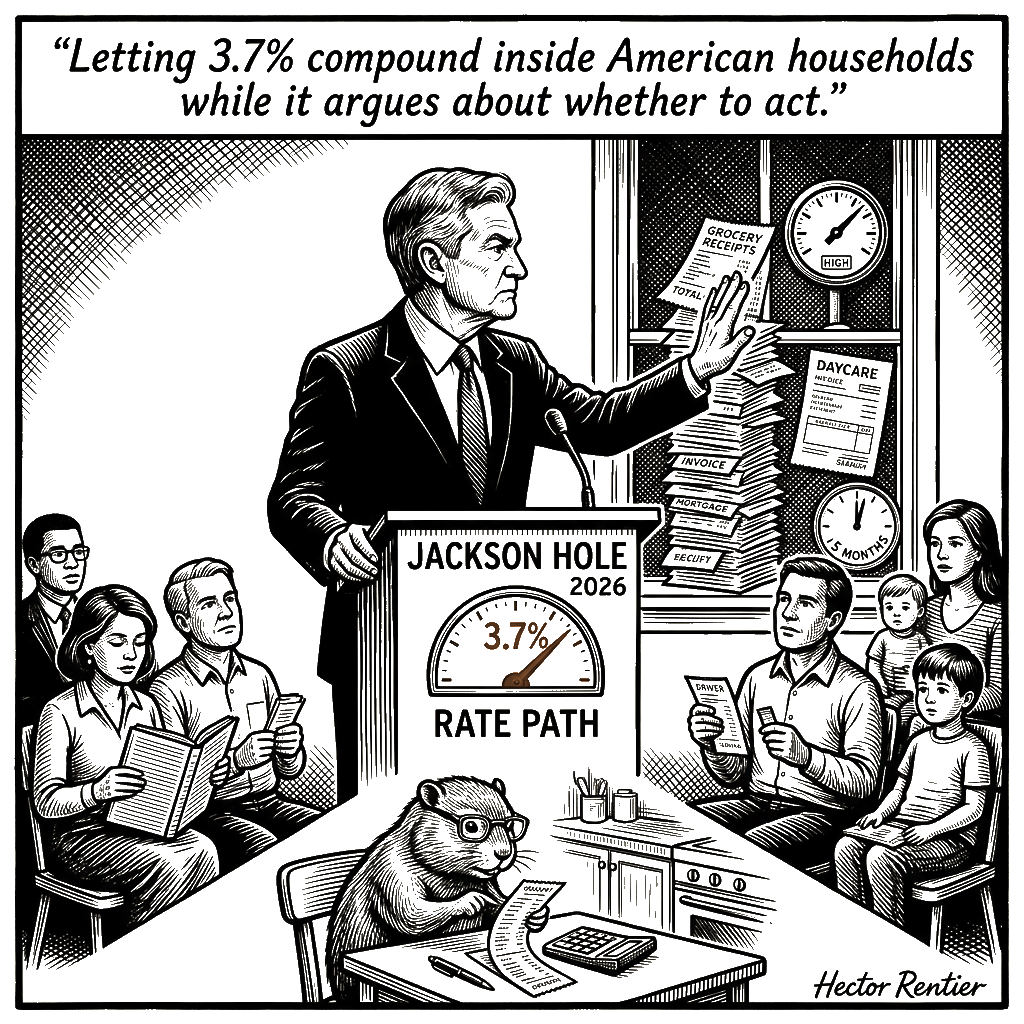
The Federal Reserve is letting 3.7% inflation compound inside American household budgets while it argues about whether to act.
Let me show you what that looks like at our kitchen table. Our net household income after taxes is $8,800 a month; daycare runs $2,400 of that; mortgage, utilities, groceries, the family-share health insurance premium, student loans, and gas take most of what is left. A 0.7-point overshoot against a 2% target, sustained across five months, is not a technical statistic. It is the line item my household pays for the Fed’s patience.
Three pressures are doing the work, and each has its own timeline. The Iran war began in late February; back then the gauge sat at 2.9%, and by July it had climbed to 3.7%. Gas has not come down because the conflict has not come down — every month the Strait stays tense, every month shipping reroutes through longer lanes, every month the cost of moving a truck, a bus, a combine, or a freight train stacks higher. That cost shows up in the grocery receipt, in the school-bus contract, in the price of moving a crop to market. The Fed cannot end a war by raising rates.
The administration has spent months telegraphing new duties on Canada and China, and the threat itself is enough to bend import prices upward. Retailers front-run tariffs. They did it in 2018 and they are doing it now. Duties that have not yet taken effect are already in the sticker price.
The country is spending like a nation wiring a new electrical grid for data centers, GPU runs, and cooling plants, and that demand is being felt in semiconductors, gaming hardware, and the components that go into both. AI capex right now is not a story about productivity gains. It is a story about pulling components out of the consumer market and into the build-out. The Fed cannot unwind an industrial build-out by raising rates.
Three of those pressures — gas, tariffs, components — are not the kind that yield to monetary tightening alone. Petersen has been writing about structural pressure for years; the diagnostic from Can’t Even travels. Some of what is being asked of American households right now has the same shape as what is being asked of a working mother told to add one more thing to her calendar without anyone taking anything off it. The job is to absorb what cannot be absorbed. Five full months living inside the same range above target is not a wobble; it is the regime. In May a separate index hit 4.2%, a three-year high. Most officials want to hold rates steady and see if the pressures cool on their own; many others want to act before expectations of higher prices get anchored. The cost of waiting is paid by renters, by drivers, by families budgeting a single grocery run. That asymmetry is what the Fed’s patience looks like from the kitchen table.
Warsh’s debut at Jackson Hole on Friday is not a routine gathering. He has been at the Fed’s head since June and inherits a committee that is publicly divided and a mandate that is not being met. Whatever he says on rate path will move markets. Whatever he says on inflation expectations will move voters.
A note on the household I am writing from: my husband and I are two college-educated professionals in a two-income household in a Philadelphia rowhouse that a grandparent’s estate helped us afford. We are higher up the insulation curve than most American families. If 3.7% is what we are absorbing, the math at the kitchen table of a single-income household paying rent in a city where childcare costs more than our mortgage has not happened yet. The Fed’s waiting posture is being run through households at the bottom of the curve first and hardest. We are running the same number with more line items to lose.
The midterm stakes are real. Voters do not feel a 2% target or a 3.7% reading as abstract data. They feel it in the cost of filling a tank, in the monthly phone bill, in the school supplies list. Other economic indicators may be moving in mixed directions, but households are not living mixed directions. They are living one direction.
The 2% target was set in a different economy — before a Middle East war reshuffled energy markets, before a tariff regime with two of the country’s largest partners became a recurring campaign event, and before AI infrastructure spending began bidding components out of the consumer market. The Fed can hold and hope, or it can hike into a war and a build-out it cannot move. Neither is a clean answer. What households actually need is relief that does not have to wait for the committee to make up its mind: child tax credit expansion that activates when the gauge runs hot, automatic stabilizers that reach the bottom of the curve first, support that arrives while the FOMC argues.
The institutions that were designed for the older economy are being asked to speak to this one. The data is unambiguous about where the pressure sits. What is still open is whether Friday’s speech tells the country which side of the line the Fed is on.