
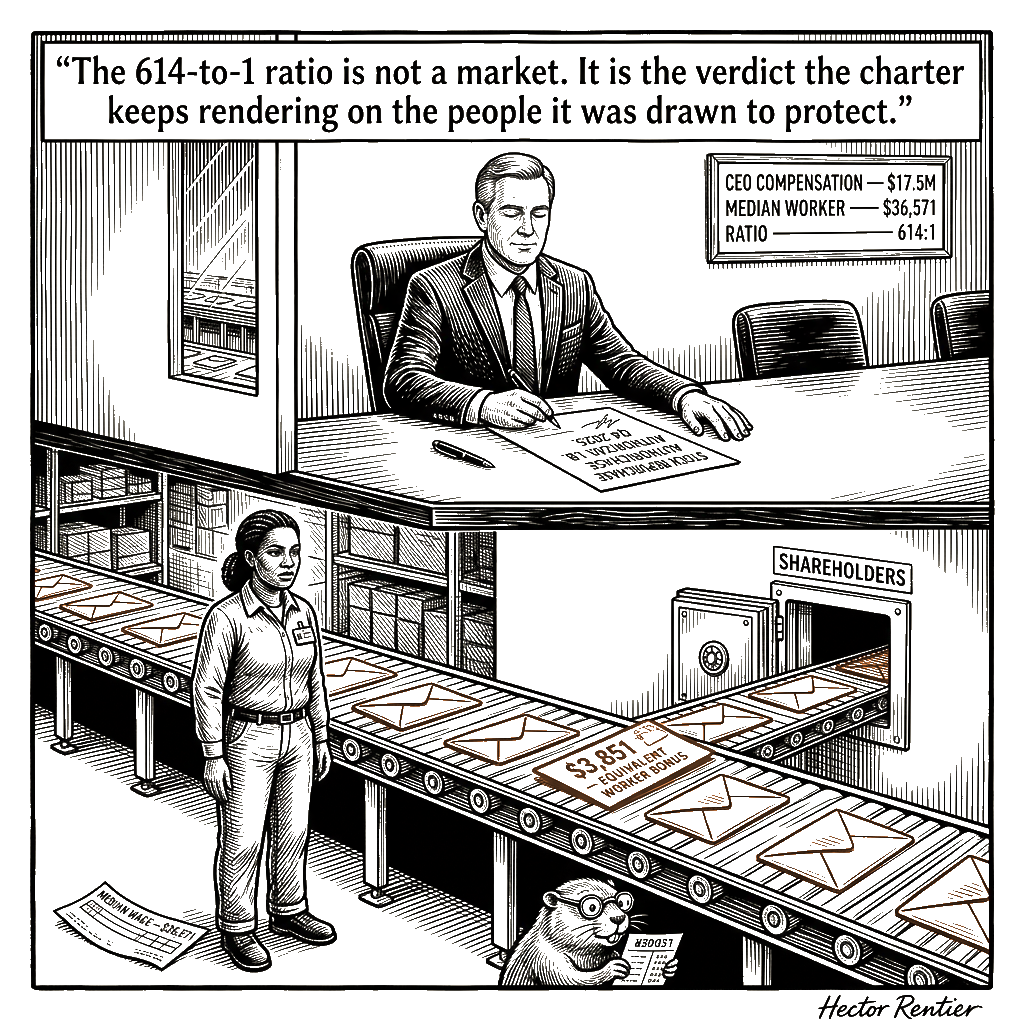
The latest executive excess report from the Institute for Policy Studies counts the average CEO of America’s 100 largest, lowest-paying corporations at 614 times the average worker’s pay in 2025. That is not a labor-market result. That is the spread a class produces when it writes the rules and carves itself out of them. Between 2019 and 2025, CEO compensation at these firms rose 41.4%, twice the median worker’s 20.7%, and inflation ran 25.9%, eating both. The executive raise outran the inflation the worker’s didn’t. The ratio at these firms climbed 8.4% across the same window. The market got less generous. The charter got enforced.
The arithmetic on the page: the average CEO on this list took home $17.5 million last year. The median worker took home $36,571. The average CEO took home in a single working day what the median worker takes home in a year and a half. Walmart’s former CEO Doug McMillan, who stepped down in January 2026, was paid $29.2 million in 2025 against a median worker wage of $30,520 — a 958-to-1 ratio, in the largest private employer in the United States. A ratio is the visible surface. The apparatus underneath is what produced it.
The apparatus has three names. The first is the buyback. Walmart alone spent $8.1 billion on stock repurchases in 2025, which the report calculates as the equivalent of a $3,851 bonus for each of the company’s 2.1 million workers — except the worker never sees it. The $3,851 went to the shareholders who own the company, and the median Walmart worker is not, in any meaningful sense, a Walmart shareholder. She is a worker. The shareholders who pocketed the $8.1 billion are the people whose compounded return put eight Waltons on the Forbes list. The report counts 36 billionaires tied to these 100 companies — the eight Waltons, Jeff Bezos and Mackenzie Scott at Amazon, Ernie Garcia II and Ernie Garcia III at Carvana — and traces their fortunes to the gap between what the worker produced and what the worker was paid. The buyback is not the worker’s cut routed through the equity markets. The buyback is the worker’s cut, kept.
The second name is the lobby. These 100 companies field 1,282 registered federal lobbyists between them. Civic engagement is what the rotary club does at noon on Tuesday. A thousand two hundred and eighty-two lobbyists is an industry — the industry of bending tax, trade, labor, and immigration policy in the direction of the executive suite. The lead author of the IPS report notes that these same companies have, by and large, refused to denounce the immigration enforcement actions terrorizing their own workforces, and that those same workers are about to absorb the largest cuts to Medicaid and SNAP in the history of either program. The lobby corps bends the policy for the corner office. The cuts land on the worker. The worker takes the cuts the corner office’s lobbyist wrote.
The third name is the tax code. The report’s policy menu proposes a new tax on any company paying its CEO more than fifty times its median worker, a hike on the buyback excise, and a bar on federal contractors who repurchase their own stock. Each is a tax on the decision to employ Americans at scale. Each shrinks the very payroll the report claims to be defending — except the payrolls were never what the apparatus was built to defend. The apparatus is built to defend the spread. The 614-to-1 ratio is the spread. The proposed surtax would be paid by the same shareholders who already captured the buybacks. It would not reach the worker. The 614-to-1 ratio will not shrink because a think tank wrote a report, or because a fifty-times surtax clears committee. It will shrink when the people who built the apparatus are forced to defend it on the merits, in front of the people it leaves holding the bag.
I have watched this movie since Nixon. The cast changes; the apparatus doesn’t. The AIG unit that blew up the firm paid itself $165 million in retention bonuses in March 2009, after AIG had taken $182 billion in committed federal support — seventy-three of those bonuses over a million dollars each, paid in the unit that lost the money. The Wells Fargo executives who oversaw the fake-accounts fraud walked with deferred-prosecution money and personal fines while the tellers took the firings. The HSBC money-laundering settlement forfeited $1.256 billion and admitted laundering for Mexican drug cartels and sanctioned regimes — and no individual went to jail. Senator Grassley’s word for it was that HSBC had “quite literally purchased a get-out-of-jail-free card.” The pattern runs the way the pattern always runs: the apparatus binds the worker and the small defendant, and carves the executive and the institution out. The 614-to-1 ratio is the visible spread. The deferred-prosecution agreement is the legal spread. The buyback is the financial spread. The lobby is the legislative spread. They are the same machine, in different costumes.
There is a name for the arrangement. A political scientist named Frank Wilhoit called it the only proposition conservatism requires: “there must be in-groups whom the law protects but does not bind, alongside out-groups whom the law binds but does not protect.” I have lived long enough to watch it operate on every docket I have ever read. I have a late husband who used to say that the bank never once knocked on a door it could send a lawyer to. He was talking about a different century and the same machine. The eight Waltons on the Forbes list, Bezos’s residual claim on the platform his name is on, the Garcias’ compounded return on the marketplace they built — those are the in-group. The 2.1 million Walmart workers who do not own a single share in any meaningful sense, the Amazon warehouse associates whose median pay shows up as $36,571 on the report’s spreadsheet, the Carvana lot crews who never see the Garcia dividend — those are the out-group. The 614-to-1 ratio is the spread the apparatus produces on schedule.
The IPS report is welcome. Sarah Anderson, its lead author, has counted what needs counting. The numbers are real, and the numbers are damning, and the numbers will not, by themselves, move the apparatus one inch. The apparatus does not respond to arithmetic. It responds to pressure — the kind that shows up at the ballot box, on the picket line, and in the rooms where the policy is actually written. The 614-to-1 ratio is the verdict the charter keeps rendering on the people it was drawn to protect. The verdict can be reversed. The people who benefit from it have made very sure, through the apparatus named above, that it has not been yet.
The ratio is not the market. The ratio is the charter. The charter can be redrawn.