
I traded paper claims on these very crops before they were planted. I sat on a Chicago desk and watched the futures curve draw itself across the screen while the actual beans went into the actual ground forty miles south of my hometown. I know what a futures market looks like from the inside. I know what a buyback looks like from the inside — a column on a balance sheet, a treasury decision, a quiet vote in a quiet room. I left the pits and came home to run a farm cooperative in Adams County, Wisconsin, and what I learned in the years since is that the column on the balance sheet and the quiet vote in the quiet room are how the institution of the firm — the company as a place, the employer as a community member — is being hollowed out and shipped to the same place the crop went: into the hands of people who will never see the field.
The new tallies from the Institute for Policy Studies and the AFL-CIO make the gutting legible. America’s 100 largest low-wage corporations now pay their CEOs 614 times what they pay their median worker; CEO compensation rose 41.4 percent in the same window, while worker pay crawled up 20.7 percent and inflation ran 25.9 percent. Real wages went backward; executive pay went forward at almost double the speed of the cost of living those executives were supposedly being retained to manage. The AFL-CIO’s parallel read of the broader S&P 500 found a 312-to-1 ratio — still grotesque, still indefensible — but the IPS roster is the worse indictment, because it counts only the companies that already pay the worst in America, the employers of last resort for people with no leverage and no options, and layers a 614-to-1 extraction ratio on top of that foundation. The median worker at one of these firms earns $36,571. The average CEO on the same list takes $17.5 million. And at least a dozen S&P 500 CEOs cleared $200 million in 2025 alone.
There is an honest thing to be said for the other side of this argument. Executive markets are global. Talent does have to be retained. Stock-based compensation, in principle, aligns the manager with the owner. The ratio is, in some narrow sense, what the market will bear. All of that is true. None of it is the point. The point is the suppressed variable: the firm is not a stock chart. The firm is an institution. It is a place where generations built something, where a worker could expect to spend a career, where the local economy had a pulse, where the profits that flowed out the door were understood to have come in through the loading dock. When the ratio is 614-to-1, the firm has stopped being an institution and started being a sieve. And what flows through the sieve is the labor of the low-wage worker into the inheritance of the billionaire class — the Forbes-400 cohort climbing 31.8 percent in the same window, with at least 36 of those billionaires (eight Waltons, Jeff Bezos, Mackenzie Scott, Ernie Garcia II, Ernie Garcia III) bound up in the same 100 companies that pay their workers the worst.
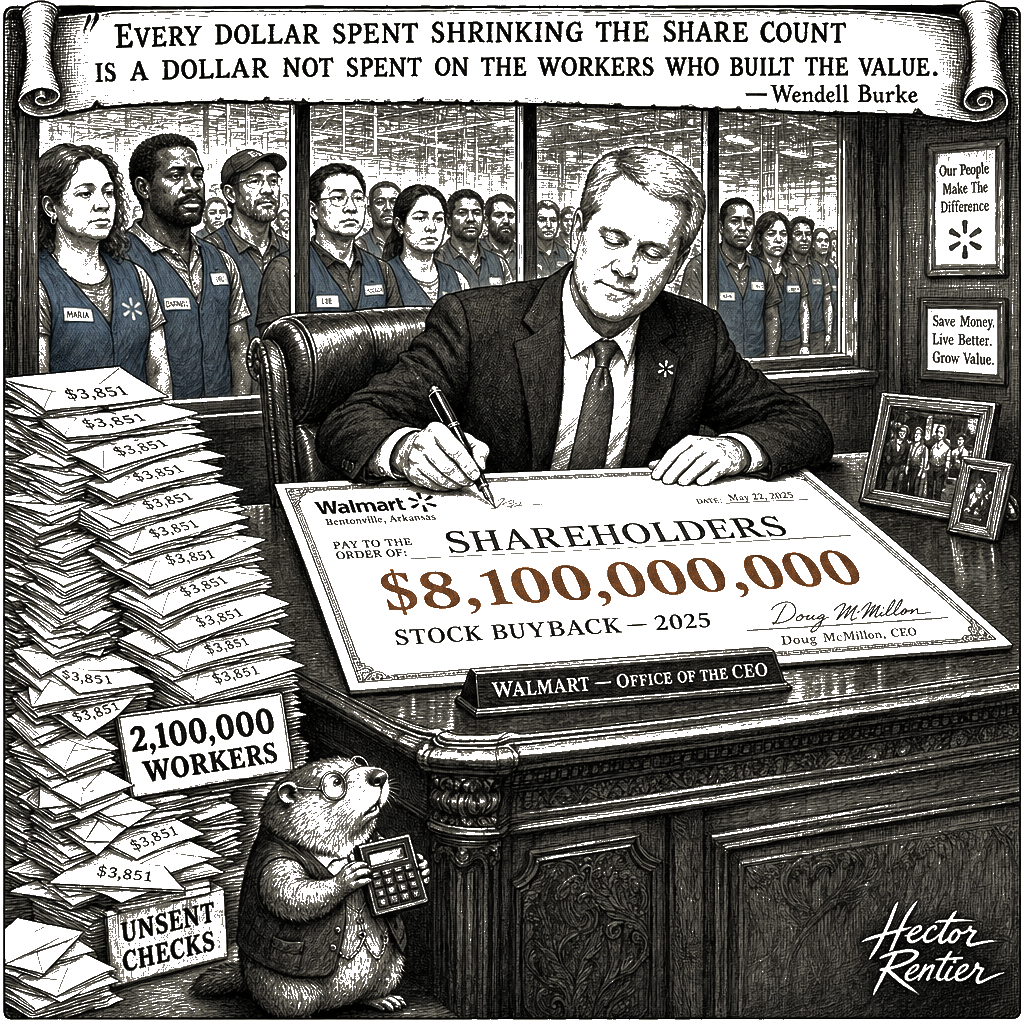
I used to sit on a desk that priced what those workers built. I did it for a living. The mechanism that turns labor into inheritance at 614-to-1 is not mysterious. It has a name. It is called a stock buyback. Stock buybacks across the low-wage 100 hit $108.6 billion in 2025, up from $105 billion the year before, and a staggering $718 billion cumulatively between 2019 and 2025. The arithmetic is exact and it is unforgivable: every dollar the company spends shrinking its own share count is a dollar not spent raising wages, lowering prices for the people who need them lowered, or reinvesting in the workforce that built the value in the first place. The C-suite’s favorite form of capital return is the form that does the most damage to everyone who isn’t in the C-suite. Look at Walmart. Doug McMillon, who stepped down as CEO in January 2026, took $29.2 million in 2025 compensation — 958 times the median Walmart worker, who earned $30,520. The same year, Walmart authorized $8.1 billion in stock buybacks, a number that works out to roughly a $3,851 bonus for each of its 2.1 million workers. Imagine that check arriving. Imagine not receiving it. That arithmetic is the entire political argument in one column.
The point is not that the ratio is unfair. The point is that the ratio is the residue of what has been done to the institution. Brandeis called bigness a curse a century ago because it concentrates power; the firm at 614-to-1 is not big in the productive sense, it is big in the extractive sense — a Hayekian problem in reverse, a giant corporation that has become its own central planner, deciding the wage, deciding the price, deciding the destination of the surplus, and answerable to no one in the county where the warehouse sits. Pope Leo XIII, in Rerum Novarum, put the principle plainly a century before Brandeis: property is real and legitimate, but it carries a social mortgage; the earth was given for all. Pius XI made the same point from the other direction in Quadragesimo Anno: it is a grave evil to assign to the higher and larger what the smaller and lesser can do. The 614-to-1 firm has assigned everything to the higher. The worker has been reduced to a line item in a treasury decision made by people who will never set foot in his store.
And then, having extracted the proceeds, having shrunk the float, having padded the option stacks — these same boards, these billionaire inheritors and billionaire self-makers, these 1,282 federally registered lobbyists keeping the conversion rate favorable — have watched their workers get terrorized by ICE, denied food assistance, stripped of Medicaid, and said nothing. Sarah Anderson of the Institute for Policy Studies said it more crisply than I can: “These CEOs are just living on a remote economic planet from the one that their employees are living on, and it makes it really hard for them to fathom what it’s like to have to worry about putting food on your family’s table or even coming home at night if you are at risk of being detained by ICE.” That is not a metaphor. Living on a remote planet is a corporate strategy. It is also the precise opposite of what the institution of the firm used to mean in a country like mine.
The institution of the firm is the answer, if the institution can be restored. There are fixes on the shelf — a tax surcharge on corporations whose CEOs earn more than fifty times the median worker; a higher excise tax on stock buybacks; a flat prohibition on federal contractors engaging in buybacks at all. None of these are radical. Each of them is in the conservative grammar: it limits the bigness, it disperses the power, it returns the firm to the institution it used to be. But the deeper answer is not a tax. The deeper answer is what Chesterton saw when he said the trouble is not too much capitalism but too few capitalists, and what Belloc saw when he said ownership should be spread so that no block of interests can dominate. The deeper answer is the cooperative.
I manage one. I will not pretend the floor of my co-op looks like the floor of a Mondragon or the loading dock of an Organic Valley; it does not, and that is the honest admission the co-op movement owes itself. But the members across my counter are the owners across my counter, and the surplus that is not reinvested in the next season’s equipment or held back for the bad year returns to the families who earned it. Organic Valley, in western Wisconsin, has united more than 1,600 organic family farms into a federation that captures roughly a third of the organic milk in the country and pays its members a price the giant processors could not match. Mondragon, in the Basque country, employed more than 70,000 people last year on €11.2 billion in sales, with internal pay ratios that would embarrass the low-wage 100 into the ground. REI is member-owned. Land O’Lakes is member-owned. Adams-Columbia Electric Cooperative, headquartered two miles from where I’m writing this, serves more than 31,000 member-owners across twelve central Wisconsin counties, and no one in New York can decide what the rate will be. The members in these enterprises are not 614-to-1 from the people who run them, because the people who run them are not separate from the people who own them. That is not a sentimental preference. It is a different grammar for what a firm is for.
The 614-to-1 is the residue of a question answered wrong. The question is: what is the firm for? The answer that built Adams County was: the firm is for the place, for the people who work there, for the members it serves, for the county whose tax base depends on its presence, for the parish a stone’s throw from its loading dock, for the generations who came before and the ones who will come after. The answer that built Walmart is: the firm is for the share price, for the buyback, for the executive who walks away with $29.2 million in a year the median worker earned $30,520, and for the 1,282 lobbyists who make sure no one in Washington asks the question again. The two answers cannot coexist in the same company. The country has decided, by failing to legislate, by declining to enforce, by refusing to restore the institution, that the second answer is the one that prevails. It does not have to be. But the next time someone tells you that corporate America is paying its workers fairly, that executive compensation reflects performance, that buybacks benefit shareholders, that the wealth at the top trickles down — point them at the 614-to-1. Point them at the 958-to-1. Point them at the $718 billion. Then point them at Mondragon. Then point them at the cooperative down the road. The choice, after all, is not between capitalism and something else. It is between the firm as a sieve and the firm as an institution. Conserve what, exactly?