
Six months.
Six months into a war he sold as weeks, Trump has kept the defense primes on wartime billing. Lockheed Martin. RTX. Northrop Grumman. General Dynamics. Boeing. Six months of premium-priced contracts. Six months of replacement parts billed at wartime rates. Six months of work that does not get questioned because the war is on and somebody has to keep the supply chain moving.
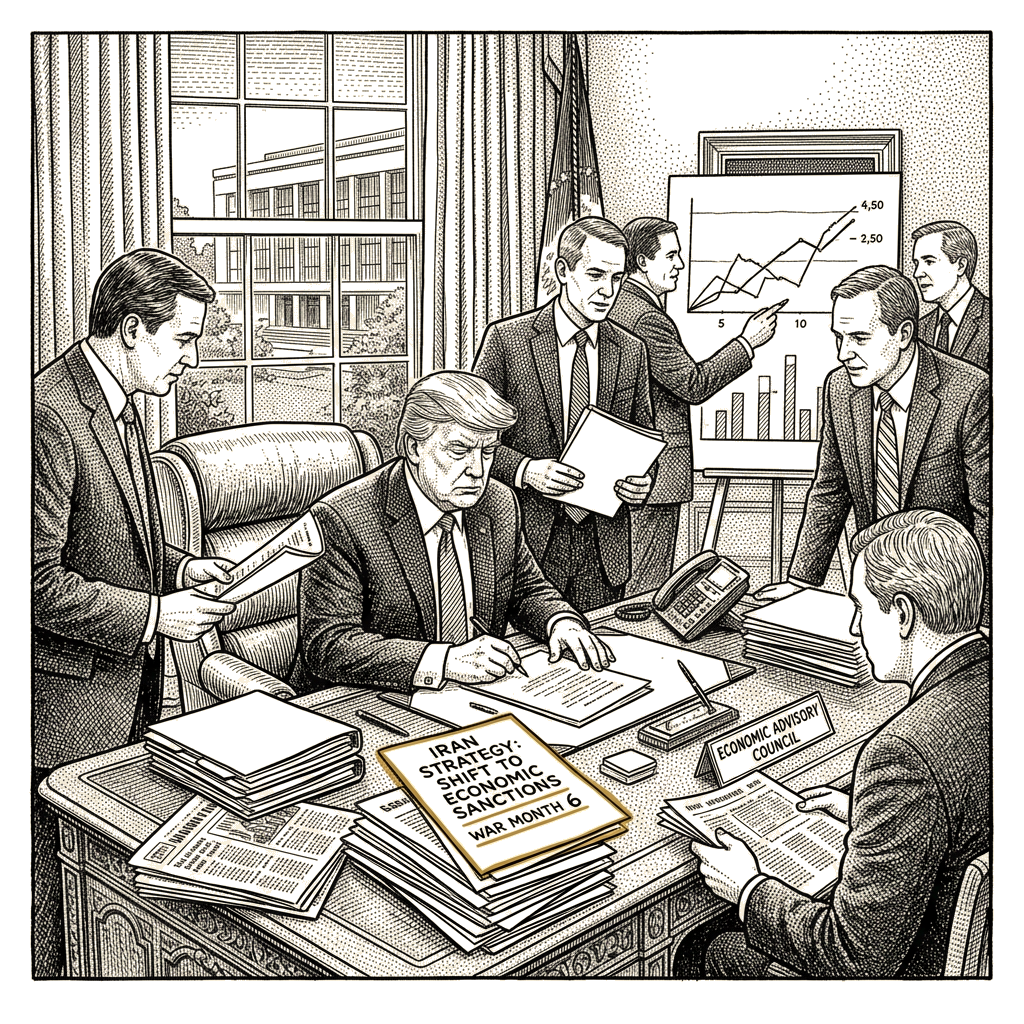
The war itself has not gone to schedule. President Trump told the country this would be a “little excursion” lasting a matter of weeks. The country is six months past the wrapping-up date. Two months ago he was still vowing to hit Iran “very hard” as diplomacy collapsed. Now the line is sanctions — economic pressure on any country or entity that still does business with Tehran. That pivot is being sold as a finishing move. It is not. It is what an administration does when the munitions are running low and the war is still on.
Let me tell you what six months looks like at the kitchen table.
It looks like the deployment order on the refrigerator. Every county in this state has a Guard unit. The unit from the next county over has been gone eight months. The boy who pumped gas at the Quick Mart before he deployed — his mother still works the register, and his grandmother sits with me at the church on Sunday and watches the news like the rest of us. She does not want to hear about “little excursion.” She wants to hear when her grandson is coming home. Six months in, the answer to that question is: when the President says so.
It looks like the meter running at the pump. A blockade means tankers take the long way around. The long way around is a longer shipping bill, and the longer shipping bill is a higher price at the register. The refinery buys crude at the new rate and passes it to the distributor who passes it to the truck stop. The truck stop passes it to the working family filling up the tank to drive to the job that does not pay enough to cover the new price. The tanker companies and the hedge funds do very well on this arrangement. The working family does not.
It looks like the supply truck that didn’t come. From where I sat in the gunner’s seat in 2003, the parts that were supposed to be at the depot weren’t always at the depot — and the ones that were came in at a price the contractor could charge because the war was on. The contractor’s price was the country’s price, and the country’s price was paid by the soldier who made do and the family that waited and the taxpayer who wrote the check without knowing what it bought. I have seen this before. The contractor eats first. The country pays the rest.
It looks like the contract that didn’t renew. The small machine shop down the road had three jobs lined up for the year — two with defense subcontractors, one with a regional carrier. Two of them went on hold when the war started. “Capacity constraints,” the letters said. The owner told me the prime contractors above him were pulling every machinist they could find and routing them to wartime work. That is not a story about capacity. That is a story about wartime pricing and who gets to charge it. The little shop absorbs the squeeze. The prime books the premium.
That is the bill. The defense primes collected six months of wartime contracts at wartime prices, and the working family is going to pay for those contracts in higher fuel costs, in deferred civilian production, in the boy overseas who is not coming home on schedule, and in the tax bill that will arrive in pieces for years to come.
Now the President wants the same war, paid for by the same working families, run through the financial system this time. A sanctions regime against every counterparty on earth is not a cheaper war. It is a longer war with a different meter running. The meter is on every tanker reroute, on every importer who touches Iranian oil, on every bank that clears a transaction with an Iranian counterparty, and ultimately on the same kitchen table where the deployment order sits on the refrigerator.
The administration will tell you this is the cheap part. I have heard that arithmetic before. The next phase is always sold that way — the hard part is paperwork now, the bomb-site will confirm what the brief says it confirmed, and the working family will sort out the bill when it lands.
The easy part is not finished. The bill is just beginning.