
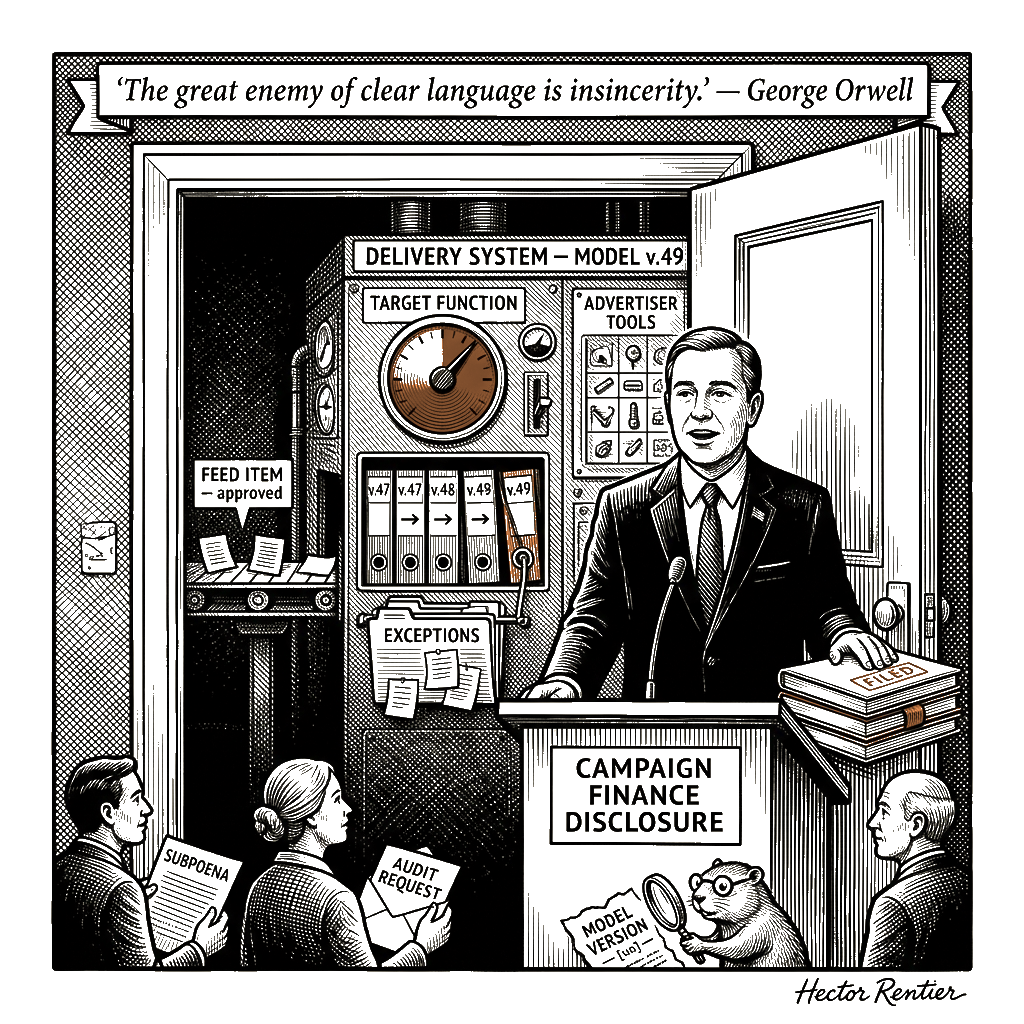
Meta, Palantir and Kalshi use private systems to capture public power.
To be fair, The Wall Street Journal reports preparations, not an announced investigation. Its sources say executives and advisers at Meta and Palantir have discussed congressional information requests, hearings and subpoenas if Democrats take the House in November. No committee has issued a subpoena, and no company has been charged. The uncertainty matters. The operational substance remains: which decisions were made, under what rules, and with which audit trail?
Meta is a useful first case because “algorithmic amplification” is too often left as a political slogan. The company does not operate one machine called the algorithm. It operates a chain. A pool of candidate material is assembled; ranking models estimate a person’s likely response; delivery systems place selected material in a feed; and those responses feed back into later ranking and model updates. The target function, in plain language, is the measurable outcome engineers tell a system to predict or maximise.
The distinction matters because political influence can enter at any stage: through content policy, advertiser tools, enforcement decisions, exceptions, ranking objectives or delivery experiments. A person can be reached because the system predicted a response. A political account can be treated differently because a policy rule was changed. A story can disappear because it failed a quality model, or remain because the model was quietly updated. The noun “algorithm” collapses all of those different control points into one thing.
Cory Doctorow calls the continuous computer-side adjustment of rankings, recommendations, prices and visibility “twiddling.” The word is useful because it describes an operating practice without pretending that the system has a political will. Political judgement may shape the objective, the eligible material, the exceptions or the order in which results are presented. Engineers then build the machinery that makes that judgement repeatable at enormous scale.
Meta’s federal political nonprofit giving totals at least $30 million this year. It gave $5 million each to House Majority Forward, the Senate-aligned Majority Forward, American Action Network and One Nation, then gave another $10 million to a Trump-aligned political committee in the spring. The four $5 million nonprofit donations are not required to be publicly disclosed, according to the Journal. No evidence in the report shows that a donation changed a particular ranking, and it would be careless to claim otherwise.
But money does not have to purchase a single ranking decision to purchase leverage. Meta controls distribution machinery, paid political advertising products and a feedback system that measures how people respond to what they see. The donation record and the delivery record should be audited separately at first. Only then can anyone compare them without pretending that a political contribution must be an ad purchase or that an ad purchase need be unlawful.
That is the proper scope of the planned multi-front investigation. Congress could request model and policy versions around elections, records of political advertising and nonprofit-linked spending, enforcement decisions, approved exceptions, experiments and an event history showing what changed, when and under whose authority. A hearing that cannot identify the relevant system version, policy change or account exception has not yet established causation. It has established only that the question was asked.
Palantir sits at a different layer. Its leverage does not primarily operate in a public feed. Foundry and Gotham are built to connect siloed data sets, apply access permissions, run models and analyses, and place the resulting work inside operational workflows. Their shared ontology—a common map of what each field means—can make data held by several agencies usable in one investigation, command centre or case-management process.
That integration is genuinely useful. A disease outbreak, supply disruption or benefits investigation may require combining records that arrived in incompatible formats. Utility does not cancel leverage; it shows us where leverage sits. Once mappings, dashboards, permissions, interfaces and model definitions become part of daily work, changing vendors is no longer a matter of moving a folder. The receiving organisation needs the old system’s history, relationships and labels to understand what arrived.
Tim Wu’s account of chokepoints is useful here. Control over a necessary route turns ordinary market power into leverage over everyone who must pass through it. A company that owns the data model and the interface can make its system difficult to replace without a costly reconstruction. That is interoperability in the opposite direction: instead of allowing another tool to attach, the vendor becomes the attachment point.
A serious Palantir inquiry would therefore examine more than contract totals and political donations. Those are not engineering evidence, and neither procurement records nor donations prove an exchange between the two. They are the two sides of a relationship that must be compared. Committees could ask which source systems supplied data, which transformations changed it, who had access, which model versions were used, where a human could override a recommendation, where a machine made the decision, and how long the relevant logs were retained.
A contract will not answer those questions. The system specification might. Data lineage, permissions and decision records are the machinery beneath the corporate relationship. If Palantir can reconstruct them, investigators can test a specific claim. If it cannot, the absence of a coherent record is not a clerical detail; it determines whether oversight can distinguish deliberate intervention from routine system operation.
Kalshi provides the cleanest demonstration that the rules are the product. A prediction contract is a financial instrument whose payment depends on a specified outcome. Buyers and sellers submit orders, an exchange matches them, collateral governs exposure, and a resolution source determines the final result. The displayed price is therefore the output of a larger system for defining the event, collecting information, detecting manipulation and settling disputes.
The difficult engineering is not prediction. Prediction can be wrong without being corrupt. The difficult questions concern definition and control: Which event may be listed? Who approves the wording? What data source resolves it? What happens when sources disagree? How does the exchange detect unusual trading or conflicts involving people close to the company?
The Journal reports that Donald Trump Jr. is a strategic adviser to Kalshi. That relationship does not prove that any market was manipulated. It does create a conflict architecture that should be described precisely. The former Democratic aides hired by Kalshi, including Stephanie Cutter and John Bivona, show that the company recognises political exposure. Neal Katyal’s retention as counsel serves the same function. Hired influence is not the same thing as operational control.
An investigation could accordingly ask how contracts touching political or administration outcomes were approved, what disclosures traders and regulators received, which data feeds supplied resolutions, what market surveillance records were generated, and what information the strategic adviser could access. It should also ask whether company personnel traded in contracts connected to matters they knew about. These are questions about system controls, not accusations arising from a losing wager.
Musk is the conspicuous exception to the hedging described by the Journal, with a reported plan to spend more than $100 million to help Republicans retain Congress, as MSI’s midterm coverage records. The amount is a political figure, not an engineering specification. SpaceX makes the operational point more concrete: launch operations, satellite communications, spectrum licences, procurement and government contracts are systems with records, interfaces and dependencies. Campaign spending is legible because it is a payment. Public dependence on infrastructure is harder to reduce to a line item.
Across these companies, the common unit of analysis is not the cheque, lobbyist or election. It is the system of control around privately owned infrastructure that can produce public consequences. Meta has ranking and delivery systems. Palantir has data lineage, permissions and operational models. Kalshi has contract definitions, order matching, resolution data and market-surveillance rules. Different systems require different tests, but the public principle is the same: private decisions with public consequences must remain inspectable.
The remedy should therefore be operational rather than theatrical. Public procurement should require machine-readable logs, model and data versioning, independent audit access, conflict disclosures and interoperable exit plans. A customer should be able to export not merely rows of data, but also mappings, transformation histories, permission structures and the audit records needed to preserve meaning. Open interfaces matter. Copying another company’s proprietary model weights is neither necessary nor realistic; rebuilding its private operating model from scratch should not be required either.
That is a narrower form of structural remedy than breaking a company and hoping power becomes harmless. Breaking a firm while leaving customers locked into the same opaque records and interfaces may change the ownership of the bottleneck without changing the bottleneck. Interoperability and public auditability get closer to the mechanism because they reduce dependence and make intervention difficult to conceal.
My father spent thirty years on the bar mill at Manitoba Rolling Mills before Gerdau bought it in 1995. He kept his job while several uncles did not. The lesson he carried home was not an abstraction about corporate efficiency. It was that whoever controls the manual can define the repair, and whoever controls the production record can define which costs count. The systems in this story own records that are harder to put on a workbench.
Campaign-finance transparency alone cannot expose those records. A disclosed cheque tells us where money moved. It does not tell us which ranking rule changed, which public data set was ingested, which event contract was listed, or who could inspect the result. The operational record is where the transaction between private power and public consequence becomes testable—or remains deliberately invisible.
Congress can make a great deal of noise with a subpoena. It can also do the less theatrical and more useful thing: demand the system, the version, the inputs, the exceptions and the audit trail. If the inquiry cannot expose those, it has not reached the machine. It has only asked its owners what they remember.