
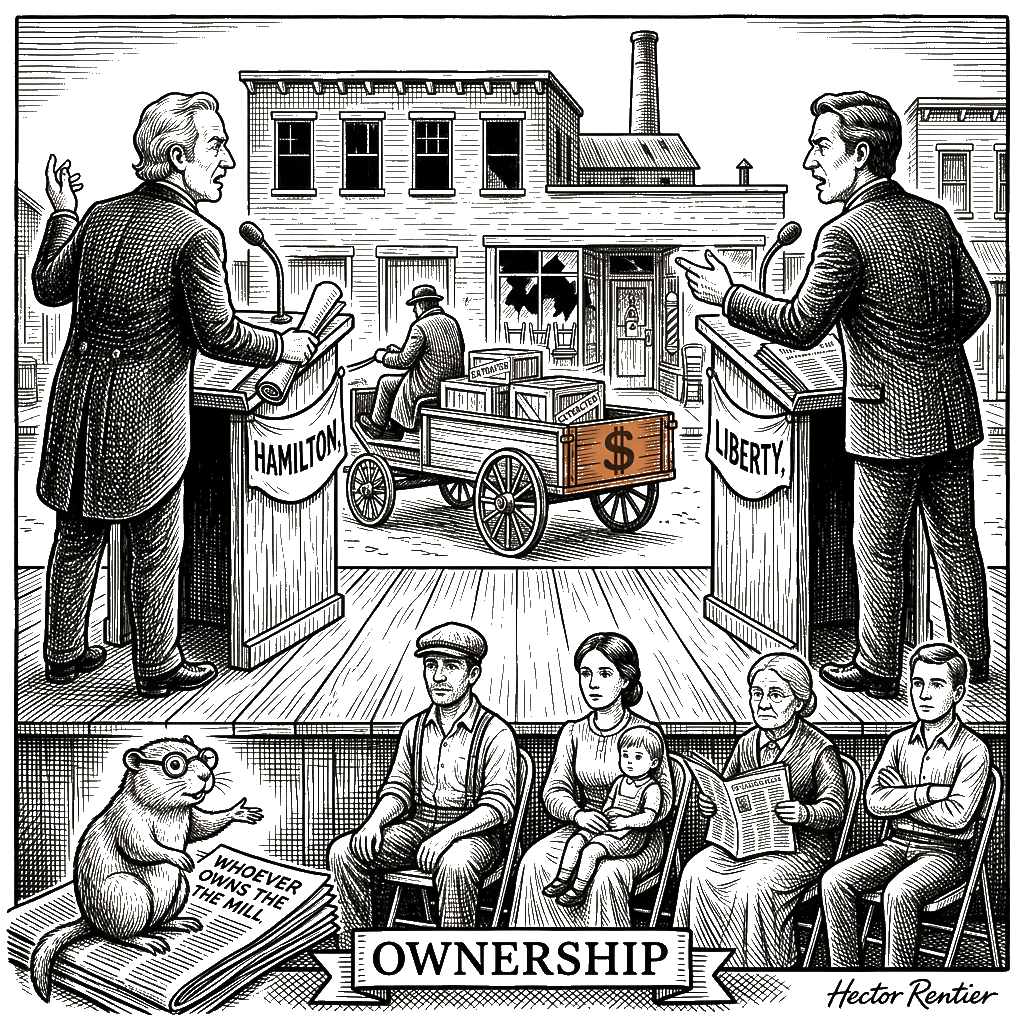
Two halves of American centralization destroyed civic life, and the fight between them is over which half. Andrew Langer, president of the Institute for Liberty, argues in What JD Vance Gets Wrong About Hamilton for the Wall Street Journal that Vice President JD Vance’s pivot to Alexander Hamilton conflates a Christian moral order with the liberty markets actually require, and that America’s institutional decline flowed from government expansion crowding out civil society — not from laissez-faire. Vance, by Langer’s telling, has the diagnosis wrong. Both of them have it wrong, and the variable neither piece names is the one that did the work: ownership.
The corporate form is a Hamiltonian invention. It pooled capital across geographic communities, severed ownership from place, and turned a worker from a member of a town into a unit of a national labor market. Federal charters and limited liability let absentee owners escape the obligations local partners owed each other. By 1900 the United States ran on a Hamiltonian chassis: a central bank, federal land grants financing railroads and state universities, a protective tariff, general-incorporation laws turning the corporation from a special legislative favor into a default form of business life, and an income tax waiting in the wings. Langer is right that the welfare state did not invent the dependency of individuals on distant institutions. The New Deal did not invent centralization; it nationalized a structure already in place. The Great Society did not create that dependency; it answered to a labor market and a civic landscape the Hamiltonian synthesis had already reorganized around scale. When the Gilded Age trust-busters tried to undo the resulting concentration, they did so with federal antitrust law — a Hamiltonian answer to a Hamiltonian problem.
Vance is right about something different, and Langer is too quick to grant it only as background noise. Langer concedes in his own piece that “government expansion didn’t single-handedly cause the decline of religious participation or civic life.” Then he pivots to “public provision frequently displaced voluntary provision.” The pivot is where his case starts to slide. He’s describing a real mechanism — programs can crowd out private provision — but it isn’t the story of post-1970s America. The story of post-1970s America is the mill closing. The mills closed. The main streets emptied. The local banks consolidated into nothing. Free trade without concern for domestic productive capacity. Free capital movement without asking what happens to the towns the capital leaves. A financialized economy where returns flow to asset holders rather than wage earners — Galbraith’s bezzle, the interval when the books show wealth and the town shows nothing. Communities don’t form bowling leagues and parent-teacher associations when the local economy has been strip-mined for three decades. They form those things when people have work, when neighbors share economic life, when there is something to organize around.
Hamilton lost the political argument with Jefferson. His policy program won the institutional war. Then the Friedmanite extension rode on top of it: free trade that outsourced the production, free capital that concentrated the returns, a financial sector that grew larger than the real economy it was supposed to allocate capital toward. The corporation severed ownership from place. The capital flight severed production from place. You need both halves to explain why the lodge died, and the historian’s question of which came first is a luxury the country with hollowed main streets cannot afford.
The tell is the variable neither piece names. Langer names the welfare state as the institution that crowded out the lodge. Vance names the free market as the institution that drained the mill. Neither asks what kind of firm would still be there when the mill closed, what kind of bank would still hold the local deposits, what kind of employer would still know the workers’ names. The corporate form made ownership fungible, mobile, and absentee; the financialized economy made that mobile ownership a vehicle for extraction. Industrial policy without ownership reform is a tariff that protects absentee shareholders. Deregulation without ownership reform is a memo from the private-equity playbook that buys the mill, loads it with debt, and leaves town with the silverware. The right diagnosis is ownership, and both diagnoses miss it.
A worker cooperative in the Basque Country — Mondragon — has run for seventy years, paid its workers a living wage, and relocated almost 1,700 of its 1,800 members when its flagship appliance co-op went bankrupt in 2013. That’s not a model that depends on whether the tariff schedule is Hamiltonian or libertarian. That’s an ownership structure that kept the productive base inside the community when the market wanted it gone. We’ve run a profitable state-owned bank in North Dakota since 1919; nobody ever called Bismarck the Kremlin. Rural electric cooperatives still serve 42 million Americans across 56% of the country’s landmass because Congress, in 1936, decided the wires should belong to the people who used them. The 145 million Americans who belong to a credit union already belong to a cooperative and have somehow never been to a Politburo meeting.
Langer is right that the Friedmanite framework won’t rebuild what it helped break. Vance is right that his own nationalism is the wrong answer to the right complaint. Neither is asking the question the towns need answered: who owns the thing now, and who will own it when the next decade turns ugly? The answer isn’t a return to a free-market Eden that never existed on this continent, and it isn’t a Hamiltonian centralization that exists only to funnel subsidies to the same firms that already own everything. The answer is what gets built when the question changes from “free market or industrial policy” to “who owns the thing, and who pockets the gains?”