
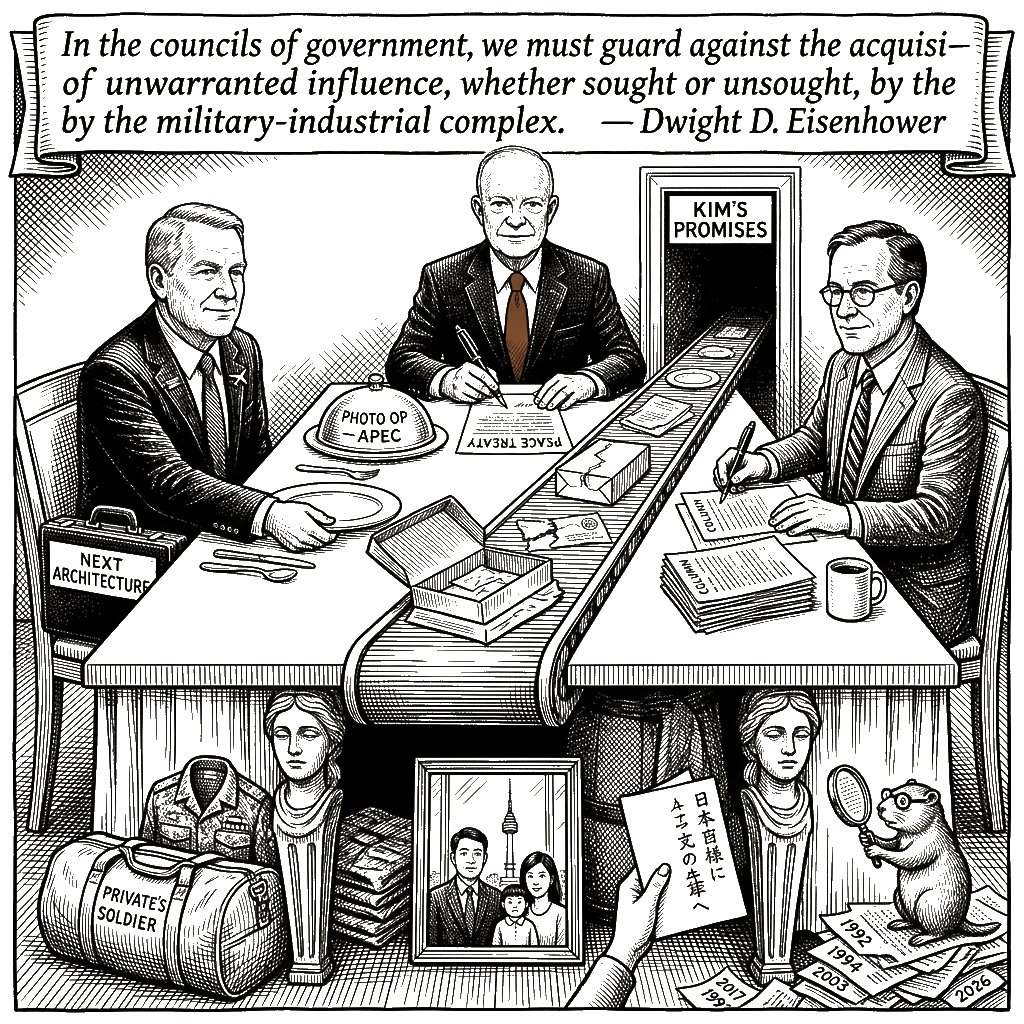
Trump is selling out South Korea to a nuclear-armed dictator for a photo op. That is the deal the administration is putting together for the APEC summit this fall, and the people writing the briefing slides are not going to walk you through it.
Now, I’m just a simple man, but I know what it looks like when somebody walks into my shop and tries to trade me a bad transmission for a good engine. They’re hoping I don’t read the paperwork.
The package reportedly accepts North Korea as a nuclear-armed country. It permanently ends the joint exercises our military runs with South Korea. It signs a peace treaty that undercuts our legal reason for being on the Peninsula in the first place. It asks for promises in return that the last three Kims have never once kept. We are told this is “achievable.” Achievable for whom is the question.
I’m a 42-year-old auto-shop owner in Georgia. I’m a veteran of the Iraq War. Third Infantry Division, 2003 through 2005. Abrams crewman. I learned to read Sun Tzu the way a man learns to read a torque-spec sheet, because if you don’t, you break things that cost a lot to fix. I learned to read the games governments play with working families’ children because I was one of those children, and the children I served beside were one of those children, and the children coming out of high school this fall in towns like mine are still those children.
This deal is being negotiated over their heads. They should know what it costs.
Let me walk through what is actually being given up, in language a shop steward or a county commissioner can follow, because the architecture of this thing matters and the people writing the briefing slides are not going to walk you through it.
First: the nukes. North Korea now has at least 57 nuclear weapons, by the administration’s own count. The deal doesn’t ask Kim to give them up. The deal says they can stay. Once the United States signs a paper that says North Korea gets to keep its nukes, every country in the region gets to ask out loud why they can’t have theirs. South Korea has the scientists. Japan has the fuel. Both have been waiting for a reason. This deal hands them the reason on a plate. That is not managing the problem. That is signing the receipt for it.
Second: the soldiers. The administration is talking about permanently ending the joint exercises our military runs with South Korea. Those exercises are not a diplomatic favor. They are how our soldiers and theirs learn to fight together so they don’t have to. They are the reason nobody has had to fight in Korea since 1953. End them, and the safety that has kept my kids, your kids, from being drafted into a Korean war becomes a slogan on a briefing slide. “Restructured exercises” is the phrase the deal’s defenders use. The question is whether the new exercises still train the way the old ones did. If they do, the concession is smaller than it looks. If they don’t, we’ve traded the muscle memory of seventy years for a piece of paper.
Third: the peace treaty. This is the part that scares me most, because it is the part that will be used against us the day it is signed. A peace treaty says the war is over. Fine. The war has been functionally over since the armistice in 1953. But the United Nations Command, the multinational body that has legal authority for the Korean Peninsula, exists because the war is not formally over. If the war is over, the UNC has no purpose. If the UNC has no purpose, our forces have no legal reason to be there. If our forces are still there, the North will say, in every forum from Pyongyang to the United Nations, that we are the ones blocking the peace. They have been rehearsing that line for seventy years. They will not need to rehearse it again. They will simply deliver it.
I want to name who benefits, because naming them is part of holding them accountable.
Not the working families in Dalton, Georgia, or Pueblo, Colorado, or Killeen, Texas, whose sons and daughters are the ones who would actually have to fight the next Korean war. Not the small businesses around Fort Liberty and Camp Humphreys and the other bases that anchor their economies. Not the taxpayers who already carry a national debt the deal’s defenders never mention when they talk about how cheap peace on paper looks.
The defense contractors benefit. Lockheed Martin. Raytheon. Northrop Grumman. They have built an industry around the current posture. They will build an industry around the next posture. They have lobbyists on K Street making sure that whatever the architecture is, it requires their equipment. The consulting firms that wrote the Iran deal are now writing this one, and Kim Jong Un is reportedly studying that deal for what he can demand next.
The politicians benefit. The photo op with Kim at APEC this fall is the kind of cable-news moment campaigns are built on. “I ended the Korean War” is a line that writes itself, regardless of whether the war is actually ended or whether the document merely tells our allies we have left them to handle the consequences.
The columnists and think-tank folks who pushed this approach benefit. They get to write the next round of “pragmatism” pieces when the deal falls apart, just as they did after the 1994 Agreed Framework collapsed, just as they did after the 2015 Iran deal, just as they did after every North Korean agreement since 1992. They are never the ones who pay when the agreement fails. Our soldiers pay. Our allies pay. The Korean people pay.
That is the part the briefing slides will not say.
I want to come back to my own shop floor, because I want the reader in the place I used to be, the reader who watched the news, who trusted the politicians, who waved the flag, to hear this in his own register.
I served in the Third Infantry Division. I rode an M1A1 Abrams from Kuwait to Baghdad. I watched the WMD briefing slides in 2003 that turned out to be wrong about everything. I watched the same politicians who sent us to Iraq tell us we had to finish the job. I watched the same think-tank folks write the op-eds that said we couldn’t leave. I came home and went to work on transmissions and brake jobs, and I waited for somebody to come into my shop and explain to me what any of it had been for.
The “achievable” deal on Korea right now is built by some of the same hands. The architects of the Iraq miscalculation are advising this administration. The people who argued for the surge in 2007 are arguing for the deal in 2026. The pattern is the same: announce a big moment, sell it as pragmatism, accuse the skeptics of being warmongers, sign the document, and let the bill come due for somebody else’s children.
I am not a warmonger. I have seen what war costs, and I have friends who paid for it with their bodies and their minds. I am for honest negotiation. I am for verifiable deals. I am for the day North Korea stops making its own people starve and its neighbors fear. I want that day to come.
But I am against a deal that gives the dictator everything his family has demanded since 1953, takes the muscle memory out of our alliance, gives every country in Asia a reason to build its own bomb, and calls it pragmatism because Kim is willing to sign it.
Achievable, the deal’s defenders say.
Achievable for whom?
For Kim Jong Un, achievable. For the contractors who will build whatever the next architecture requires, achievable. For the politicians who want the photo op, achievable. For the columnists who will write the next round of “realism” pieces, achievable.
For the private from Dalton, Georgia, who will ship out if the deal collapses and the war starts back up, that private does not find this deal achievable. For the South Korean family in Seoul who lives forty miles from the DMZ and is being told the alliance is being restructured, this deal is not achievable. For the Japanese mother in Osaka who watches her government debate whether to build its own nuclear weapons because we just signed a paper saying Kim gets to keep his, this deal is not achievable.
Eisenhower, in his farewell address in January 1961, warned the country about the military-industrial complex. He said we had to keep an “alert and knowledgeable citizenry” watching. Sixty-five years later, the most consequential decision on the Korean Peninsula in a generation is being prepared in a framework the citizenry is not being told to read. That is what should worry us most. Not the deal. The fact that the deal is being made while we are being told not to look at it.
I am telling my neighbors to look at it. I am telling them to call their representative. I am telling them that the soldier the deal puts at risk may be their son, their daughter, their cousin, the kid who joined because the recruiter’s office in the strip mall was the only door he could see.
The bill always comes due. The question is whether the people who signed it will be standing next to the people who have to pay it.
In my shop, we call that looking at the invoice before you sign the work order. The administration is asking the country to sign the work order without reading it.
Don’t sign what you haven’t read. And don’t let them tell you the bad deal is “achievable” when what they mean is achievable for everyone except the people who have to live with it.