
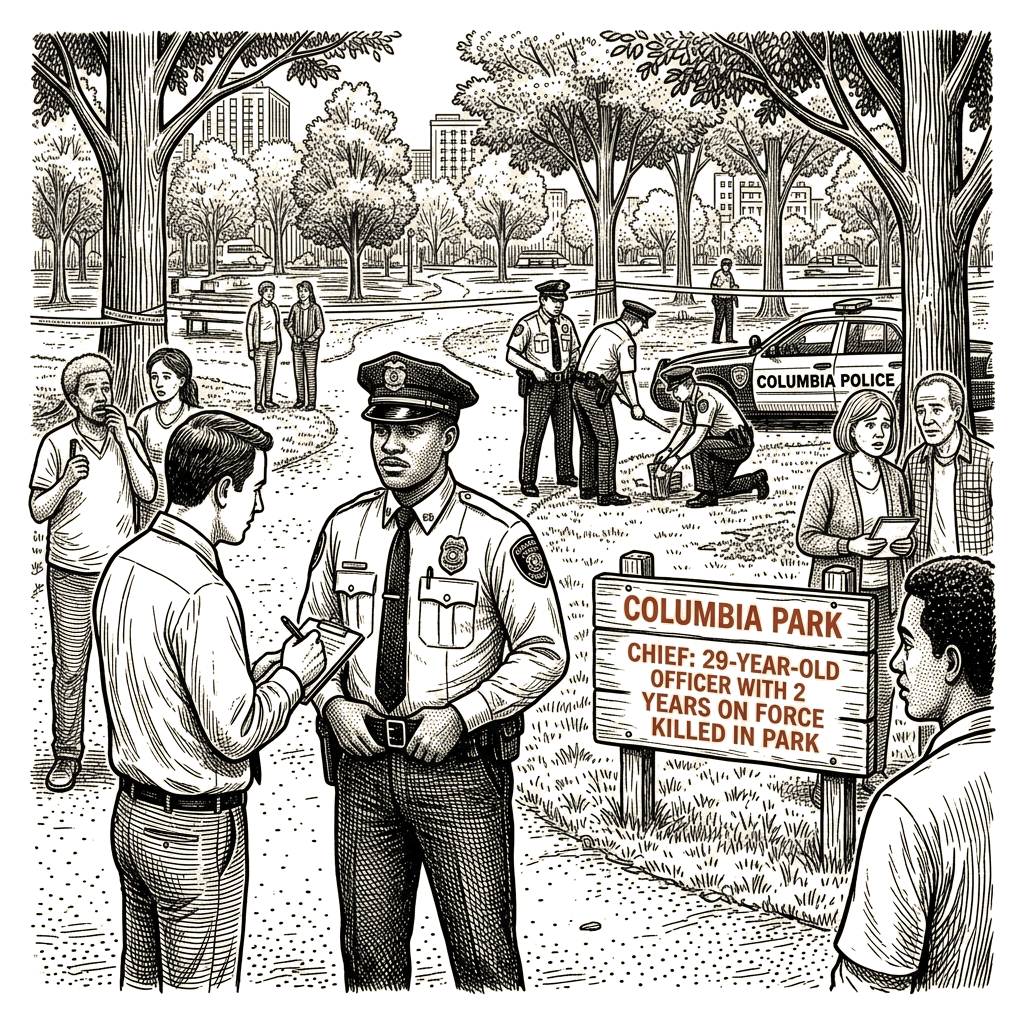
Chief W.H. “Skip” Holbrook’s Columbia Police Department sent a two-year officer to a domestic-dispute call in a park Saturday evening, and a gunfight came back. The 29-year-old officer was a husband and a father of two young children. He did not come home.
Holbrook stood before reporters Saturday evening and asked the city for prayers. “Our hearts are broken this evening,” he said. “I hope that our officers know that they’re not alone in this. We will lean on each other in this tragic time. Let’s pray for this department.”
Holbrook is not a fellow griever. He is the chief of a department that put a two-year officer on a domestic-dispute call and got a gunfight back. He is the spokesperson for an institution that controls what the public will be told about the choices that produced Saturday’s killing, and on Saturday evening he chose to tell the city almost nothing. He did not release the officer’s name. He did not take questions. He did not say what domestic-call protocol dispatched the two-year officer rather than a senior partner. He did not say how many hours of domestic-violence response training the department requires before an officer is sent on such a call. He did not say what the suspect’s “lengthy criminal record” — Holbrook’s characterization, not the briefing’s documentation — actually consisted of, or whether it included the misdemeanor domestic-violence convictions that federal law already uses to prohibit firearm possession.
That is the arithmetic of Saturday.
Two months before the Columbia park shooting, an officer was killed in Montreal in the line of duty for the first time in 24 years. In April, a Chicago hospital shooting left one officer dead and another critically wounded. The settings change. The call type changes. What has not changed across the line-of-duty-death log is the chain of choices that put each of those officers on the calls where they were shot — the dispatch protocols, the training hours, the staffing configurations, the gun-access pathways the lobby keeps open.
Holbrook asked for prayers. The receipts he owes are not prayers. They are the answers to four questions.
Who decided a two-year officer got that call. The deceased had barely passed the end of any probationary period, if Columbia uses one. Holbrook’s briefing did not disclose whether CPD’s domestic-call protocol requires a senior partner, a minimum tenure, or a specialized domestic-violence certification. The briefing did not disclose whether the two-year officer had completed the de-escalation training the department allocates, whatever the allocation is. These are not questions grief precludes. They are the questions a serious department answers first, before the eulogies. In departments where the pattern has been documented, the answers often reveal probationary officers carrying the high-risk calls because senior officers bid out of them through union or seniority structures. Whether Columbia is one of those departments is the question Holbrook did not answer.
Where the gun came from. The 33-year-old suspect died at the scene carrying a firearm. Holbrook described him as having a “lengthy criminal record” and stopped there. The chief did not say whether the firearm was lawfully possessed, whether it was purchased by the suspect or trafficked to him, or whether prior convictions should have prohibited possession under 18 U.S.C. § 922(g). He did not say whether the suspect’s record included the misdemeanor domestic-violence convictions the federal Lautenberg Amendment already uses to bar firearm possession, or whether the relationship category at issue fell inside the long-standing “boyfriend loophole” — the carve-out in federal law that exempts dating partners not married to, related to, or co-parenting with the victim, and that the gun lobby and the legislators it carries have repeatedly blocked federal efforts to close. He did not say whether South Carolina’s domestic-violence firearm-prohibition statutes close the gap at the state level. The gun industry benefits from the size of the legal market. The lobby benefits from blocking every expansion. The gap is their product. Whether the gap is what put a firearm in the suspect’s hand on Saturday evening is the question Holbrook did not answer.
Who decided the staffing. Holbrook’s department decided how many officers would be on patrol Saturday evening, how they would be paired, and what call types would draw two-officer response. Two officers were sent. Whether a more senior officer was unavailable, off-shift, or assigned to a different call is a question the briefing did not address. Whether CPD’s staffing model routinely places probationary officers on high-risk calls because the specialized unit is unavailable, because the alternative cost was cut to fund something else, or because senior officers have bid out through the union, is a question Holbrook did not answer.
Who decided the budget. Columbia’s city council sets the budget that determines CPD’s officer count, training hours, equipment, and domestic-violence unit staffing. The council’s choices determine whether two-year officers are sent on Saturday-evening domestic calls in parks because the staffing is thin, because the specialized unit is unavailable, or because the alternative cost was cut to fund something else. Holbrook did not name the budget. The council has not yet been asked to.
The 29-year-old officer died in a park Saturday evening. The arithmetic that put him there was decided in budget hearings, in dispatch protocols, in seniority structures, and in the gun-lobby victories that left a dating-partner gap in federal and possibly South Carolina domestic-violence firearm law. The arithmetic is not mysterious. It is documented in the choices the chief did not disclose and the council has not yet been asked to disclose.
Holbrook’s prayer for his department is sincere, and deserved. But the prayer is not the plan. The plan is what the city council appropriates, what CPD’s protocol requires, what the South Carolina statute closes, what the state POST commission audits, and what the chief discloses. Each is a named actor with a named decision to make. Each owes the dead officer’s wife and two young children the receipts.
The arc bends only when someone pushes it. The four questions are the place to push.
Holbrook said further briefings would be forthcoming. They will be. So will the next one, and the next, and the next Saturday after. The difference between the next Saturday and this one is whether the chief, the council, and the state POST commission answer the questions grief does not preclude.
For now: another Saturday, another officer down, another round of prayers, and a chain of choices nobody has yet been asked to name.