
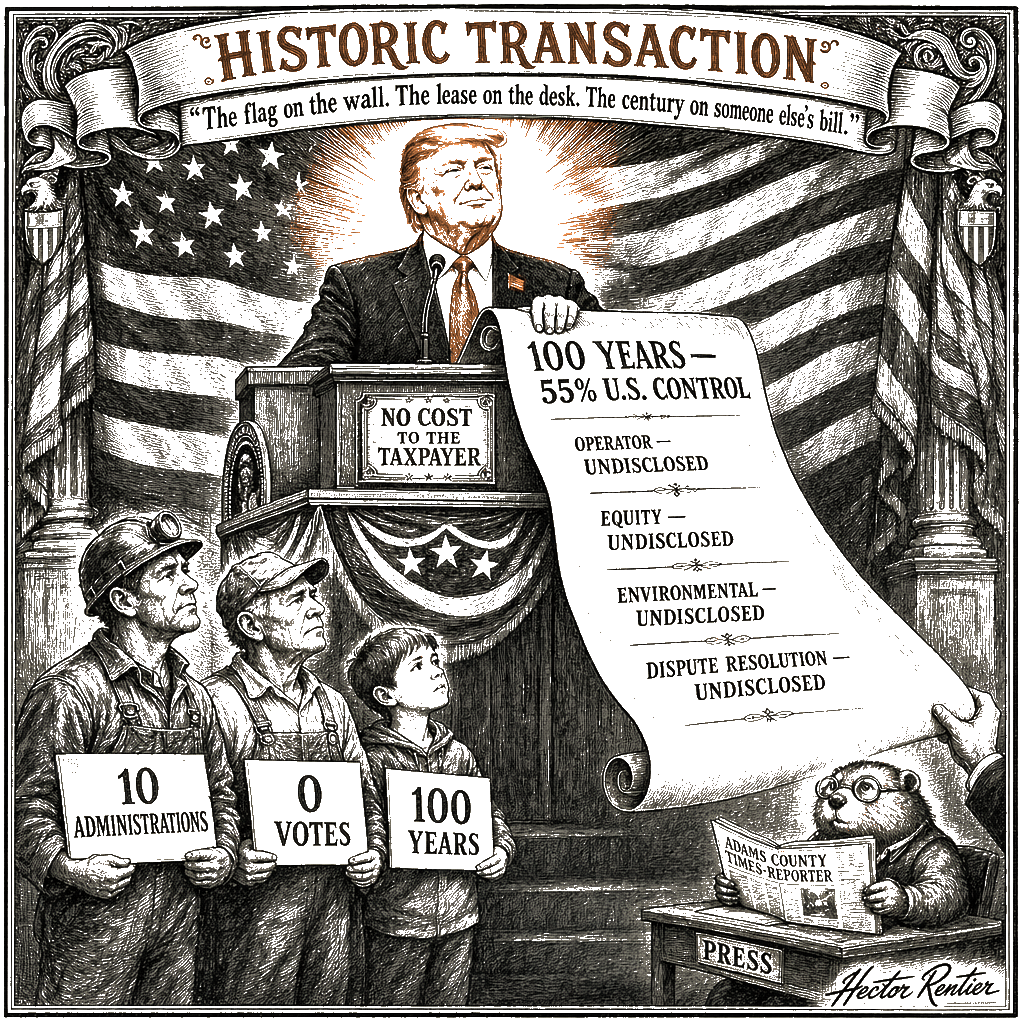
Trump seized Venezuela’s oil by force and gave a private joint venture a hundred-year lease.
I was filling the diesel tank on the Ford at the co-op pump yesterday morning when the second cup of coffee went cold in the cup holder. There’s a little rack by the pump where folks leave the Adams County Times-Reporter when they’re done, and somebody had left the front page folded to the story about the deal. I read it twice and bought a paper for the bench.
The story is this. Last week President Trump announced that the United States had reached an agreement with Venezuela covering more than sixty-five billion barrels of proven oil reserves and called it a “Historic Transaction.” A US official briefed CBS that Venezuela’s interim president, Delcy Rodriguez, had granted a private joint venture a hundred-year concession on sixty-three billion barrels of Venezuelan petroleum, with the United States keeping fifty-five percent of the control — split between equity in the venture and the right to obtain oil at cost. Secretary of State Marco Rubio called it “a huge win for both the American and Venezuelan people.” Trump said the agreement was reached “at no cost to the American Taxpayer.”
It came eight months after the January third US military operation that removed Venezuelan president Nicolás Maduro and his wife Cilia Flores from power. In the hours after the raid, Trump said his administration would run Venezuela until a “safe, proper and judicious transition” could take place, and that the United States would indefinitely control the sale of the country’s oil. Yesterday’s proposed US stake in seventeen Venezuelan fields covering ninety billion barrels was the run-up. Today’s announcement is the close. Venezuela sits on the largest proven oil reserves in the world — an estimated three hundred and three billion barrels — and output had already climbed to one-point-two-three million barrels a day by mid-August, the highest since 2019. The trend line was already moving before the deal.
The first question is the mechanism. Will I see lower gas at the pump on Highway 13? Let me walk you through what has to happen between a barrel of Venezuelan crude and the price I pay at the Friendship BP. The barrel has to ship — most Venezuelan crude is heavy, and it goes to the Gulf Coast because that’s where the cokers are configured to refine it. Then it has to be refined, distributed by pipeline to the Midwest, trucked to a terminal, trucked again to my station, marked up by a retailer trying to pay his own bills, taxed by the state and the federal government, and sold to me at whatever the market will bear. The joint venture’s “at cost” oil is one slice of that — maybe a third, maybe less. The other two-thirds are refining, distribution, retail markup, and tax. If those layers hold their margins — and they always hold their margins, because the consolidated firms at every link have the market power to do so — then the wellhead price barely moves my pump price.
I’ve been here long enough to remember the last time the federal government said domestic production would deliver cheap gas. The shale boom of the 2010s drove US crude production past Saudi Arabia. The wells were real. The debt was real. My pump price did not collapse. The mechanism that gets wellhead crude to my tank held its margins at every step, and the dividend went to operators, refiners, and hedge funds, not to the family on the section-line road. I paid three-fifty-something for diesel yesterday. I paid three-something for gas. The numbers on the pump don’t read like a country that just took control of sixty-five billion barrels of foreign oil.
For Adams County specifically: the farm diesel for spring planting, the LP that heats homes off the natural-gas grid, the gasoline that runs the school bus fleet and the county highway trucks and the pickup of every neighbor with a fifteen-mile commute — those are the prices this deal is supposed to bring down. If the mechanism works, the Adams-Friendship Area School District’s transportation budget gets a break. If the mechanism works, the farmer on County G pays less to put in his corn. If the mechanism works, the widow on the south end of Friendship who heats her home with LP pays less in February. Those are real effects, and they would matter.
But the second question is the audit. Because the deal’s terms have not been released. The “experienced private operator in Venezuela” — the company that will actually run the operation — has not been named. The equity structure between the US government and that operator has not been disclosed. The governance arrangements have not been disclosed. The environmental provisions have not been disclosed. The dispute-resolution mechanism has not been disclosed. The mechanism by which the fifty-five percent American equity converts to actual pump-price relief in Adams County has not been described. And a hundred years is a long time for a deal whose only public document is a press release and a social-media post.
The third question is the authority. A hundred-year concession on a foreign country’s primary natural resource is not a routine executive action. The Constitution gives the Senate the power to ratify treaties — Article II, Section 2. A deal that binds the United States through ten or twelve presidential administrations, that commits American taxpayers through multiple generations, that hands equity to the federal government in a foreign extraction operation — that is the kind of commitment the founders wrote the treaty power to handle. Whether this particular deal is a treaty or an executive agreement is a question that should be answered before the first barrel flows. The administration has not answered it. The Congress has not been asked.
The fourth question is the contradiction. This is what gets called the nationalist shell game — nationalist rhetoric while the multinationals name the policy. The promise of “drill baby drill” has been delivered as a deal that hands a foreign country’s oil to a private operator. The promise of “no more foreign wars” was answered with a January military operation that removed a foreign head of state eight months before the deal was signed. Anyone who heard both promises and is now reading both deliveries should be asking the same question. Wendell Berry named the move in The Unsettling of America in 1977 — the imperial-extractive mind that treats land and people as expendable inputs to a corporate balance sheet, with the flag wrapped around it for marketing. The flag is the same. The corporate balance sheet is the same.
I am not against cheap gas. I run a one-man shop; I drive sixty miles a day; I fill the Ford at the co-op pump and I watch the number on the pump the way every other person in this county watches the number. I am against a deal I cannot read, that nobody in Adams County will ever vote for or vote out, that hands a hundred years of a foreign country’s oil to a private operator whose name has not been disclosed, secured by a military operation whose justification has not been examined, and sold to the American public on the promise of cheaper gas at a moment when every prior promise of cheaper gas has been eaten by the consolidated layers between the wellhead and the pump.
The hundred-year deal will outlast me. It will outlast Mike, who is eight. It will outlast Quinn, who is five. It will outlast the rack by the co-op pump where somebody left the Adams County Times-Reporter yesterday morning. The deal is bigger than the people who made it and bigger than the people who will live under it. That is the part worth sitting with. The people who made the deal won’t be alive to be held to it. The people who will live under it won’t be alive to vote for it. That is not how a democracy is supposed to run. That is how an empire runs.
I will be at the bench tonight, with the Times-Reporter open to the front page and the coffee reheated. If the terms of this deal are released, I will write about them. If the equity structure is disclosed, I will write about it. If the operator’s name comes out, I will write about it. If the constitutional question is answered in Congress and not by tweet, I will write about that too. Until then, I have what you have — a press release, a social-media post, and a hundred-year promise of cheaper gas that the consolidated layers between here and the wellhead have every incentive and every market power to eat.