This administration is sending Afghan war allies to the Central African Republic.
By the weekend a U.S. deportation flight had touched down in Bangui with twelve Afghans, eight Iranians, and several Nepalis and Nicaraguans aboard. The press had their story ready before the wheels stopped turning: another entry in the long ledger of cruelty that critics insist the administration is compiling. The story is right this time. The man at the center of this case — the Afghan in his early twenties whose brothers served alongside American troops — was exactly the wrong passenger to send to a country in Central Africa. Not because he was dangerous. Because America sent his brother home in a flag-draped box, and the administration is now sending the rest of the family to a country where they have no ties, no language, no community, and no one who knows their names.
The basic facts are on the record. His family in Afghanistan drew Taliban threats because of work performed for the U.S. military. One brother lives in the United States and served in the Afghan National Army, which fought alongside American forces until the Taliban returned to power in 2021. Another brother was a pilot trained by U.S. instructors and was killed by the Taliban. A U.S. immigration judge, weighing those facts, granted the younger brother withholding of removal — protection against being sent back to face the same people who killed his family. That ruling is the law. It is a federal court order entered under the immigration statutes of the United States. It was not honored.
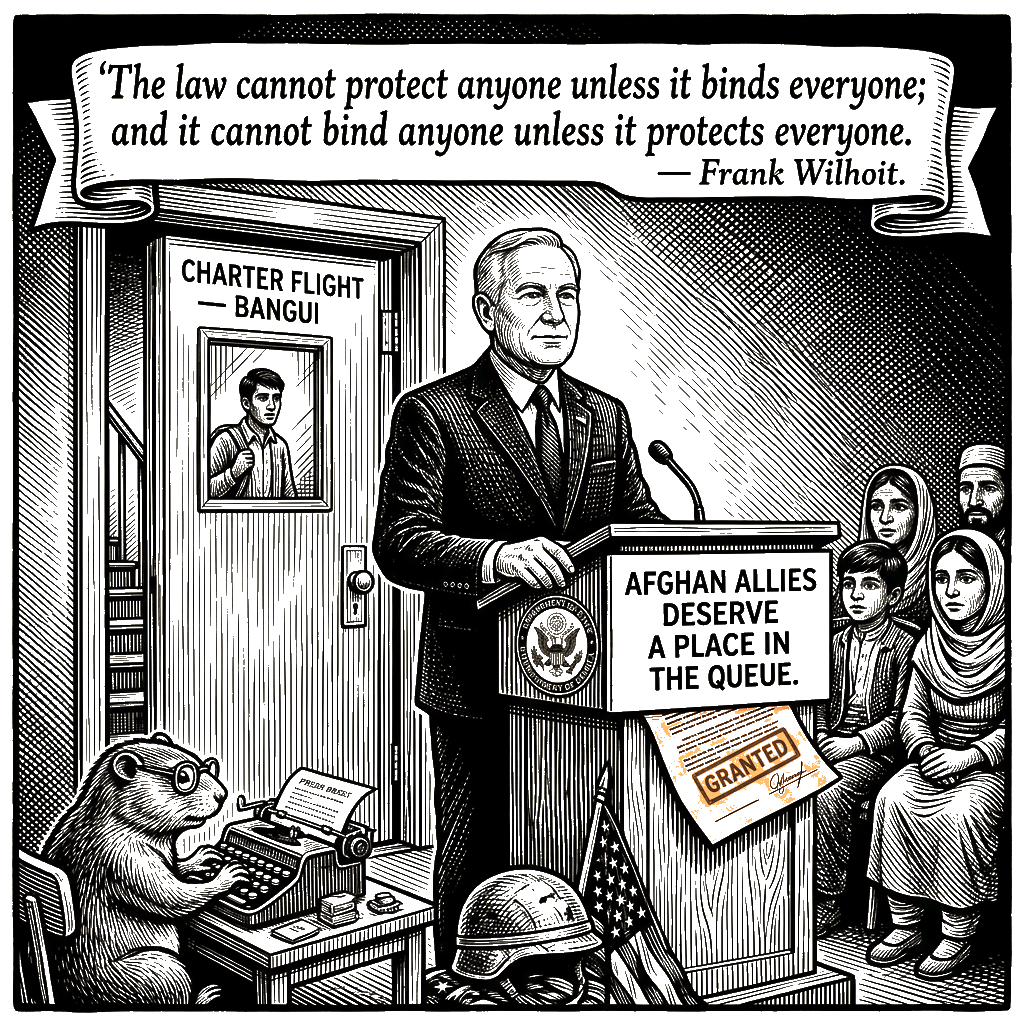
What the administration built instead is what has been called, accurately, a third-country pipeline — secret bilateral agreements, two dozen receiving countries, chartered flights that land where no press is watching. The earlier Bangui flight in June carried two dozen migrants, including an Iranian woman whose own government wanted her silenced. This weekend’s flight is the second to the Central African Republic since June. From the early discussions about moving Afghans out of Qatar to the expanded African deportation routes through Cameroon, the pipeline has been running for months. Marco Rubio spent the spring publicly defending the principle that Afghan wartime allies deserve a place in the queue; in those months, the administration was already building the pipeline that would put those allies on planes to Central Africa. The only thing that changed on Saturday is that the pipeline finally reached a name, a face, and a lawyer with a press quote.
The lawyers and the advocacy groups the administration is ridiculing for filing emergency motions are doing the work the Constitution assigned to them. Human Rights First’s director of policy, Savi Arvey, has called the practice of deporting people to countries that are not their own a legal loophole used to indirectly return asylum seekers to the countries they fled. Alma David, the attorney for the deported Afghan, has said what the record says: her client was granted protection against deportation to Afghanistan. She does not say he was granted asylum, because he was not. The distinction matters. Both of them are right. Both of them are doing the work of a country that has forgotten how to do it for itself.
You know what the tradition calls this. The Hebrew prophets called it the oppression of the stranger and the crushing of the needy. The Torah says it thirty times — love the stranger, for you were strangers in the land of Egypt. Leviticus 19 reads, word for word: When an alien resides with you in your land, you shall not oppress the alien. The alien who resides with you shall be to you as the citizen among you; you shall love the alien as yourself, for you were aliens in the land of Egypt: I am the Lord your God. The repetition is the point. It does not say love the alien unless his brother died in American service. It does not say love the alien unless the alien’s last name is convenient on a campaign poster. It says love the alien. Thirty times.
Jesus says it once, in Matthew 25, and never again needs to: I was a stranger and you did not welcome me. The King of the gospel is not making a foreign-policy observation. He is naming the people who stand at the judgment seat and say Lord, when did we see you a stranger? and discover they saw Him in every face they turned away. The stranger in Bangui is not a Christian category. The stranger in Bangui is a human being made in the image of God, and the image is in him whether the administration’s lawyers have noticed or not.
Romero, the week before they killed him for it, sent word to the soldiers of his own country’s army: In the name of God, in the name of this suffering people whose laments rise to heaven each day more tumultuous, I beg you, I beseech you, I order you in the name of God: stop the repression. He did not ask the soldiers whether the orders they were following were lawful in some technical sense. He asked them whether what they were doing was moral. The immigration officers loading a charter in Bangui are not soldiers in El Salvador in 1980. But they are not different from them either. They are following orders. The orders are lawful in some technical sense. The orders are immoral.
Francis, at Lampedusa, named the condition the globalization of indifference — we have become used to the suffering of others: it doesn’t affect me; it doesn’t concern me; it’s none of my business. The indifference has a face now. It is the face of the young Afghan whose brother the Taliban killed for flying American helicopters. It is the face of the Iranian woman whose own government wants her silenced. It is the face of the Nepali and the Nicaraguan the American public has been trained not to see.
Let me put this where it belongs. The United States of America sent young men and women into Afghanistan for twenty years. The United States recruited allies among the Afghan people, trained them, equipped them, and told them that what they were doing mattered. Some of those allies paid for the alliance with their family’s lives. The administration now proposes to reward that alliance by sending the survivors to a country whose name most of them could not have found on a map six months ago. This is not the enforcement of the immigration laws. This is the betrayal of an ally. This is what the prophets were sent to name.
The principles are not new. The Mexican bishops and the U.S. bishops in their 2003 letter Strangers No Longer set out five of them together: people have the right to migrate to support their families when they cannot do so at home; sovereign nations have the right to control their borders; refugees and asylum seekers should be afforded protection; the human rights of the undocumented should be respected. Every administration has fallen short of those principles. The withholding-of-removal statute has been honored in the breach by administrations of both parties. None of the five principles says that the families of men who died in American service should be sent to a country in Central Africa to satisfy a removal quota. All of them say the opposite.
What would a humane immigration policy look like here? It would look like honoring the federal court’s order. It would look like offering the young Afghan whose brother died what the United States offered his family in the first place: a place in the country his brother died defending. It would look like ending the third-country pipeline and bringing the people on these flights home, where the courts have already said they belong. It would look like the United States stopping the practice of recruiting allies abroad and then forgetting their names at the gate.
I am a Mexican-American Catholic who grew up in El Paso, and I will tell you, in my own voice, what this looks like from where I stand. I watched classmates disappear in pre-dawn ICE raids when I was a boy. I held a dying Iraqi child in my arms after a misidentified airstrike, because I was the medic, and the medic was the one who held the dying. I came home and rebuilt my life around the people the country has agreed not to see. None of that gives me standing to forgive what is happening in Bangui. None of that lets me look away from it. The country that built me is doing this. The country that built me is sending the brother of a man the Taliban killed for flying American helicopters to a country in Central Africa, and calling it the rule of law.
I will tell you what Romero would say to the officials making these decisions, and I will borrow his words because they are the right words and they have not yet been improved upon: In the name of God, in the name of this suffering people whose laments rise to heaven each day more tumultuous, I beg you, I beseech you, I order you in the name of God: stop this.
The door of return is open. It has always been open. The administration can stop the flights. The administration can honor the federal court’s order. The administration can offer the survivors of American wars what the country owed them in the first place. It is not too late. It is not too late because the door has been open the whole time, and the people walking toward it are the same people who have always walked toward it — in the deserts and the detention centers and the warehouse courts where the docket is six thousand cases long and the answer is always the same.