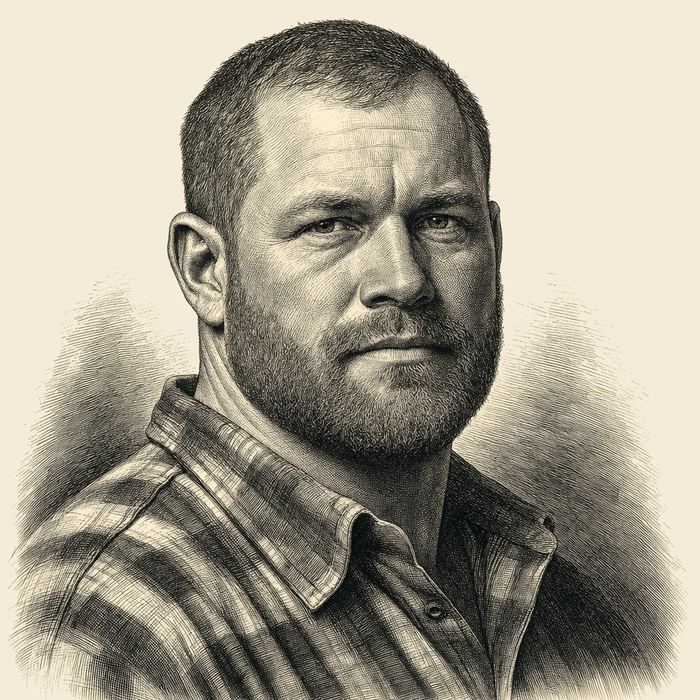
Christopher Harborne is buying Britain’s defence policy with his defence-industry portfolio.
I was under a transmission last Tuesday when a man I’ve changed oil for fifteen years came into the shop with his daughter. She needed steady hours, he said. The plant — and we don’t even say the name anymore, just “the plant,” same as you’d say “the post office” — used to build things for a company that built things for the government. The contracts left. The jobs left. The daughter is twenty-two and working two jobs and wondering if her younger brother is going to sign the recruiter’s paper the way his cousin did.
I’m thinking about that girl because I read a story this week about a man in Bangkok who owns fifteen per cent of a company called QinetiQ. QinetiQ runs the Hebridean missile ranges, develops the stealth technology for Britain’s nuclear submarine fleet, maintains the RAF’s Typhoon jets, and builds the drones the company says are “redefining warfare.” It was carved out of the Ministry of Defence under Tony Blair and sold to the private sector. The man in Bangkok — Christopher Harborne — holds about four hundred million pounds’ worth of it. He also runs Pentagon jet-fuel contracts in sixty-two locations worldwide, through a company called AML Global that he built after leaving McKinsey in the late nineties. And he bankrolls Reform UK to the tune of two-thirds of its money.
Farage is open about it. “Christopher Harborne is an immensely successful man,” he told the Triggernometry podcast. “They all say crypto, but actually that is but a part of what this guy does… I think he probably owns the biggest jet refuelling operation in the world.” Reform’s June 2024 manifesto pledged exactly what Harborne’s portfolio would benefit from: increased defence spending, “incentives and tax breaks to boost the UK defence industry,” a “Joint Acquisition Corp” to “ensure world-class procurement.” Farage took a five-million-pound gift in 2024, and the MPs’ watchdog is now investigating it. Farage decided he did not need to declare it after winning a parliamentary seat. A Reform spokesperson said Harborne had not discussed defence policy with party officials. Harborne’s lawyers at Schillings said his commercial interests are “unconnected in any way whatsoever” with his political affiliations. That is a lot of “unconnected” for a man whose companies profit from the policies in question.
When the Trump administration raised doubts about the Chagos Islands handover — home to a vital US-UK military base — Farage boarded one of Harborne’s Gulfstreams and flew to the region to protest. Reform’s deputy leader Richard Tice has pledged to tear up the deal. Boris Johnson took Harborne to Kyiv in 2023, and Harborne told the Daily Telegraph he told President Zelenskyy, “I’m absolutely passionate that Europe has to defend itself.” The British national-security network behind him is exactly the kind of allied cooperation Western defence ministries say they want: AML Global’s leadership includes Scott Elder, a retired US Air Force colonel who served as Pentagon host-nation liaison at the embassy in Bangkok from 1996 through 2011 — the year Harborne took Thai citizenship. Harborne’s Subsea Resources co-director was David Charters, listed in official filings as a Foreign Office veteran, the polite British locution for MI6. His replacement on the board was Tim McClement, a recently retired Royal Navy vice-admiral whose war service included sinking the Belgrano as a submariner in the Falklands. Another early director, Arthur Napolitano, trained at Sandhurst and served in the Queen’s Dragoon Guards before going on to the Sultan of Oman’s land forces. Paul Chambers, the University of Oklahoma scholar who was forced out of Thailand last year for the crime of studying it, put it plainly: the Royal Thai Air Force interacts with Harborne’s firms for “global logistical support, international flight operations, and overall air transport administration.” When commentators call this a concern, they are denouncing the very allied logistics they celebrate when an American prime does it.
Now here is the thing about all of that, and it is the thing that matters whether you live in Birmingham or Atlanta or any town a military base used to mean a paycheck. When one man’s checkbook can determine a country’s defence policy, the money that buys the policy is the money that doesn’t fix the roof at the local VA. It is the money that doesn’t hire the school counsellor. It is the money that doesn’t keep the youth centre open so that twenty-two-year-old girl doesn’t have to wonder whether her brother is going to come home from a war somebody’s portfolio made profitable. The plant closed in my customer’s town because the contracts went to a prime contractor that doesn’t make things there. The plant closed in a hundred towns. The donor didn’t notice. The donor’s planes kept flying.
Sam Power, a political-funding academic at Bristol, conceded on the record that “it doesn’t necessarily follow that Reform will have policies that will benefit Harborne’s interests in the military-industrial complex” — and then urged a “spotlight” anyway. Jerry McGinn, who used to run procurement at the Pentagon and now works at Washington’s Center for Strategic and International Studies, confirmed the government’s position: “The government vets these companies. They take this very seriously.” The vetting is supposed to be the answer. The spotlight is supposed to be the protection. But the question is not whether the Pentagon vetted AML Global. The question is why a political party can be bought by a man whose companies profit from its policy platform, and nobody is allowed to call that what it is.
Dwight Eisenhower, a five-star general and a Republican president, stood in front of the American people on January seventeenth, 1961, and warned of “the acquisition of unwarranted influence, whether sought or unsought, by the military-industrial complex.” He had just spent eight years running the Cold War. He knew what he was looking at. Sixty-five years later, the British variant of the same complex is on display: one donor, one party, one portfolio, one manifesto. The complex has learned to speak with a British accent. It has not learned to be honest.
From where I sat in the gunner’s seat of an Abrams tank in 2003, the military-industrial complex was not an abstraction. It was the fuel contract. It was the contractor who got paid whether the convoy arrived or not. It was the private security firm driving past our checkpoint in a vehicle we couldn’t afford. It was the sergeant who came home and couldn’t get an appointment at the VA. The people who sent us to war made money. The people who fought it paid the bill. That pattern is not American. It is not British. It is the price of letting the business of war become the business of one man’s portfolio.
The question working people should ask is not whether Christopher Harborne is a crook. The question is why a man who owns the fuel supply, the privatised defence contractor, the political party, and the manifesto gets to set the terms of what your country’s army does next. That is not a corruption story. That is a stress test. And the British state can either treat it as a scandal to manage or as the cheapest, clearest drafting instructions for defence-procurement transparency it will ever receive. A donor’s portfolio intersecting this openly with the defence policy of a party polling in double digits is the world Eisenhower warned about, wearing a British accent. The plant closed in my customer’s town because the contracts went somewhere else. The daughter is working two jobs. The brother is eighteen. The donor’s planes kept flying. The bill keeps coming due.