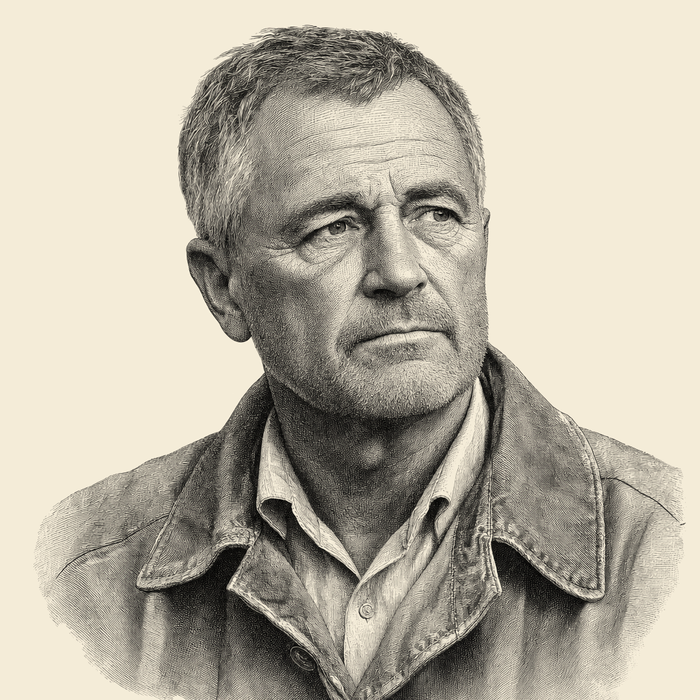
He did not donate to Reform UK. He bankrolled it. Roughly two-thirds of the party’s declared funding flows from his companies. He gave Nigel Farage £5 million — a gift the MPs’ watchdog is now investigating. He flew Farage on a private jet to the Chagos Islands to register a public objection to a policy he opposed. Reform’s June 2024 manifesto reads like a procurement wishlist for the donor’s portfolio. This is not a donor. This is a patron, and a patron’s interests become the policy whether or not anyone signs the paper.
Start with what Harborne actually owns. He is the largest minority shareholder in QinetiQ, holding fifteen percent worth roughly £400 million. QinetiQ was carved out of the Ministry of Defence under Tony Blair and still runs the Hebridean missile ranges, develops stealth capability for the nuclear submarine fleet, maintains the RAF’s Typhoon fleet, and builds the drones the company boasts are “redefining warfare.” Harborne has added a stake in a former Royal Marines reservist’s “Iron Man” combat-suit company and a slice of a Starlink rival. He is constructing a military-industrial position across the United Kingdom, and he is doing it with British pounds that will, if Reform ever takes power, be steered by a party he largely finances.
Then there is AML Global, the jet-fuel brokerage Harborne founded in Thailand after stints at McKinsey, PepsiCo, and the markets. US government data show Pentagon fuel contracts worth more than $140 million since 2013, with awards clustered late in Trump’s first term and continuing since. The firm’s Northern Irish partner Jet Assist boasts that no other company supplies the US military with jet fuel in more places — sixty-two by the end of 2025. The firm’s vice-president is a retired US Air Force colonel who served as a Pentagon “host nation liaison” at the US embassy in Bangkok from 1996 to 2011, the years Harborne arrived in Thailand and took Thai citizenship. The firm lives inside the Pentagon’s supply chain by design — and the Pentagon’s startup spending has tripled and yet remains under one percent of the overall budget, which tells you whose supply chain still runs on relationships vetted in places like Bangkok.
Read Reform’s June 2024 manifesto against that portfolio. The party pledged increased defence spending and “incentives and tax breaks to boost the UK defence industry.” It promised to “improve equipment self-sufficiency and manufacture world-class products for export” and to set up a “Joint Acquisition Corp” to “ensure world-class procurement.” Each of those commitments — defence spending, defence-industry incentives, export promotion, procurement reform — would directly benefit QinetiQ and the rest of Harborne’s holdings. The manifesto does not name them. It does not need to.
Farage has been unusually candid about whose interests he is saluting. On the Triggernometry podcast in July he called Harborne “an immensely successful man,” name-checked the QinetiQ stake, and volunteered that Harborne “probably owns the biggest jet refuelling operation in the world.” When Trump bombed Iranian nuclear facilities, Farage urged the British government to commit forces. When Trump objected to the Chagos Islands handover, Farage flew on a Harborne jet to the region to protest. Reform’s deputy leader Richard Tice has said the party would rip up the deal if it took office. The choreography between donor and leader is no longer subtle. This is also a leader who has previously failed to declare benefits from a convicted fraudster — a pattern the latest denial does not dissolve.
The Thai angle is darker still. Paul Chambers, a Thai-military expert at the University of Oklahoma who fled the country under army pressure, said Harborne maintains a business relationship with the Royal Thai Air Force through AML Global and Sherriff Global Group. Neither Harborne’s lawyers nor the Thai air force would answer questions. Back in the UK, early corporate filings trace a Harborne board seat at Subsea Resources alongside a co-director described at a security conference as “a former MI6 intelligence officer.” When Harborne gave up that seat, his replacement was a recently retired Royal Navy vice-admiral whose exploits included sinking the Belgrano. This is a network that runs through former UK and US security personnel as a matter of design.
Sam Power, a political-funding expert at the University of Bristol, put it cleanly: “It doesn’t necessarily follow that Reform will have policies that will benefit Harborne’s interests in the military-industrial complex. But it warrants a spotlight.” The alignment is no longer interesting. It is here. The £5 million man is not a mystery.
Now hear the defence, because the donor’s defenders are not stupid and the steelman has real teeth.
The Pentagon, the most paranoid procurement bureaucracy on Earth, vetted Harborne’s fuel operation across sixty-two locations and continues to treat it as a trusted supplier. The Department of Defence buys more jet fuel than any entity on the planet and chooses to buy it from this firm. A suspicious-activity report filed by bankers in 2014 under his Thai name, Chakrit Sakunkrit, produced twelve years of prosecutorial silence from every authority with jurisdiction. The Electoral Commission is now examining the £5 million gift as a routine process, not a verdict — and the Commission itself flagged it, which is how the system is supposed to work. Both men say the gift is unconditional. To treat their joint denial as evidence to be set aside because the donor-benefactor relationship is inconvenient for the donor-benefactor’s critics is not journalism. It is wishful prosecution.
The defenders are also right about one thing the counter-narrative will not concede: under the rule this story would impose, every defence-sector donor in Britain is a scandal, every defence-sector voter is suspect, and the only fit funder of a defence-expansion party is someone with no defence investments at all — a category that does not exist. That rule is incoherent. Its function is not principle. Its function is disqualification before a general election. The machinery of politics trying to make patriotism a crime is a real machinery, and it does not care about the conservative principle either. The fact that the disqualification rule is incoherent, however, does not dissolve the underlying arrangement. It only tells you whose side the searchlight is shining from.
Now the harder answer, the one the donor’s defenders do not want to give.
The conservative tradition I was raised in — Belloc against the servile state, Chesterton against the concentration of capital, Brandeis against the curse of bigness, Pius XI on subsidiarity, the co-operative founders on one-member-one-vote — does not stop at the factory gate. Belloc’s distributist principle was that ownership should be spread so widely that no single block of interests could dominate the means of life. He meant the economy. He meant the press. He meant the polity too. When two-thirds of a party’s declared funding flows through one man’s companies, the party is no longer a coalition of citizens pooling small contributions toward a common platform. It is a subsidiary. And a subsidiary does not say no to the parent.
I have watched this in my own country. The Republican Party in the United States has spent forty years discovering what concentrated donor power does to a coalition. When a single donor can fund a Super PAC, the Super PAC funds the primaries, the primaries select the candidate, and the candidate governs for the donor’s portfolio. The conservative critique of that arrangement is not that it is left-wing or right-wing. The conservative critique is that it is unconstitutional in the deeper sense — it dissolves the citizen’s standing into the customer’s standing. A party that cannot say no to one man cannot say yes to its members, its voters, or its country. That is what Belloc called the servile state, and it has nothing to do with which uniform it wears.
The donor’s defenders will tell you the donor has not lifted a finger to influence policy. They may be right. They are also missing the point. The structural fact is the structural fact. A party financed this way has no mechanism by which to say no to its financier, because the financier can always withdraw the next cheque. The choreography Farage insists is not happening is the very thing the structure guarantees.
I run a farm co-operative in a small Wisconsin county. I will spare you the lecture on what one-member-one-vote looks like on the ground, except to say this: it does not work because the members are saints. It works because no single member can buy enough votes to capture the board. The principle is older than the Rochdale Pioneers and sterner than any watchdog. It is the principle that has governed every mutual aid society, every credit union, every farmers’ co-operative, every building society in Britain since 1844. The same principle Pius XI wrote into Quadragesimo Anno in 1931 — that higher bodies should not absorb what lesser and local bodies can perform. A party funded the way Reform is funded is the inverse of subsidiarity — a higher body absorbing the lesser members and answering only to one.
The defence the donor’s defenders mount is the right defence to make against the establishment’s hypocrisy. It is the wrong defence against the conservative test. The conservative test is older than any party and sterner than any watchdog: no block of interests, however patriotic, however vetted by the Pentagon, however loudly his man calls himself a reformer, should hold the policy of a major British party in one hand and the chequebook in the other.
Let the Electoral Commission do its work. Let the parliamentary commissioner do hers. And let the rest of us remember, while they work, that a conservative politics worth the name is a politics of distributed power — in the economy, in the press, and at the ballot box alike. The remedy is not a louder searchlight. The remedy is what the founders of every mutual aid society in Britain already knew: many small contributions from many citizens, each accountable, none dominant. The co-operative principle applied to politics. The credit union applied to the franchise. The same answer my own co-operative offers the farmer being squeezed by the grain elevator — only at the level of the body politic.
That is the test the £5 million fails. Not because the donor is foreign, or corrupt, or unfit — the prosecutors have looked for twelve years and have not found it. Because the conservative principle is older than any party and sterner than any watchdog. Because a democracy that cannot function without one man’s check has lost the habit of distributed life. The £5 million man is not a mystery. He is exactly the kind of patron Belloc warned us about. The story being told this week is not a scandal uncovered. It is a scandal that cannot be uncovered, told as if it had been — by the same political class that helped build the structure it now denounces.