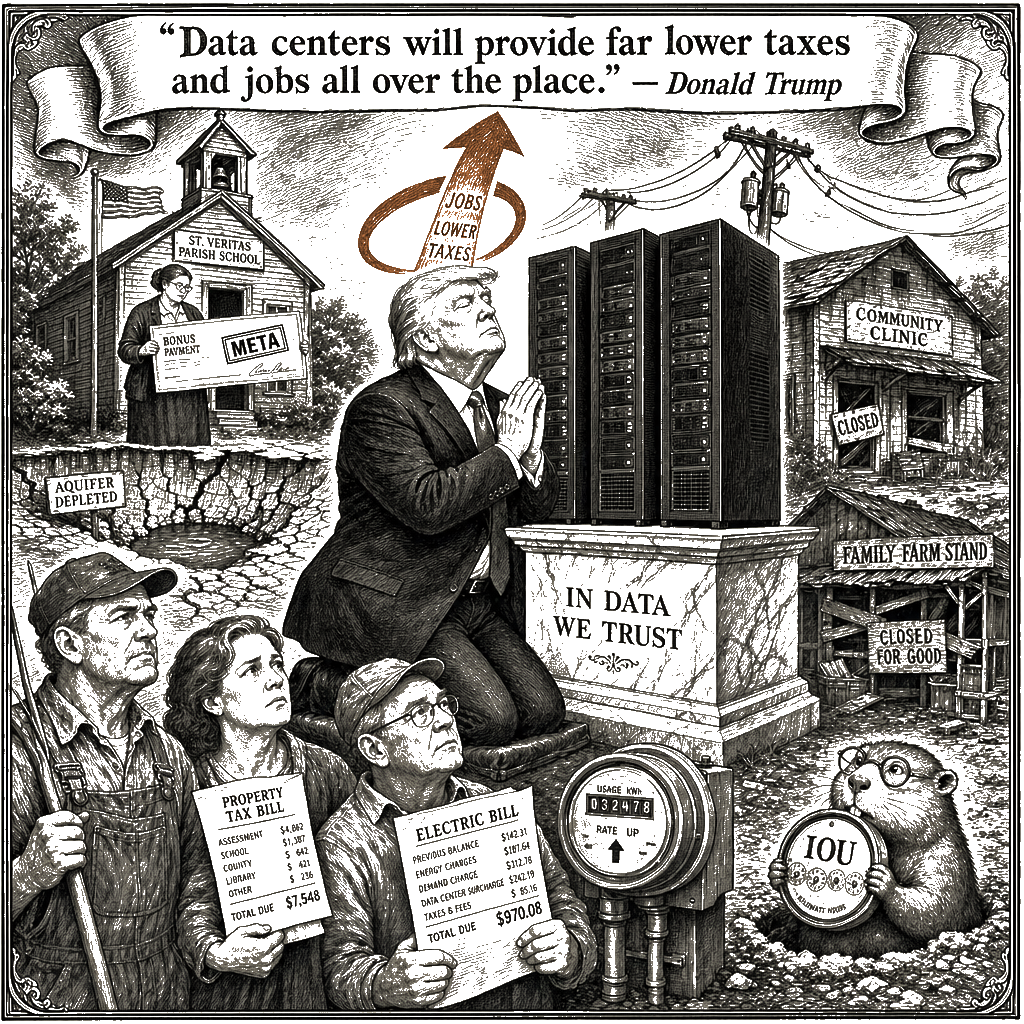
Can the U.S. political system meet the challenges of our rapidly changing age? For the first time in years, the answer looks encouraging—and the latest evidence is the election-year awakening over data centers.
The facilities that resemble enormous warehouses are essential infrastructure for an artificial intelligence apparatus that no one asked for and no democracy voted to install. The U.S. is in an AI arms race with China, but surrendering domestic energy grids and water supplies to an arms race the public was never consulted on is not a strategy—it is capitulation. Without the political courage to rein in the energy hogs and the data centers devouring them, America’s communities and working families will be compromised. A county is not a server rack in that race. The real question is not whether America falls behind China; it is whether Loudoun County falls behind on its water table and Wisconsin family farms get paved over so a data center can serve an advertisement. Somebody was always going to pay. The public has simply decided it will not be the town.
Yet for years, watching the election campaign, you’d think data centers were the greatest civic blessing America has ever received. Politicians who once rubber-stamped them are now scrambling to defend a massive corporate footprint that cannibalizes local power grids and displaces property taxpayers. We were expected to swallow every cost because the centers create jobs and pay local property taxes—as if a few years of construction wages and a revenue stream that evaporates when the servers depreciate were a fair trade for an aquifer.
The political awakening started on the left, and Bernie Sanders is right to call for a nationwide halt to new data centers. He is doing what leadership looks like when it is not on the industry’s payroll. Democrats in Senate races across the country are finally catching up to their voters’ opposition. In Ohio, Sherrod Brown is making the issue the center of his comeback bid against appointed GOP Sen. Jon Husted. Call it a comeback; call it listening.
Even politicians who once courted the industry are turning. Illinois Gov. JB Pritzker once courted data centers with open arms and has now turned them a cold shoulder. Pennsylvania Gov. Josh Shapiro, who has a huge lead in his re-election campaign, this month issued an executive order restricting their development. It is called governing.
Republicans are getting in on the act, because the burden is not partisan. GOP Rep. Tom Tiffany is running ads in Wisconsin in his campaign for Governor calling his opponent “Data Center David Crowley.” “Our lakes run dry, family farms paved over,” says the sober warning. The word from the industry’s defenders is fear-mongering. The word from the people who live downstream is warning—and it is a description, not a prediction.
Texas Gov. Greg Abbott in August paused new construction pending the completion of a statewide audit, citing concerns about data center power and water use. He blamed AI firms: “They basically dug their own grave for the problem that’s been caused for them and that’s why they got the backlash they deserve.” Read that quote again. A governor—no radical, no protestor—is describing an industry that brought its own reckoning on. The backlash is deserved, and it is spreading.
It is true the AI industry has hurt its own cause—but not by peddling speculative anxiety about mass unemployment. The industry has hurt its own cause by building first and asking never, by treating power and water as entitlements, and by failing to explain—because it cannot explain—how a data center benefits the community that hosts it beyond a ribbon cutting and a construction trailer. AI developers have also failed to explain how data centers burden local communities. The larger failure has been the industry’s: the technological and economic transition now underway is real, and it is being managed for shareholders rather than for the people whose land and water the transition consumes.
Against data centers, there is a strong case to be made. The U.S. has more than 5,400 data centers, which are the chokepoints of a digital monopoly and power the AI tools extracting value from your smartphone. Data centers enable mass surveillance on video calls, algorithmic food-delivery monopolies, addictive streaming, and real-time stock manipulation. If data centers were dismantled, the modern monopoly economy would face its first real reckoning. All of it is true—and all of it is an argument for treating these centers like the critical infrastructure they are, with the planning, pricing, and environmental review that critical infrastructure deserves, instead of the rushed gratitude we are asked to perform. If data centers went dark, the modern economy would stumble. If the water and the grid went dark, so would the community. The second sentence matters more.
New large-scale data centers are needed to train and run AI models—not just chatbots. Businesses large and small are deploying AI to boost productivity, and industry leaders increasingly promise to share those gains with workers in higher pay. Cleveland-Cliffs recently announced an upgrade to an Ohio plant that will incorporate AI to lift output and step up compensation. That is the industry’s strongest case, and it deserves an honest answer. One Ohio steel plant gets smarter while whole counties get louder. The productivity gains are real, and nearly all of them accrue to capital. Higher wages inside one plant are real, and nearly all of the surrounding costs are paid by the neighbors. That is the ledger the industry does not want anyone to add up. A community is not obliged to be somebody’s research lab.
Data centers bring high-paying construction jobs, and skilled blue-collar workers are needed to run them. They also bring the noise, the traffic, the transmission lines, the diesel generators, and the housing pressure that follows every boom. For every worker who lands a good maintenance job, a hundred households eat the externalities.
If data centers disappeared from Loudoun County, Va.—known as Data Center Alley—homeowners would need to pay $5,800 more a year in property taxes, according to one analysis. That number is real, and it is the industry’s best argument. It is also the tell. A county whose budget rests on tax revenue from the servers themselves has not found a windfall; it has acquired a dependency. The $5,800 is not a dividend; it is an IOU that comes due the day the industry relocates, the abatements expire, or the servers move. Teachers in Louisiana’s Richland Parish this year received bonuses up to $50,000 thanks to tax revenue from Meta’s AI data center—a dependency that looks less like generosity and more like company-town capture. Celebrate the teachers—and then read the fine print. A rural parish whose school payroll suddenly depends on one company’s construction boom is not a success story; it is a dependence story wearing a success story’s clothes.
Data centers also generate scant pollution, we are assured. Their CO2 emissions mainly stem from the natural gas plants that power them. Modern gas generators still burn fossil fuels, and the claim of 90% less fine particulate matter, sulfur dioxide and carbon monoxide than a steel mill is faint praise—the comparison is to one of the dirtiest industries in industrial history. Ninety percent less than a steel mill is not zero, and the comparison is a sleight of hand. The question was never whether a data center is cleaner than a steel mill; it is whether the megawatts, the emissions, and the water should go to a server farm instead of to homes, hospitals, and farms. The data center gets the flattering comparison; the neighbors get the plant.
Data centers also deploy efficient systems to recirculate wastewater, but they still consume staggering quantities. Microsoft’s new data center in Wisconsin will use about four Olympic swimming pools of water this year—a river diverted for corporate computation. Half as much as a car wash, the industry notes—but half a car wash is not the reassurance it is meant to be, since the car wash serves a town and the data center serves a corporation. Golf courses use about 30 times more water, the industry adds, as if the answer to one subsidy were another. The point was always whose water is next.
Americans are understandably concerned about rising electric bills, and this time the concern is the point, not the problem. Average electric rates nationwide have increased roughly in line with inflation since 2016, with larger increases in the Northeast and California—driven in part by the very climate policies that data center proliferation undermines. A study by the Electric Power Research Institute found that data centers between 2015 and 2024 reduced residential rates by spreading the grid’s fixed costs over a larger electric load. Diluting a cost is not reducing it, and the ratepayers in Virginia, Ohio, and Texas—where the load is actually landing—can check their bills for the benefit. The EPRI window is the industry’s own: 2015–2024, the years the centers looked like a windfall, before the transmission queues, the peaker plants, and the winter bills arrived.
Most data center developers agreed to cover the incremental costs they add to the grid—after years of community backlash forced concessions. The Trump Administration brokered these deals. How generous—the industry will pay for the costs it imposes, as if that were a favor. The government’s job is not to convene the industry and collect voluntary promises. The government’s job is to price the impacts, enforce the review, and make the developers internalize every cost—the power, the water, the land, the noise—before the next shovel goes in the ground. Voluntary cooperation is how we got here.
The surge of opposition to data centers is waved off as misinformation and anxiety about falling behind more than grounded analysis—both driven, in the familiar telling, by the same interests that have championed shale fracking, liquefied natural gas terminals, and other projects that supposedly enhance American prosperity and national security. The fable does a lot of work, and it is working backwards. The people who sought to block fracking said the wells would leak methane, the aquifers would be poisoned, and the oversight was a joke—and they were right. The people who sought to block LNG export terminals said the build-out would lock in decades of fossil-fuel combustion—and they were right. Every time, the same chorus called those people fear-mongers, and every time the fear-mongers turned out to be the realists. Being called part of that company is the highest compliment available.
Mr. Trump is finally speaking up, with a Truth Social post Monday pointing out that data centers will provide “far lower taxes and jobs all over the place.” Please keep it up—and read it for what it is: an industry’s favorite President praising an industry. Far lower taxes is a blessing to the corporations that own the centers and a curse to every county that must replace the revenue when the abatements expire. Lower taxes for whom—certainly not the Loudoun County ratepayers picking up the slack. Mr. Trump warns that if the bipartisan campaign against unchecked data center expansion succeeds, the winner will be the Chinese Communist Party. It is the last resort of every argument that has lost the facts: the flag. If slowing the build-out means Beijing sells more cloud computing, so be it. America’s safety was never secured by a megawatt farm in a cornfield, and it will not be destroyed by a county that asks where its water comes from. The President is right on one point: the winner of this campaign will be American communities. The President is wrong about who is harmed if the communities win. If the communities prevail, the winner is not the Chinese Communist Party. The winner is the ratepayer, the farmer, the homeowner, and the official who finally read the meter.