
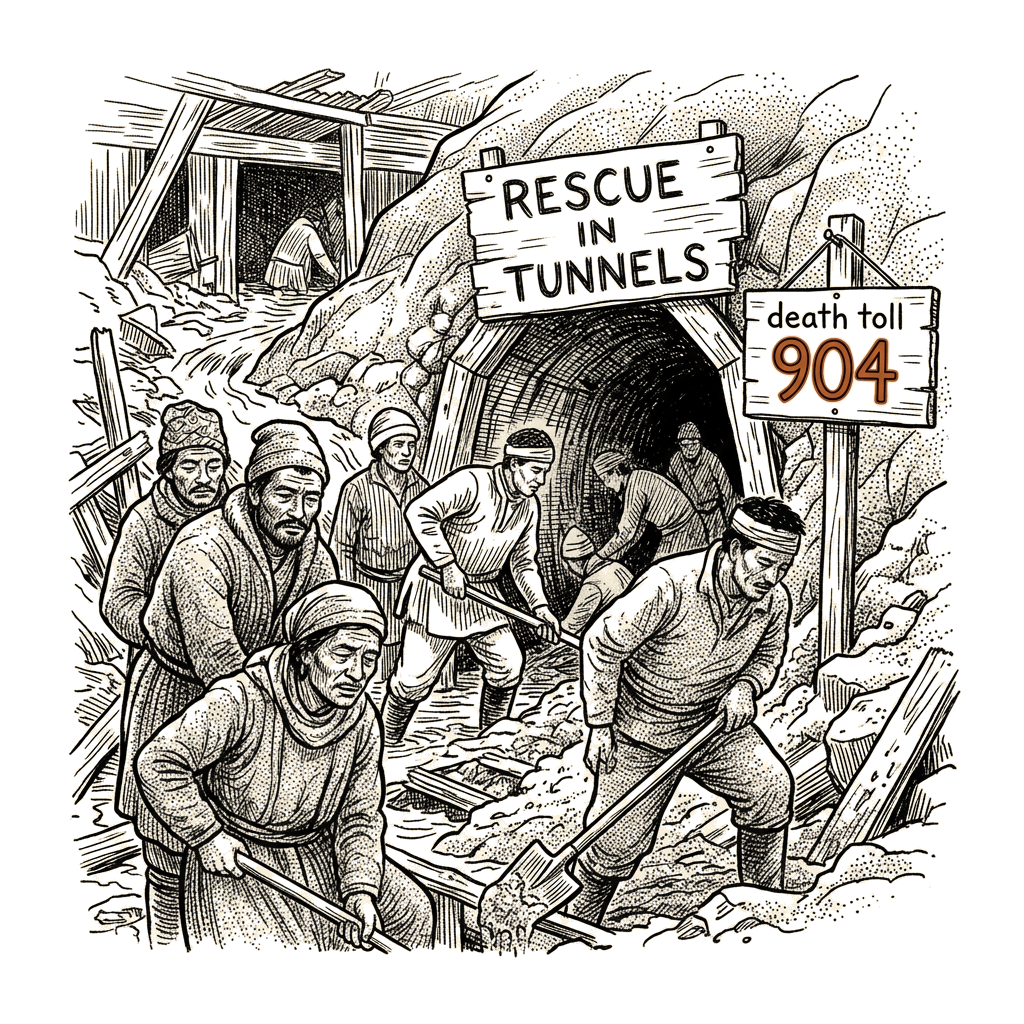
The mountain moved on Wednesday. Nine hundred four are dead. Four thousand two hundred seventy-four are missing. Nine hundred thirty-three workers are believed trapped alive in hydroelectric tunnels. Nepal is going in. The world is looking on.
By Monday morning the count out of Nepal’s border district had crossed a number most readers will struggle to hold. Nepal’s National Disaster Risk Reduction and Management Authority’s 9 a.m. update: 904 dead, 4,274 missing, 267 injured, 18,000 households affected, 17,000 children impacted. Eighteen schools destroyed, twenty more damaged. Twenty-one hospitals holding unidentified bodies. State Department spokesperson Tommy Pigott told ABC on Sunday that 85 Americans are unaccounted for. The broader missing list includes 592 foreign nationals.
Wednesday morning, a glacial collapse high in the Himalayas sent a wall of water through the catchments along the Nepal-China border. The U.S. Geological Survey recorded the event as a 5.2-magnitude earthquake — that is how much force the deluge carried. The mountain didn’t just melt. It moved. Between Sunday and Monday alone, the death toll climbed by more than one hundred, and the missing count grew by more than twelve hundred. The numbers are still climbing.
Buried inside the 4,274 missing is a smaller number that changes the calculus: 933 workers believed trapped alive in hydroelectric tunnels, behind a wall of debris and rising groundwater, in tunnels carved into the mountainside for power generation. The 4,274 are the people who vanished from view. The 933 are the people who may yet be saved.
None of that is the story. The story is what is being done about it — and what is not.
More than 20,500 security personnel are now in the field — the size of a small army. They have already pulled 10,400 people out of the debris, including 252 non-citizens. Of 267 people reported injured, 156 have been discharged. The Ministry of Energy, Water Resources and Irrigation has teams preparing to travel 180 meters from a tunnel portal into the dark, carrying oxygen, medical supplies, communications equipment, and cameras — to look for live workers the surface rescue cannot reach.
Nepal is going in anyway.
If your daughter were 180 meters into that tunnel right now — if her phone hadn’t connected since Wednesday morning, if her lunchbox was still on the kitchen table, if you had heard nothing from her in four days and four nights — you would not be reading this column. You would be in the dark with her, or you would have moved heaven and earth to be there.
There is a taste at the back of your mouth right now — if you are reading this in a country that could send rescue aircraft, that could send engineers, that could send the tunneling equipment Nepal does not have — and the taste is the recognition that you knew, and you did not go. Your shoulders carry it. The stillness in your chest carries it. The scroll of the next headline, already loading, carries it for you, if you let it.
The 933 workers in the dark have done nothing wrong. They went to work on Wednesday morning. Their children packed them lunches. Their wives texted them about dinner. They are underground in tunnels carved for hydroelectric power, behind a wall of debris, in air that is failing — and they are alive, perhaps, possibly, maybe — and they are running out of hours.
The bottleneck is not search-and-rescue. Nepal has assembled twenty thousand personnel, pulled out ten thousand people, and is preparing an underground operation in addition to a surface one. The bottleneck is everything else: identifying the dead, sheltering the displaced, reckoning with a piece of geography that is fundamentally more dangerous than the infrastructure built on top of it — and convincing a world that has already scrolled past that the mountain is still moving.
The 17,000 children will need schooling, trauma care, and years of follow-through. The 18,000 households will need rebuilding that accounts for the next glacial event, not the last one. The hydroelectric infrastructure that drew the tunnels — and the workers into them — will need a national reckoning about what kind of infrastructure is built where.
But the 933 will not wait for that reckoning. The 933 are now. The 933 are this week. The world is going to move eventually. The donor system will convene. The rescue aircraft will arrive. The engineers will follow. And then the cameras will turn, and the world will move on to the next scroll.
The 933 will be a number by then.
Truly I tell you, whatever you did for one of the least of these brothers and sisters of mine, you did for me. — Matthew 25:40
The mountain has spoken. The country is listening. The rest of the world is still catching up.