The authority by which the Department of Homeland Security and the Department of Transportation have moved against the commercial driving schools and the licensing records of immigrant truck drivers rests on the sovereign’s settled power over the alien within the territory. The Supreme Court of the United States has confirmed that power in every generation — in Chae Chan Ping v. United States, 130 U.S. 581 (1889), in Fong Yue Ting v. United States, 149 U.S. 698 (1893), in Knauff v. Shaughnessy, 338 U.S. 537 (1950), and in Trump v. Hawaii, 585 U.S. 667 (2018). The doctrine extends, by the structure of the case, to every lesser measure by which the political branches execute their stewardship of the public road and of the alien’s permission to operate upon it. The licensing of a commercial driver is a public trust. The schools that confer the privilege are stewards of the public’s confidence that the man or woman behind the wheel of an eighty-thousand-pound vehicle has been trained to the standard the road requires. The Secretary of Transportation, Sean Duffy, announced in Detroit this week the emergency shutdown of nearly three hundred such schools. One hundred and ten of them had produced a disproportionate share of applicants who could not pass the English-language proficiency element of the licensing test; one hundred and sixty were operating out of facilities too small or unequipped to train applicants in the operation of a large vehicle. “There’s a new sheriff in town,” the Secretary said. The phrase names the doctrine. The federal authority over the licensing system, and over the alien’s standing upon the public road, is being reclaimed from a decade in which the steward allowed it to lapse.
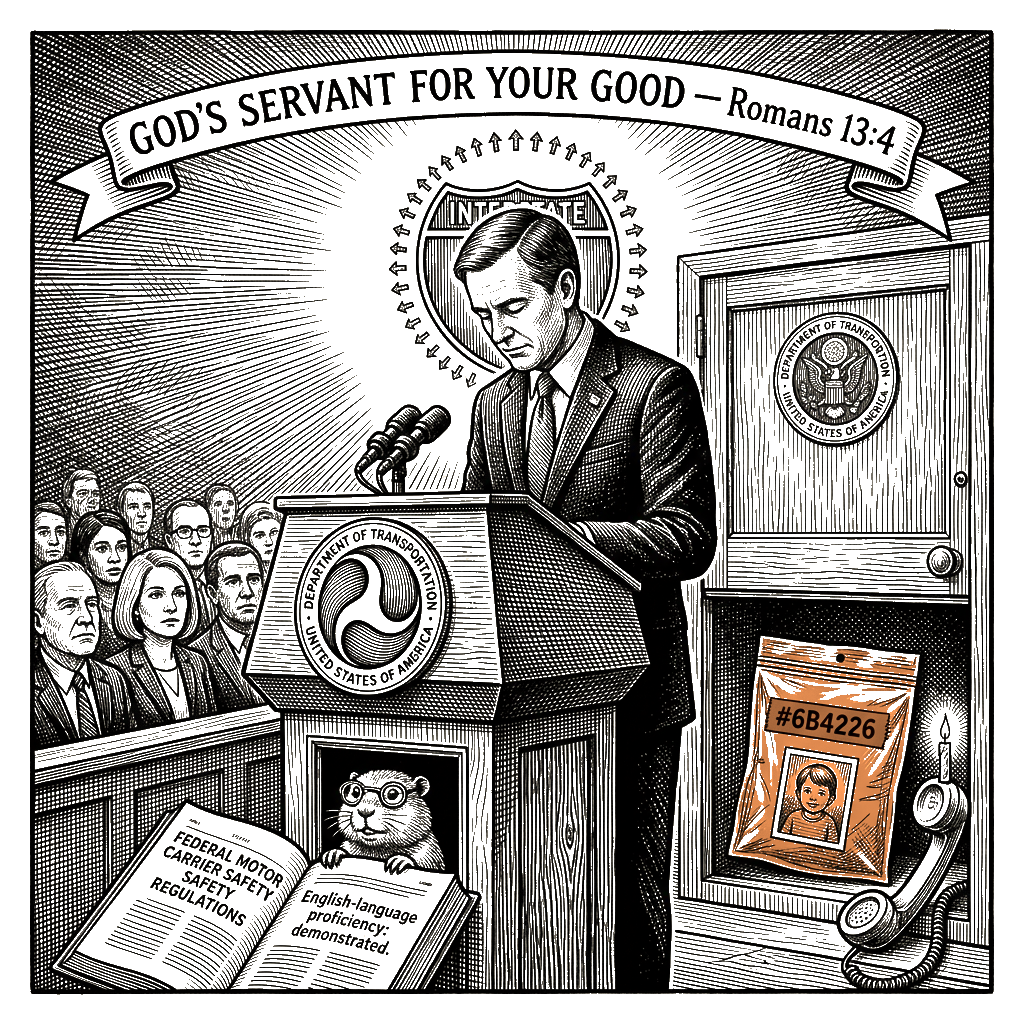
The disorder the steward has been called to remedy is not theoretical. Five thousand three hundred and fifty people died in large-truck crashes in 2024, according to the Insurance Institute for Highway Safety. Three people were killed in Florida in August of last year when a noncitizen driver performed an illegal U-turn and precipitated a six-vehicle collision, according to the Florida Department of Highway Safety and Motor Vehicles; another child was severely injured in California in 2024 in a six-car pileup the Department of Homeland Security attributes to an immigrant truck driver, and she sat beside Secretary Duffy at Monday’s announcement. The road is a public trust. The driver who holds the commercial license holds a delegated portion of that trust. The school that trains the driver holds the further delegated portion. When the trust is betrayed — when the school is too small to train, when the driver cannot satisfy the English-language requirement, when the work permit has expired and the driver continues to operate — the steward of the public road is bound to act. The Secretary has acted. The Department has demanded the records the American Association of Motor Vehicle Administrators holds, the seventeen-million-driver database known as the Commercial Driver’s License Information System, which processes approximately ninety million record checks a month and which has not previously been used for wholesale immigration investigations. The Transportation Department in August threatened to pull the organization’s funding if it did not comply; the Department of Homeland Security issued a subpoena for the same records. Twenty states have sued to block the federal data sharing, arguing the administration is violating federal privacy laws; a federal judge has issued a temporary restraining order pending the September hearing. The litigation is the lawful contest the Constitution anticipates between federal supremacy and state administration. The doctrine is not in doubt. The licensing of the commercial driver is an instrumentality of the interstate commerce the federal government regulates; the administration of the alien’s standing is the sovereign’s prerogative; the two authorities converge upon the man behind the wheel. The Secretary has, alongside the enforcement, announced a “Freedom Haulers” program to fast-track veterans into the empty seats the proper sorting has opened — the steward restoring the work to the household’s own. The magistrate, Paul writes, is “God’s servant for your good” (Romans 13:4). The magistrate’s good here is the good of the citizenry who share the road.
The steward has done what the prior decade avoided doing. He has taken the inventory. He has set the stings upon the highways. In a three-day operation in July across Illinois, Indiana, Iowa, and Ohio, the Department of Homeland Security took 766 unsafe drivers and vehicles “out of service,” detained 51 immigrants whose presence in the country the records confirmed was not authorized, and issued 36 violations to drivers for failing English-language proficiency. The enforcement is the restoration the plenary authority requires. While the Secretary announced the shutdowns in Detroit and the Department issued the subpoena in Washington, the names the database held were already living the standing the inventory would assign them.
He had come to the United States on an H-2B temporary work permit seven years before. He had crossed at the port of entry in south Texas with the visa the consulate had stamped, the contract the staffing agency had prepared, and the intention the visa itself named: to work, and to return. The work was long-haul trucking. He took the commercial driver’s license course at a small school outside Houston, passed the written and the behind-the-wheel, and obtained the CDL. He drove for the same carrier for six years — the long-haul runs that paid by the mile and kept him out two weeks at a stretch. He renewed the work permit twice. The second renewal, filed the year before, sat in the backlog the prior administration’s processing had accumulated. The permit expired. He kept driving. The CDL was still valid. The carrier ran it through the same state system the carrier had always run, and the system cleared him. He did not know, when the expiration passed, that he had crossed from authorized presence into unauthorized presence, and that the highway he drove each week was the highway the federal authority had begun to watch.
He had a daughter, born in Houston the year his second contract was renewed — a citizen of the United States by the place of her birth.
The sting set up on Interstate 70 outside Effingham, Illinois, on a Wednesday in July. The officers of the Department of Homeland Security had the license plate of his tractor from a record check run against the database the subpoena sought to obtain. They pulled him over at the scale house. They asked for the CDL, the medical certificate, the work authorization. He handed over the CDL. He handed over the medical certificate, expired three months earlier, the renewal appointment scheduled for the following week. He handed over the work permit. The officers looked at the permit. They looked at the date. They told him the permit had expired eleven months before. They told him he was under arrest. The officers handcuffed him at the cab of his own truck, in the sight of the other drivers who had pulled in behind him, in the sight of the state trooper who had been detailed to keep the scale-house traffic moving. The officers impounded the tractor. The load — a full freight of refrigerated produce destined for a Walmart distribution center in Indiana — was transferred to another driver. His wallet, his phone, the photograph of his daughter he kept in the visor of the cab, were placed in a plastic bag the officers sealed and numbered. The plastic bag went into an evidence locker at the scale house; the photograph went with it.
The officers took him to the county jail in Effingham, the facility under contract to Immigration and Customs Enforcement to house federal detainees. The holding cell was a concrete room with a metal bench and a steel toilet. The fluorescent light was on continuously; the mattress, when one was issued after the first night, was a thin plastic-covered pad over a concrete slab. The meals were commissary portions — bread, processed protein, rice — insufficient to maintain body weight during the cortisol exposure of indefinite detention. He could not sleep. He could not reach his wife, whose number the officers had allowed him to write on a form the first evening, but the only phone the unit provided was the wall-mounted unit in the common area, and the schedule the unit ran allowed one fifteen-minute call per day, and the line was busy, or the family was not at the number, and the days accumulated. The cells around him held men who had been picked up at factories, at gas stations, at the parking lots of the truck stops along the interstate; some had been in the country twenty years, some had been in the country twenty weeks. The length of the stay was set by the contract that administered the facility, not by the magistrate.
The medical intake had recorded the depression the prior night’s intake nurse had noted on his face. The medical unit at Effingham did not follow up. The unit was two nurses for the housing unit of two hundred and forty men. The unit’s policy was to see walk-ins on Tuesdays. He was added to the Tuesday list. He began to lose weight. He stopped eating the commissary portions in the fourth week. The officer who ran the tier walked past his bunk each morning at six and recorded his weight in the log: down seven pounds from intake in week one, down eleven in week three. The log was sent to the medical unit. The medical unit returned the log with a note that the man was to be added to the Tuesday list.
The Department transferred him after nine weeks to the larger immigration detention center in Louisiana, the facility whose contract supports a parish economy dependent on the per-diem. The facility held eleven thousand men. The medical unit had a two-week backlog for non-emergency complaints. The depression he had begun to feel in the third week of detention had deepened into the gray that did not lift in the morning. The counselors placed him on a suicide watch after he told one, in the second of the two sessions the unit’s schedule allowed, that he did not see the point of continuing. The watch consisted of a room without fixtures, a mattress on the floor, a blanket the guards checked each hour to be sure he had not tied it to the sprinkler head. The light in the room was on continuously. The observation camera in the ceiling ran on a continuous loop the guards monitored from the station down the hall. He was held on the watch for seventy-two hours. The counselors returned him to the general population because the watch had not produced an attempt, and the watch bed was needed for the next referral.
In Houston, his wife was navigating the consequences. The carrier had stopped sending the per-diem the contract specified for detained drivers; the carrier was no longer his employer. The carrier had already replaced his tractor with another man’s. The landlord began eviction proceedings against the apartment in November. His wife moved, with the daughter, into her sister’s one-bedroom. The daughter, who had been read to each evening by telephone from the cab of the truck, asked each night for three months when her father was coming home. The answer her mother gave her was the answer the immigration court had not yet entered.
The immigration court date was set for the following April, nine months away. The bond hearing was held in October. The bond was set at fifteen thousand dollars. His wife could not raise it. The family’s savings had been consumed by the months of detention visits the facility’s distance from Houston had made impractical; the detention facility’s contract required that visits be scheduled three weeks in advance, and the wife made the drive twice. The cost of the gasoline, the lost wages from the days she could not work, and the cost of the lawyer the bond hearing required together exceeded the family’s monthly income in the third month of the detention. The lawyer’s retainer had been the daughter’s college fund. By January the fund was empty.
The daughter’s seventh birthday passed in February. The detention facility did not permit birthday visits. The wife baked the cake the daughter’s grandmother had baked each year of the daughter’s life and set a candle in it, and the daughter blew it out by telephone, her father on the other end, the connection breaking twice during the singing.
By the April court date the daughter had not seen her father for nine months. The court continued the case. The bond remained fifteen thousand dollars. The Department did not release him. The detention continued.
He stands outside the covenant. The license he held was a privilege — a permission to operate, conferred on the alien whose presence the sovereign had authorized and whose authorization had, by the operation of the law the visa applies, expired. The work permit was the privilege. The commercial driver’s license was the privilege derivative upon it. The privilege is revoked when the conditions of its issuance are no longer satisfied. The highway is the public trust the steward administers. The truck is the eighty-thousand-pound instrument of the public trust. The man who operates the instrument holds the privilege the sovereign confers. The privilege was held past its term. The steward reclaimed the privilege. The reclamation is the verdict the standing disclosed.
Scripture names the boundary in the words Paul spoke at Athens, that God “made from one man every nation of mankind to live on all the face of the earth, having determined allotted periods and the bounds of their habitation” (Acts 17:26). The sovereign who revokes the privilege the alien held past its term acts within the order that assigns each person to the place fixed for him. The privilege is the permission to operate within the bounds. The privilege was held past the bounds the privilege named. The steward has returned the man to the bounds his nationality assigned him. The daughter’s face the cab of the truck had known by the photograph the officers placed in the evidence bag is the face that stands within the wall the soil conferred. The wall does not extend to the parent whose privilege has been revoked. The two standings do not converge. The wall runs where it has always run, between those the household acknowledges and those it does not. The ledger is settled.