
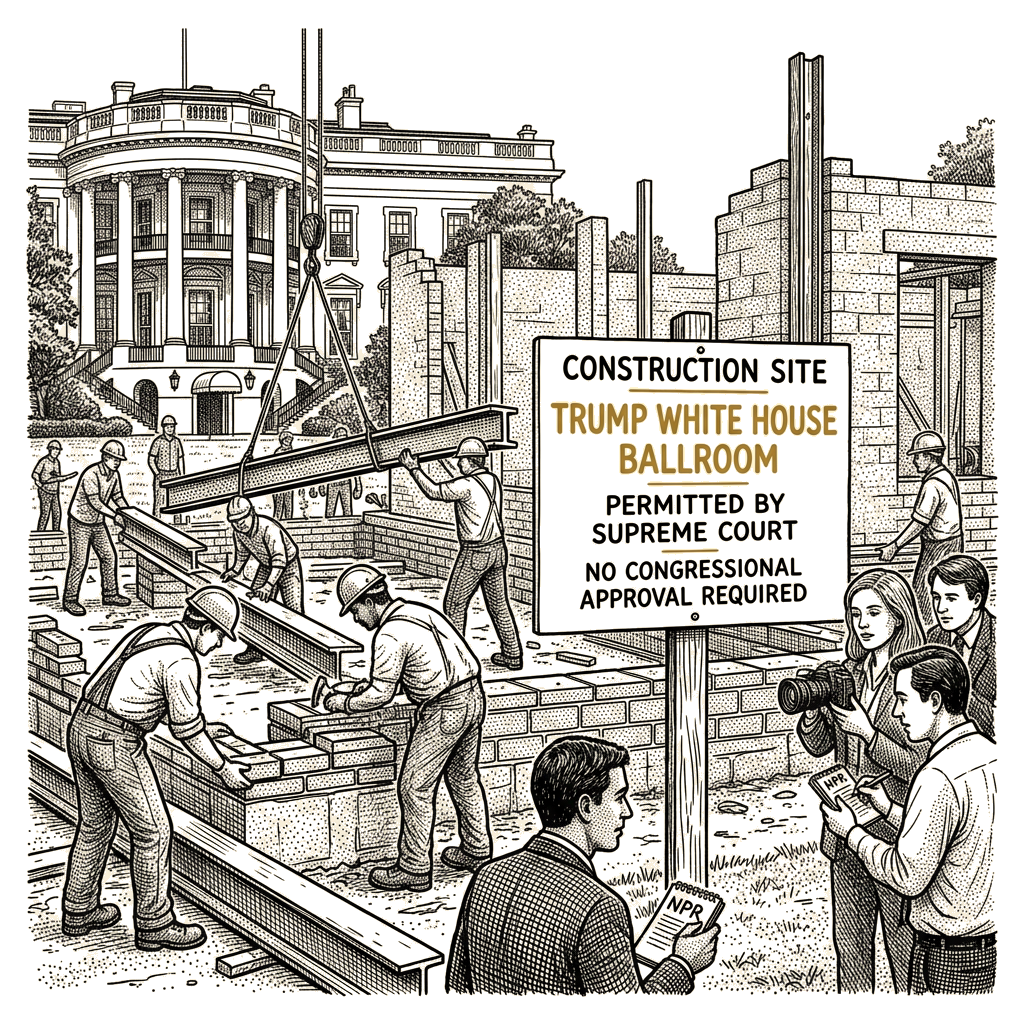
The Supreme Court gave Donald Trump his $300 million ballroom by killing the only lawsuit.
The Court did not decide whether the President can lawfully tear down the East Wing of the White House — a federally owned landmark — and replace it with a privately styled event space paid for with public money. It decided, instead, that the National Trust for Historic Preservation, the chartered body whose statutory mission is to protect that building, had shown no “concrete injury” sufficient to challenge the demolition in federal court. Chief Justice Roberts joined the dissent. The majority did not write about the law. It wrote the plaintiff out of court.
The standing doctrine the majority applied deserves to be named before it is taken apart. Article III of the Constitution limits the federal courts to “Cases” and “Controversies.” From that text the Court has long required a plaintiff to show an injury that is “concrete, particularized, actual or imminent” — not hypothetical, not generalized, but real, traceable to the defendant’s conduct, and redressable by a court order. Lujan v. Defenders of Wildlife, 504 U.S. 555 (1992). The bar exists for a reason. Federal courts are not roving commissions. A plaintiff whose only stake is that the government ought to obey the law gets bounced at the door.
A historic-preservation plaintiff might or might not clear that bar. The Supreme Court is right that “concrete injury” cannot mean “any interest a chartered organization declares for itself.” But this is the case where the test should be satisfiable. The National Trust is not an ad hoc advocacy group. It is a federally chartered body, created by Congress in 1949, whose mission is to protect the buildings the President is tearing down. The injury alleged is not abstract. A building the Trust was created to protect is being demolished on a specific date by a specific project. The dust is in the air. The marble is being cut. The strongest evidence that the standing line was drawn to do procedural work, not jurisdictional work, is that the Chief Justice joined three colleagues in finding it untenable.
But the standing question is not where the substantive evil lives. The substantive evil lives in the merits the Court chose not to reach. Several bodies of federal law are squarely engaged.
The Appropriations Clause, Article I, Section 9, Clause 7, is the Constitution’s most basic check on executive spending: “No Money shall be drawn from the Treasury, but in Consequence of Appropriations made by Law.” No statutory exception permits a President to draw $300 million of public funds without congressional authorization. The Property Clause, Article IV, Section 3, Clause 2, gives Congress the power to “make all needful Rules and Regulations” respecting the Property of the United States. The White House is federal property. The East Wing was federal property. The National Historic Preservation Act of 1966 requires federal agencies to take historic preservation into account before acting on historic structures they own. The Antiquities Act of 1906 gives the President authority to designate national monuments; it does not give him authority to undo a congressional designation of federal land without following the statutory procedure Congress wrote.
Back in August, a federal appeals court did read these provisions. It heard the same arguments and applied the same statutes to the same project, and concluded in plain terms that the President must get congressional authorization before continuing. That ruling addressed the underlying question — whether the President can spend hundreds of millions in public funds reshaping a building that belongs to the public without a vote in Congress. Yesterday’s Supreme Court ruling did not address that question at all. It answered a narrower question — who is allowed to ask. The merits question remains an open legal question. It remains open because no party the Court recognizes as injured enough is in a position to ask it.
The construction crews are on site. The price has crossed $300 million, though the President told the public taxpayers would not have to pay. Congress tried to intervene when the figure climbed toward $1 billion. The Supreme Court has now answered: not your fight.
Four votes in dissent, including the Chief Justice, is not a protest. It is a warning that the standing doctrine, as the majority is now applying it, has become a permission slip dressed in procedural clothing. That silence is the ruling.