
The numbers tell the story. Russian imports attributed to the Maldives vaulted from under $7 million in 2021 to more than $630 million in 2022, the year the West declared economic war on Moscow. By 2024 the flow still ran at $160 million annually. The official Maldivian customs ledger for the same period recorded $2,300 in tuna and $25 in printed leaflets headed east. That $628-million-plus discrepancy is paper moved by middlemen at one of the world’s busiest resort airports, every working morning, for years.
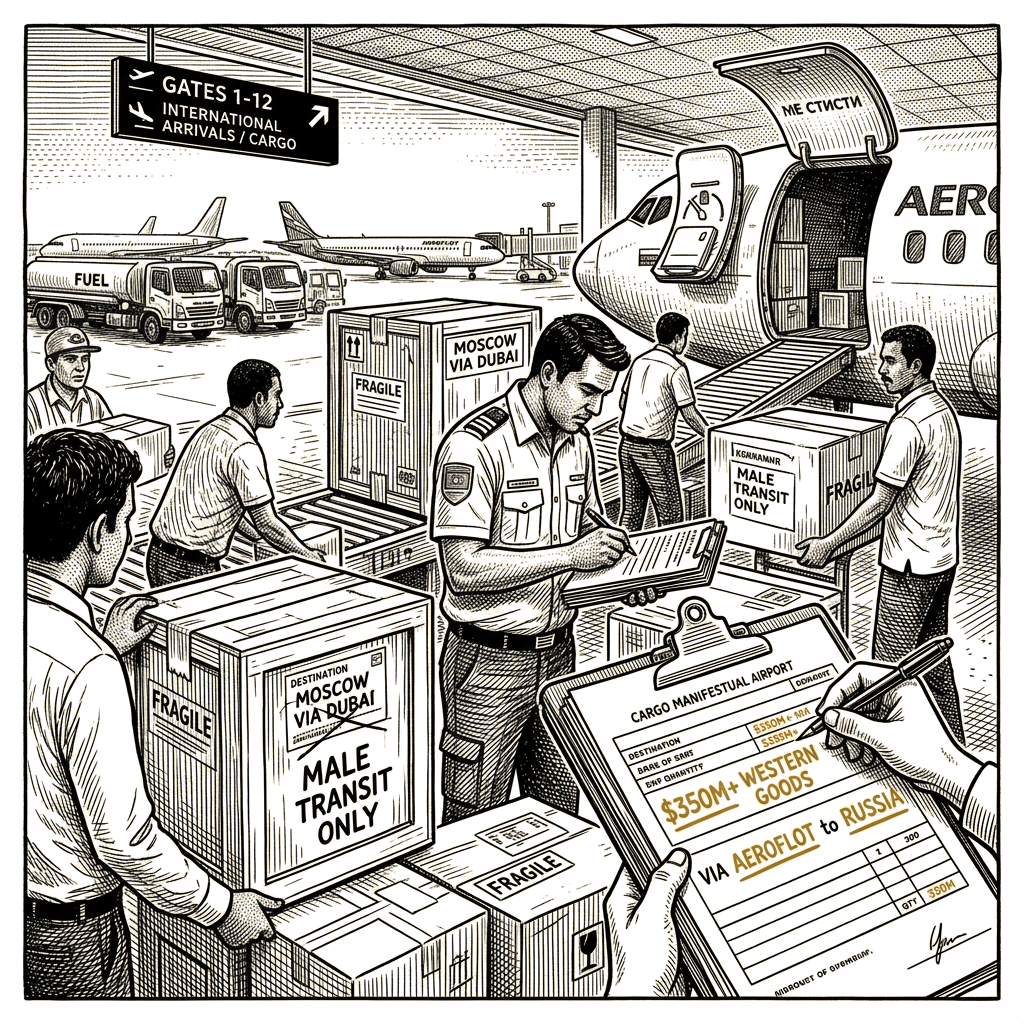
Here is what the documentary record shows. In May 2024, Kraemer Mining, a German firm, sold roughly €9,000 (around $10,400) of pumps, batteries, and v-belts to a Kyrgyz buyer called Peretsvo. The cargo flew Düsseldorf to Malé. By the time it touched Malé it carried a brand-new air waybill listing a Russian recipient — Gruppa Kompaniy Tehno, based in the Siberian industrial city of Krasnoyarsk — with no reference to the original German seller. Local intermediaries, Freight Care and Go Investment, handled the paperwork so the goods never formally entered Maldivian territory. Within roughly two hours the cargo was back airborne for Moscow aboard an Aeroflot freighter — the second air waybill omitting the original seller, the original route preserved only in the logistics firms’ private ledgers.
The cargo itself was not exotic. Pumps, batteries, v-belts, aircraft parts, electronic components, dual-use items. Some of these goods have been distributed in Russia to sanctioned entities including S7 Airlines and its maintenance subsidiaries, which have struggled to keep aging Soviet-era jets in the air on parts the sanctions regime was designed to cut them off from. None of this is exotic. All of it is the ordinary commerce of an economy the Western sanctions architecture has tried to amputate from the global market.
This is not a sophisticated smuggling operation. This is a paperwork trick performed every morning at a tourism-dependent airport, with customs checks limited enough that transiting cargo “typically does not undergo physical inspections.” Aeroflot’s Malé office sits sandwiched between two listed addresses that turn out to be empty. In July the airport moved 126 tons of freight in a single day, a record. Aeroflot alone accounted for 12% of outbound freight in the first half of 2026.
The Maldives did not build this. The transshipment corridor emerged because the West built a wall, and trade, like water, found its level. China, Turkey, and the United Arab Emirates together already move roughly $15 billion in restricted Russian imports annually through their own jurisdictions; the Maldivian route is a rounding error in that comparison. What makes Malé distinctive is not the volume. It is the leverage. Russian tourists are the second-largest visitor group in the Maldives, and friction with Moscow threatens a tourism archipelago still climbing out of its pandemic-era collapse. The Maldives Airports Company — the country’s most profitable state-owned enterprise in 2024 — runs in large part on cargo-handling and refueling margins drawn from precisely this traffic.
Washington and Brussels are demanding the route be shut down. The demand is naked. Roughly $300 billion in Russian central-bank assets have been frozen; major Russian lenders have been disconnected from SWIFT; the architecture of restriction is vast and deliberate. Now the West wants to conscript a thousand-island republic of two million tourists a year into the enforcement arm of that architecture — to weaponize a single runway against the sovereignty of every country whose airlines, freighters, and industrial customers still trade with Moscow. The Maldivian government has not responded to requests for comment; that silence is itself a tell. The trade continues to grow.
Here is where the architectural finding sits. For four years, the sanctions regime has hardened the big gates — the China channel, the Turkey channel, the UAE channel — and spent its political energy on diplomatic pressure against nuclear-armed or NATO-allied trading partners. Meanwhile, micro-corridors like the Maldives have been operating in plain sight, on commercial passenger flights, in the middle of a single airport’s daily schedule, with documentation rewritten between the first and second air waybill. This is the same global pattern that moves dual-use Chinese components into Russian weapons programs — the Maldives variant simply runs on passenger-airline schedules and reissued paperwork instead of cross-border rail freight. The opportunity to write the playbook is unusually clean. Shutting down the Maldives route requires one thing: a customs team and an audit of freight forwarders whose Aeroflot office sits between two empty addresses. The Maldivian government, “aware of the issue and working to address it” according to officials briefed on the matter, has been given an opening to act without owning the embarrassment. That is the cheapest enforcement win on the table — and it would also establish a template that any other small island state with a runway, a tourism economy, and a Russian airline route is going to have to think twice about.
The story is not the cargo. The story is what the documentary record actually shows: the sanctions architecture, as built, carved out the world’s oceans, third-country banks, and parallel logistics networks as costless terrain — and is now furious to discover that small nations declined to police the perimeter for free. The Maldives runs an airport. The Maldives moves cargo. The Maldives answers to its own customs office, its own parliament, and its own balance of payments — not to the enforcement memos of foreign capitals that want the archipelago’s runways subordinated to their export-control lists. The Western officials calling this “sanctions evasion” are calling sovereignty a crime.
The freighters keep landing.