
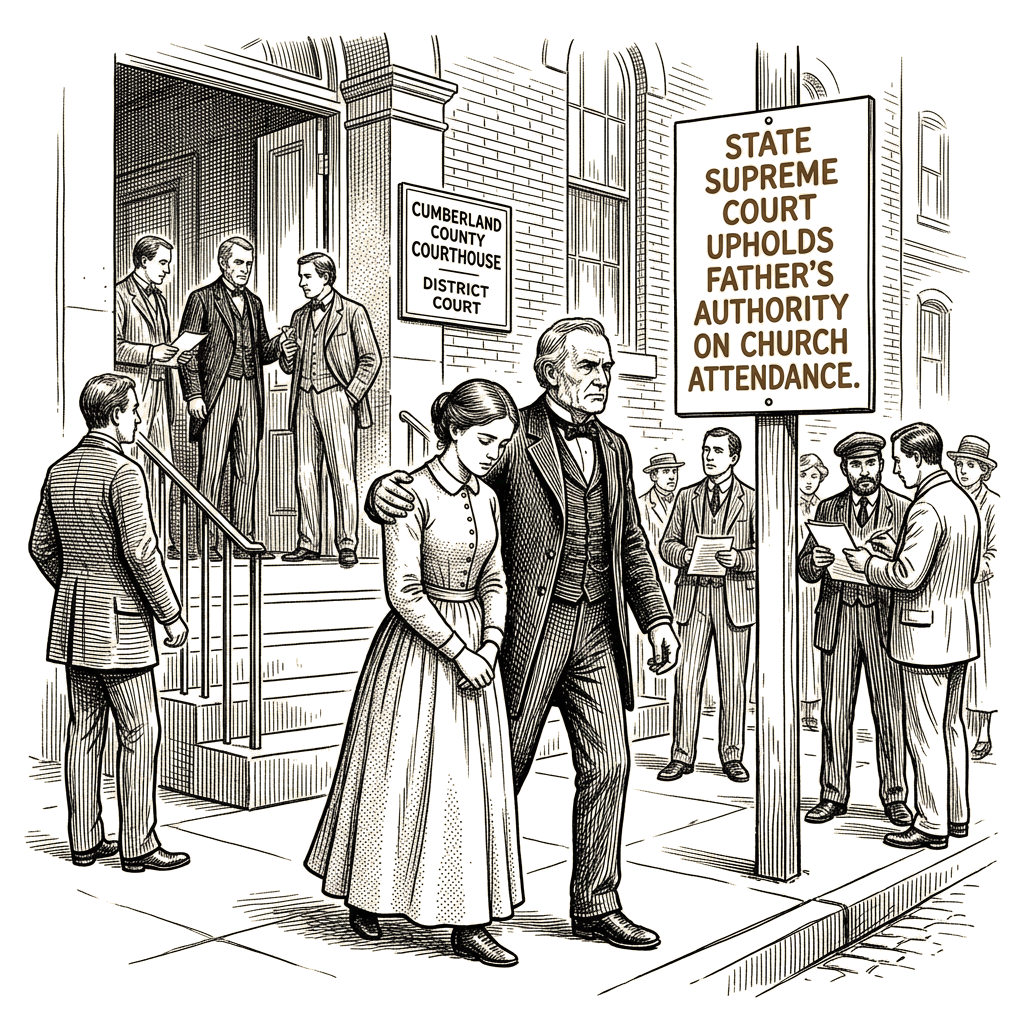
Calvary Chapel Greater Portland in Westbrook, Maine, taught dispensationalist rapture doctrine to an eleven-year-old girl who had a documented panic attack in response. The Maine Supreme Judicial Court ruled September 1, 2026, that the father — and not the mother who had been bringing the girl to multiple services a week — now holds the authority to determine whether his daughter will continue attending the church.
The Sept. 1 ruling affirmed a 2024 Portland District Court order in the custody dispute between Matthew Bradeen and Emily Bickford over their daughter’s religious upbringing. Bradeen had called the church “a dangerous and harmful environment” and said his daughter had the panic attack after hearing the church teach that Christians will be suddenly snatched away to meet God in the air while everyone else is “left behind” to suffer through seven years of tribulation. The high court treated the documented symptom as a sufficient basis for confirming the lower court’s allocation of decision-making authority to the father.
Here is what the Sept. 1 ruling did.
It confirmed the lower court’s allocation of the religious-upbringing prong of custody to the father, over the mother’s objection. It treated the documented panic attack as a sufficient evidentiary basis for that allocation. It placed on the public record, in a published judicial opinion, that the religious instruction at Calvary Chapel Greater Portland produced a specific psychiatric symptom in a specific child.
Here is what the Sept. 1 ruling did not do.
It did not adjudicate the doctrine. It did not rule that dispensationalism is wrong. It did not find that Calvary Chapel violated any specific child-welfare regulation. It did not formally enjoin the church from teaching the rapture to anyone. It did not find the church’s theology defective. It ruled, in this custody dispute between these two parents, that the father holds the religious-upbringing decision.
The rule the court applied was the family court’s parens patriae authority — the state’s role in protecting a child’s welfare — operating through Maine’s child-best-interests standard for custody. The court, by allocating the religious-upbringing decision to the father over the mother’s objection, effectively ratified the lower court’s finding that continued attendance was contrary to the child’s welfare. The breach the court identified was not doctrinal. It was custodial: a specific child, in a specific church, experiencing a specific psychiatric symptom, attributable to a specific teaching, with the religious instruction continuing over the other parent’s documented objection.
Calvary Chapel Greater Portland teaches dispensationalist eschatology — the doctrine that Christians will be suddenly removed from the earth before a period of tribulation, after which Christ will return in person. The teaching was essentially codified in John Nelson Darby’s writings in the 1830s and in C.I. Scofield’s 1909 Scofield Reference Bible; it is not ancient Christian doctrine, but a nineteenth-century system. Whether the doctrine is true is not the question before the family court. Whether the church taught it to an eleven-year-old in a manner that produced a panic attack is the question the family court answered.
The harm was documented, named, and placed on the public record. A panic attack in a child is a psychiatric event, not a mood. The court treated it as such. The record before the court included the panic attack, the father’s characterization of the church as “a dangerous and harmful environment,” and the religious instruction continuing over the other parent’s objection.
The remedy the court ordered is parental, not institutional. The father now holds the authority to remove the child from the religious instruction that produced the documented harm. The remedy does not reach the church’s teaching of the same doctrine to other children. It does not formally find the doctrine itself harmful. It does not put Calvary Chapel under supervision. It does not require the church to alter its children’s curriculum. The remedy is the minimum the family court can order: take the child out of the specific environment that produced the specific documented harm.
The institutional accountability question is raised by the ruling, not answered by it. The court did the work the state authorized it to do. The institution the family court effectively ruled against has not answered for what its teaching did to the child whose father went to court to stop it. A church that teaches urgent eschatological terror to children, in a context where the other parent has documented the child’s distress and objected, is a church whose published judicial record now formally records the harm. The next parent who walks into the Portland District Court with a documented panic attack attributed to the same teaching at the same church will have this ruling on the docket. The pattern, if it exists, will be visible.
This is the institutional accountability the column is asking about. It is not the accountability of criminal regulation or civil liability. It is the accountability of a published judicial record that names what happened, in what institution, to what child, with what consequence. The state has now formally recorded, in a judicial ruling, that one specific child panicked in response to the teaching at Calvary Chapel Greater Portland. The church may continue to teach what it teaches. The state has not enjoined it. But the state has put on the public record what its teaching did to one of its children. The question of what the institution does next is the institution’s question, and it is on the public record.