
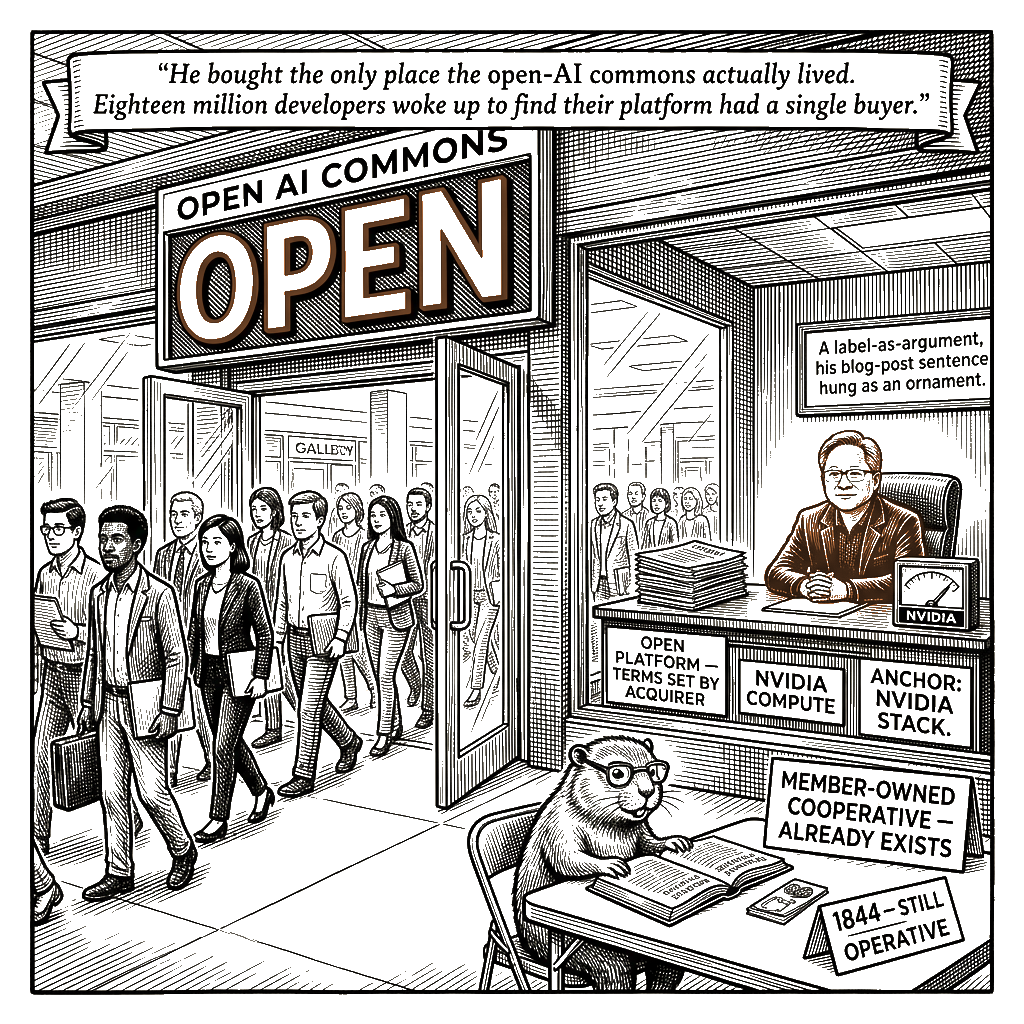
The chipmaker bought the only place the open-AI commons actually lived, and called it a victory for openness. Eighteen million developers who share three million models, half a million datasets, and a million applications woke up Thursday to find that their platform has a single buyer. Nvidia, the firm that sells the chip on which almost all of this work actually runs, has agreed to acquire Hugging Face for about $12.93 billion, the Associated Press and the Wall Street Journal reported Thursday. The promise is the price of admission. The structure is the problem.
Chief Executive Jensen Huang wrote in a Thursday blog post that Hugging Face “will remain an open platform for the entire AI ecosystem,” that developers would choose their own models, frameworks, clouds and inference providers, and that “Nvidia compute will not be required to build on or deploy through Hugging Face.” He added that “open weights broaden access to AI and help ensure that AI leadership is distributed across companies, institutions and communities.” The Wall Street Journal, citing industry executives, separately reported that the acquisition could help counter the rapid rise of Chinese open-weight models by putting American weight behind a platform that already hosts the world’s largest open-model community. (Our coverage of Nvidia’s $6 billion Poolside licensing deal tracks the same strategic logic.) The argument deserves its honest weight.
Open-weight models are a real and good thing — the difference between a public road and a private tollway. The researchers at the universities, the small teams at Hugging Face itself, the volunteers who keep the libraries honest have done work that has paid for itself a hundred times in distributed innovation. Huang is right that Nvidia’s resources could accelerate that work, and he is right that a serious American effort to counter the rapid ascent of Chinese open-weight models is not a paranoid fantasy. An open platform under American ownership, with American compute behind it, is a more useful answer to that competition than another closed frontier model. The argument is not stupid. It is the steelman of an honest operator with deep reasons for what he is doing, and it earns the column’s full hearing.
The structure is the problem. More than eighteen million people depend on a working commons that smaller numbers built the way a co-op is built — the maintainers of the libraries, the curators of the datasets, the volunteers who answer the forum questions, and the millions more who build on what those people keep running. The institution served them and they served it back. They maintained the libraries. They filed the bug reports. They vetted the datasets. They taught each other in the forums. They did for free what no central planner could have bought at any price, because the work was voluntary and the governance was theirs. On Thursday a single buyer — the world’s largest publicly traded company, valued in the trillions — wrote them a check for $12.93 billion and walked off with what they built.
I know how this works. I traded these very futures out of Chicago for a living. The mechanism is older than the chip fab. You find a working commons — a community institution, a cooperative, a fairground, a paper — that produces more value than it captures, and you buy it for less than the future earnings stream is worth. You load it with the cost of the acquisition. You install your people on the board. You promise the members everything they already have, because saying no would collapse the deal. Then, two or three years out, when the contracts have been signed and the platform has been migrated to your stack and the alternatives have atrophied, you change the terms. Not all at once. Slowly. By then the members have no place to go, and they tell themselves the new arrangement is fine because it has to be.
It is the argument I used to hear on the floor in Chicago, in a different dialect, from the men who ran the grain trade. The pitch was always some version of scale beats fragmentation — let the efficient firm absorb the inefficient exchange, and the farmer benefits because somebody has to move the volume. The efficient firm always turned out to be the one that set the price. That is the part Huang’s post does not address, and it is the part that matters to anyone who has watched what happens when a commons passes into private hands.
The moral geometry is local as well as global. Adams County watched it with the Chicago & North Western. The railroad hired the same neighbors who laid its ties. It set the price of every bushel of grain they grew. When diesel came, it walked away from the people whose taxes had paid for the station. The work stayed in the company. The community kept the depot. I have met the men who bought our local paper and our local co-op and the local lumber yard down the road. They were sincere, every one. They said the bylaws wouldn’t change. I have watched the bylaws change. The pattern is older than the chip and it will outlast the chip.
Nvidia does not primarily make its money from open weights or closed weights. Nvidia makes its money from the picks and shovels — the chips and the systems and the software stack that every model, open or closed, runs on. The “openness” of Hugging Face, if it is preserved at all, expands the universe of developers who need Nvidia’s compute to do their work. That is not a coincidence. It is the whole architecture of the thing. The platform stays open in the same way that a shopping mall stays open — anyone can walk in, but the lease terms, the anchor stores, and the electricity bill are all set by the owner. The developers are the foot traffic. Nvidia is the landlord.
You will hear this called the future of American innovation. It is the future of American enclosure. I have seen both up close, and they do not look alike.
So what gets built instead? The honest answer, in the conservative tradition I was raised in and the cooperative tradition I work in now, is something older than Nvidia and longer-lived than any chip fab. It is a digital commons owned by the people who use it, governed by the people who maintain it, and accountable to the people whose work fills it.
The legal tools already exist. Capper-Volstead gave America’s farmers a limited antitrust exemption to organize collectively in 1922; a similar cooperative structure for AI developers would let the eighteen million members of Hugging Face bargain collectively against the chipmakers, the cloud providers, and the model labs that have been extracting value from their work. The Rural Electrification Act of 1936 — also a cooperation law, also a structural answer to a market that had refused to serve — wired the countryside with member-owned electric cooperatives and put the grid in the hands of the people who used it. The Adams-Columbia Electric Cooperative sits four blocks from my office, serves thirty-one thousand members across twelve counties, and answers to a board its members elect. The members own the poles. The board sets the rates.
The cooperative tradition has spent two centuries building the legal architecture for exactly this problem — member-owned infrastructure, governed democratically by the people who use it, one member one vote, not one share one vote. Mondragon is a co-op of seventy thousand workers in the Basque country — they own the firm, the surplus is theirs, and the firm has outlasted three Spanish recessions. Land O’Lakes is a farmer-owned cooperative that put a hundred years of agricultural research in the hands of its members and made the butter, too. The Rochdale Pioneers laid down seven rules in 1844 — voluntary membership, one member one vote, member economic participation, autonomy, education, cooperation among cooperatives, and concern for community — and those rules still govern every credit union and electric cooperative in this country. They can govern an artificial-intelligence platform. There is nothing magical about software that exempts it from the principles that have held every working commons together for two hundred years.
Holding an open commons together against the largest chipmaker in the world, with the largest financial backstop, in a geopolitical environment that punishes slow coordination — that is a harder fight than the one the farmers won in 1922. It will need antitrust enforcement serious enough to break the assumption that Nvidia’s vertical integration is inevitable. It will need public-interest infrastructure — public compute, public datasets, public benchmarks — that does not depend on a single firm’s roadmap. It will need the developers themselves to organize the way the Grange organized, the way the rural electric co-ops organized, the way the REA wired the countryside that the market had no intention of wiring on its own. The mistake is to think the only alternative to Chinese open weights is American concentrated weights. That is not a national-security strategy. It is a merger.
I used to trade the futures on the crops grown by the neighbors I grew up with. I know what “open market” means when the man saying it owns the exchange. The chipmaker says Hugging Face will stay open. The open table is for sale. The cooperative is the answer we already have.