
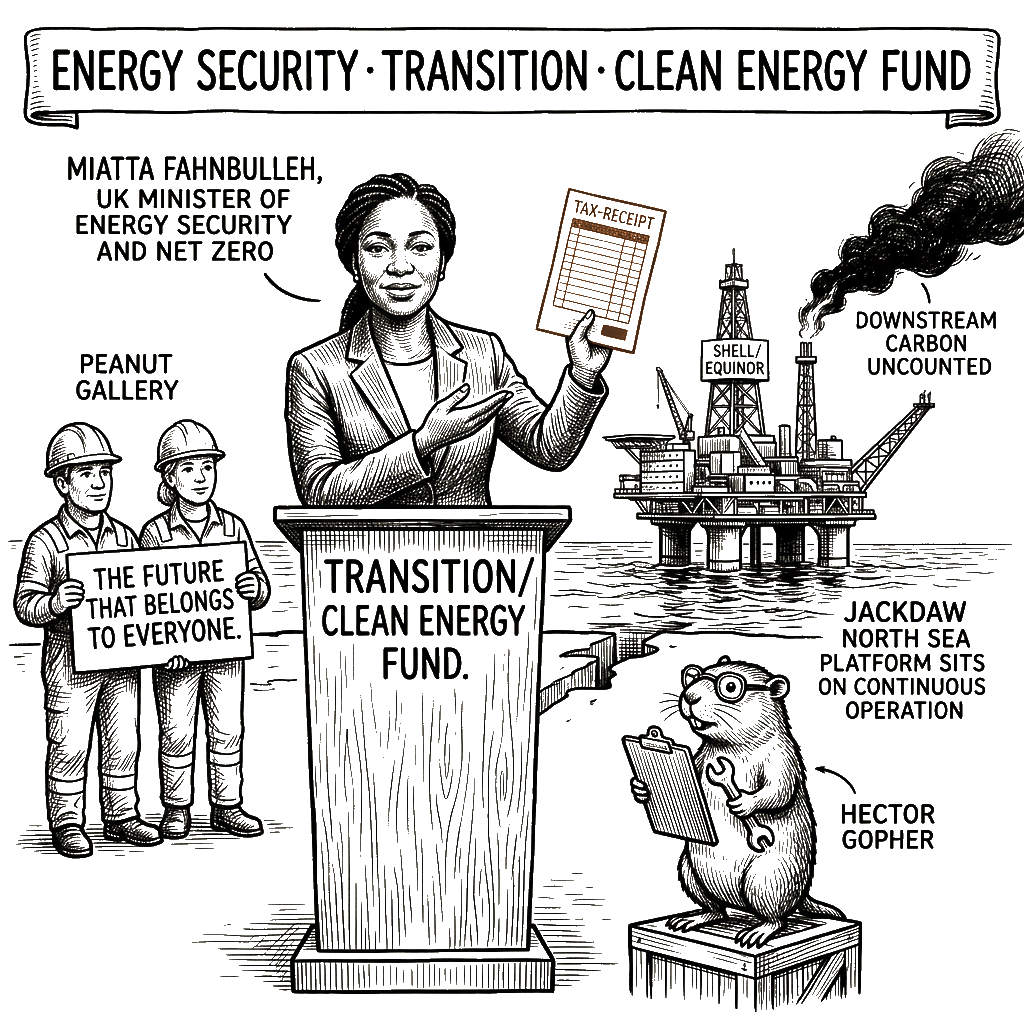
Miatta Fahnbulleh is preparing to greenlight Jackdaw’s climate damage.
I have watched Lake Petenwell’s ice go out eleven days earlier than when I first wrote it down twelve years ago. Twelve dates are not a climate model, and I would not pretend otherwise. They tell me something plain: when a date changes, every plan built on the old date has to move. A drilling approval moves in the other direction. It surrounds the future with wells, platforms, contracts, and jobs built on extraction continuing beyond the date when the government expects clean power to take over.
The Guardian reported on Friday that Fahnbulleh is likely to recommend approval of the Jackdaw gas field off Aberdeen as soon as Monday. The North Sea Transition Authority could issue the formal permit a week or more later. The same process is considering Rosebank, a separate £8.7 billion oil field that the industry says could hold as much as 500 million barrels of oil or oil equivalent.
Final decisions have not been made. That matters. But approval is close enough that the government’s reasoning can be examined before another group of men sign the permit.
Both fields already have licences to operate. What they lacked after a judge ruled against the companies was proper environmental approval. The judge found that Shell and Equinor had not adequately accounted for the emissions produced when the oil and gas are burned, not merely extracted. The companies resubmitted their applications earlier this year.
The government says approving the permits would not violate its manifesto commitment not to issue new oil or gas licences. That is true. It is also the hinge on which the whole dodge turns.
A licence and an environmental permit are not the same thing. An old licence does not make carbon disappear. It does not answer the question the court sent back for another look. It does not change the fact that the product is intended to enter the atmosphere as carbon dioxide.
The downstream emissions are not a technical footnote accidentally omitted from a spreadsheet. They are the reason the project exists. Jackdaw is not being built to keep its gas in a decorative bottle. Rosebank is not being drilled so Equinor can admire the geology. The companies want to sell what comes out, and the public is left to live with what happens when it is used.
That is the part the government keeps on a different sheet of paper.
The Department for Energy Security and Net Zero says the North Sea remains a vital national asset supporting jobs, growth, and energy security. It says oil and gas will continue to play an important role for decades alongside clean power.
That is the strongest honest case for approval. Britain has skilled workers, ports, fabrication yards, supply companies, tax revenue, and a domestic source of fuel. None of that is imaginary. People have built lives around the North Sea, and workers in northeast Scotland have good reason to fear a transition managed by people who expect sacrifice from the workforce while protecting every institution that fed on the old industry.
But the argument is stolen once “for decades” becomes permission to build new carbon supply without saying how much is actually needed.
A barrel sold into a world market is not British merely because it came from British water. Energy security means the British people can keep the lights on through a crisis. It does not mean the government must provide the market every barrel it can sell at a profit.
Daniel Yergin’s histories of the energy business make the point better than a slogan does. Energy systems change through infrastructure, capital, long contracts, and physical machines. They do not change because a minister adds the word transition to the authority approving another field.
Jackdaw and Rosebank are being approved after the government has already decided to expand clean power. That puts the new assets ahead of the future they are supposedly meant to bridge. It is not a temporary bridge built to carry workers from one industry to the next. It is a new shoreline on the side workers are supposed to leave.
Campaigners, not the government, estimate that the two fields could cause as much as £336 billion in economic damage through the carbon pollution from the oil and gas they produce. The exact amount can be argued. The category cannot be dodged.
A court already ruled that the companies had to account for the carbon released when their products are burned. Nothing in the reporting says the resubmitted application proposes leaving the fuel in the ground. The paperwork can become more complete while the climate consequence remains unchanged.
Environmental approval is not a housekeeping permit for an already finished shed. It is the last public gate before a company begins a major extraction project. If the government can answer only that the licences already exist, it has answered the easier question. The harder question is what public purpose justifies adding more carbon after it was told the original assessment was incomplete.
Officials are considering whether tax revenue from Rosebank could be directed into the national wealth fund for clean energy and infrastructure. The proposal is being discussed, not adopted. It should not be confused with a clean-energy plan.
The fund may do useful things. The companies and the state may invest in generation, ports, grids, or manufacturing. But the money would be useful because it is public money invested in a public purpose. It would not offset the carbon from Rosebank. Taxes can build a battery factory. They cannot uncount a tonne of carbon dioxide.
Calling the revenue a clean-energy fund does not make the producing field clean. My 2014 Chevy Silverado does not become a battery because I paid sales tax. The Honda EU2200i at my shop does not stop burning gasoline because a state fund bought a solar panel somewhere else. I own both machines, and the exhaust still comes out.
A tax receipt is not a receipt for the atmosphere.
The same problem runs through the language of energy security. The public is asked to accept drilling in the name of a stable system while the companies are given the right to supply a global market whose price will be set by OPEC decisions, world demand, shipping, finance, and politics far beyond the North Sea. Britain controls a patch of seabed. It does not control the weather of the world oil market.
Chapter 16 of We Too calls this contradiction the Nationalist Shell Game. The nation speaks while the multinational names the asset. Here, the government speaks of British jobs and British security, but the licence holders are Shell and Equinor, and the carbon consequence lands on the public after the fuel crosses an international market.
That is not because corporate executives get the final vote. The final vote belongs to elected officials and public authorities. They can approve or reject the permit. The public deserves to know who chose what, who is paid, and who absorbs the cost before the government hides the decision inside a tax strategy announced later.
On August 24, this paper showed how Europe, Britain, and Canada were cutting climate goals as energy costs rose. Jackdaw is where a revised goal meets a drilling permit. The government does not need to tear up every climate promise in one act. It only needs to keep approving the projects that make the promise impossible to keep.
The workers deserve better than being used as the human shield for that choice.
The fight to defend offshore wind jobs from Trump’s policies shows that employment and decarbonization are not opposites when workers have a union, a wage, a training plan, and a place in the new industry. A transition that abandons workers is theft. A transition that abandons the climate is theft on a longer ledger. The job is to build one plan, not two hostile ones.
Book the work before the rigs leave. Preserve wages, fund apprenticeships, use local fabrication and ports for the clean build, and put the national wealth fund behind those commitments by law. A clean-energy fund can give an oil worker a future. A new lease cannot.
Before the North Sea Transition Authority acts, Fahnbulleh should have to answer three questions plainly: what energy need requires this new carbon, what is the full climate cost, and where is the work for the people whose jobs will not last forever? If the government cannot show a gap worth the carbon, it should reject the permit. A project that cannot survive those answers does not need a cleaner label. It needs to be refused.
At my bench, I can tell when a repair fixes one part of a badly designed machine. The part is good. The design is still there. A national wealth fund can be good. A new oil field is still there. The project does not become clean because its revenue gets a clean destination.
Jackdaw is not a final sentence. But if Fahnbulleh recommends approval and the NSTA signs, ministers will have chosen to pay for more extraction with a future that belongs to everyone.
Back home, I want Mike and Quinn to inherit a county that can still be repaired. I know the ice on Lake Petenwell will go out without any help from me. The carbon from Jackdaw will also keep moving without any help from London. Only the first process is natural. The second is a bill ministers approved.