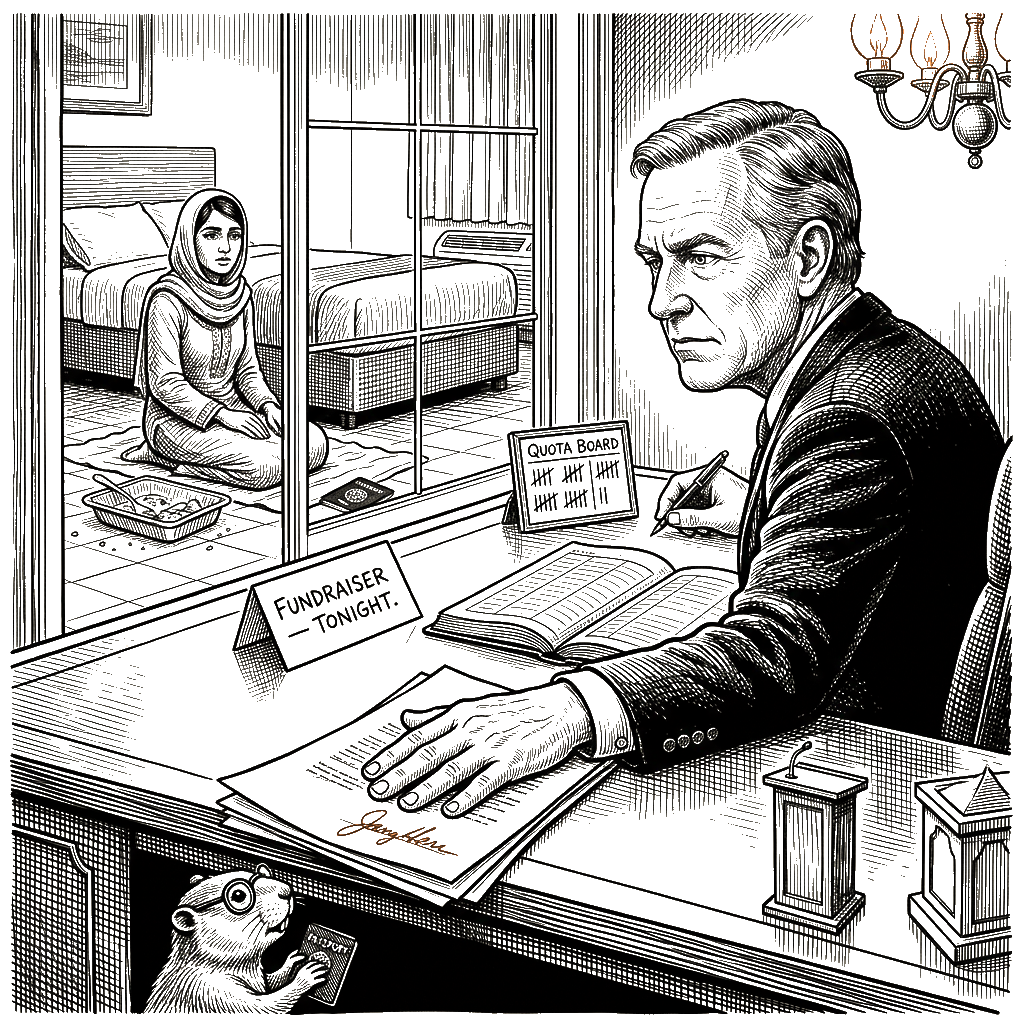
Joe, Marwa is twenty-one. She was four semesters from becoming a cardiologist. Now she sits on the floor of an Extended Stay America in Houston. Her family of nine eats halal from foil pans in silence. They used to interrupt each other for airtime. She is three-quarters of a mile from the Texas Medical Center.
In August 2021 the Taliban took Kabul. The American withdrawal executed that year was ordered by President Joe Biden and carried out by the State Department, the Defense Department, and the intelligence services under his command. Hundreds of local staff who had worked alongside American organizations — interpreters, drivers, guides, women journalists’ assistants, girls who had attended American-supported schools — were evacuated by the Wall Street Journal, the New York Times, and others. The cost of getting them out was the cost of leaving most behind.
The book The Last Free Women, by Rebecca Blumenstein and Diana Kapp, from the forthcoming excerpt below, documents what came after for four of those the Times evacuated. Marwa Rahim, twenty-one, was four semesters from completing medical school in Kabul when the city fell. Her family reached Houston through Mexico City, almost twenty-four hours after starting the day in Mexico. They were nine people. They lived in one Extended Stay America, two rooms, one for the men and one for the women. She tried to sleep through the days. She watched every Taliban edict for hours on her phone. She deleted the apps. She redownloaded them. Her skin broke out. Her sisters began taking sleeping pills.
In the years since, the policy that handed her to the foil pan has continued. In August 2026 the United States deported an Afghan who had been granted court protection to the Central African Republic. The Rahims are still in the country. The relief is contingent.
Marwa’s mother went to the emergency room afraid she was having a heart attack. Her blood pressure was high. Her breathing would not settle. The diagnosis was panic attacks and a prescription for Zoloft. Sosan, her thirty-one-year-old sister, a former math teacher who had proudly instructed girls from rural Afghanistan, now had her husband more than six thousand miles away in Turkey, with no word of when she would see him. Mursal, twenty-four, a recent graduate of law school, had received her first interview request for a legal assistant position on the very day Kabul fell. “All the law I studied doesn’t exist,” she said. “There is no anything.”
Marwa and her sister Mursal carried their passports in their pockets even to the driveway of the hotel. They walked along the highways at seventy miles an hour because they had never encountered a crossing signal. At the big-box stores they could not find rice, potatoes, milk, and onions in quantities that would feed a family of nine. Thirty loaves of bread in Kabul had cost what one loaf cost here. The mealtimes were the worst part of the day. The nine of them sat on the floor in one of their two rooms on towels, foil pans between them. The room where the family used to interrupt each other in a friendly competition for airtime was now a room in eerie silence.
Joe, hear what your signature bought. Your granddaughter is not on a foil pan in an Extended Stay America in Houston tonight. Marwa is. You put her there.
Marwa was four semesters from a white coat. The Texas Medical Center, where the practicing cardiologists wear the white coats, is three-quarters of a mile from the Extended Stay America where she sits on a towel. You put that distance there.
Joe, your throat closes when you read this. It should. It is the throat of the mother in the airport who covered her baby’s ears each time shots rang out. Your hands shake on the breakfast spoon. The hands of the men who signed the execution order for your withdrawal did not shake. Your hands should shake. Joe, you slept through the night Kabul fell. Marwa did not. The ache in your lower back at bedtime is the ache of a math teacher more than six thousand miles from her husband. The film that settles on your hands when you read about the silence at mealtime will not wash off. The not-washing is the indictment.
Marwa was asking, “Do I even have a future?” She asked it on loop. The book documents her. The book documents Sosan. The book documents Mursal. The book documents the mothers who went to the ER with shortness of breath, the new mothers who could not stop crying, the men who sat in their separate room in their separate silence, the children who will not have the aunts the girls back home have lost.
Marwa’s credits likely would not have transferred anyway. She had been told she would probably need to pass the GED to apply to college, and even if she did, she could not pay for it. She and her siblings had become the primary breadwinners. The Rahims are still here. They carry their passports.
“Truly I tell you, whatever you did for one of the least of these brothers and sisters of mine, you did for me.” Matthew 25:40
You did not get Marwa a stethoscope. You got her a foil pan and a hotel bed and a three-quarters-of-a-mile view of the medical center she should be inside of. She is one of the least of these. The Christ was in the foil pan. You are about to be photographed shaking hands at a fundraiser. Smile.