
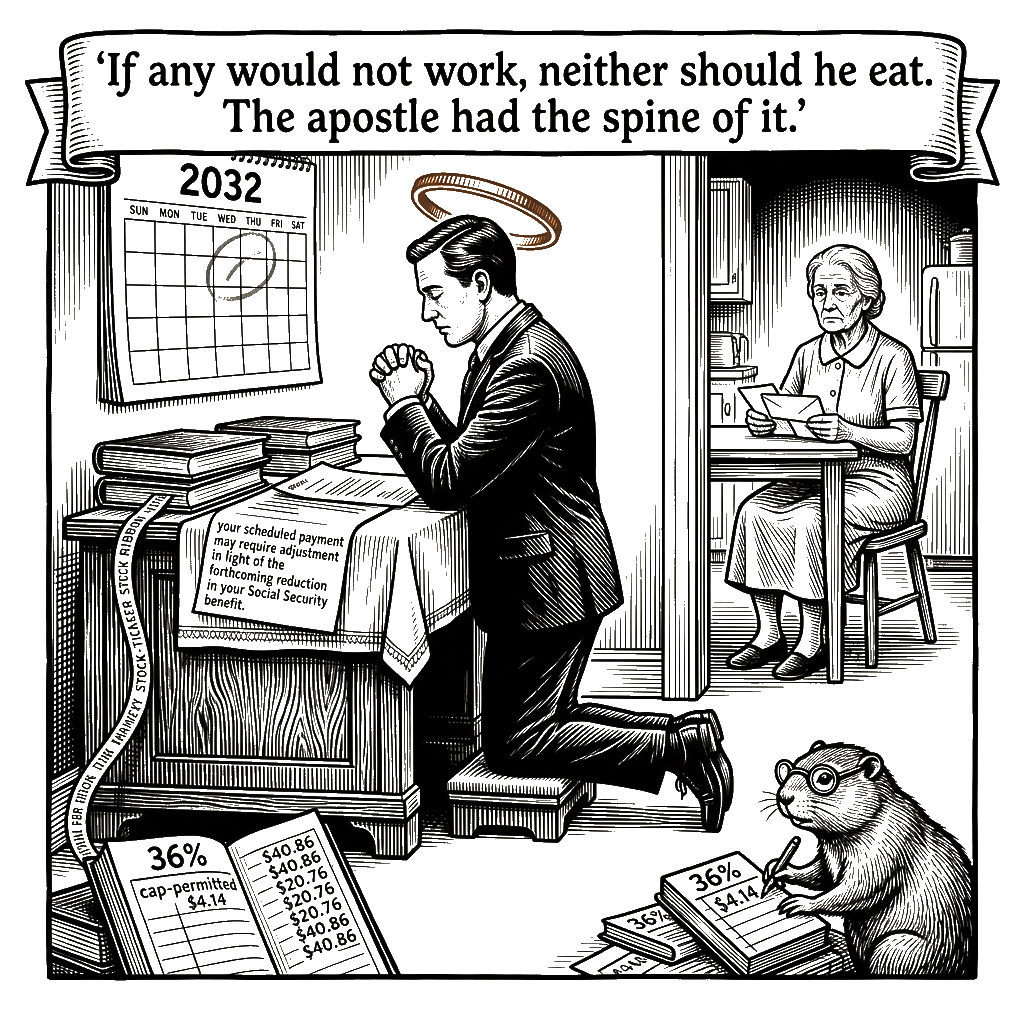
I’m drafting the form letter now.
To: [DEBTOR] From: Recovery Operations, a Sterling-class entity Re: [ACCOUNT] — Schedule Adjustment Notice
Dear [NAME],
We regret to inform you that your scheduled payment of [$X] per month may require adjustment in light of the forthcoming reduction in your Social Security benefit. Effective [DATE], your benefit will be reduced by approximately 20% as the trust fund reaches statutory depletion. Your payment plan has been revised accordingly. We appreciate your prompt attention to this matter. Please call [NUMBER] to discuss revised terms.
Sincerely, [SCRIPTED NAME] Customer Recovery
The blanks are the cruelty. The form is the sympathy. The letter has been drafted by an algorithm that adjusts the [$X] to the new benefit schedule in real time, so when the cut takes effect, the demand letter lands in the same mailbox as the reduced check. I have not asked how many of those two pieces of mail will be opened in the same pair of hands. I have not asked because the question would not improve my quarter.
Let me show you whose hands I’m drafting it into.
Jewel sits at station 14 in a call center I own in Harlan County, Kentucky, between a Dollar General and a former Denny’s. She has been on the dialer 11 months. She calls the elderly to collect the medical debt they ran up when Medicare stopped paying for what Medicare used to pay for. I bought the debt at $0.018 on the dollar. She recovers it at $0.40. The differential between those two numbers is what your payroll tax bought you. The Lord blesses the patient lender, and the Lord has blessed me very patiently.
“Jewel” is the kind of name you put in a sentence when you want the reader to forget there’s a dialer. She has called 23,400 numbers in that time. Of those, 1,894 reached a live debtor. The skip is logged; three skips in a week is a write-up; three write-ups is what my operations manager calls a “voluntary separation” and what I call a write-down of a depreciating unit. She has not skipped a single call. Her hand shakes when the algorithm routes her own household number.
She makes 14 agreements a week. Her annual recovery value is $1,498,640. Her annual wage is $26,624. The differential — $1,471,016 — is mine. I am paying her roughly 1.78% of her recovery value. The script is cheaper than a slave would have been and considerably more efficient.
Now pull the dialer’s other end into the room. Alma is on it. She didn’t pick up; the form letter found her. 62 years old. A laundry hand at the hospital across the street. The flat sheet that goes under you on a bad night you spend there comes out of the water through her hands.
14 days ago she borrowed $300 from my drawer at 11 a.m. The loan is due on the 14th. Her pay arrives on the 15th. I keep one day between the two — a day she has to live through, a day with no money in it, a day her wages are already mine by prior claim. The cash hits the drawer first. I take the $45 and hand her the document. God keep the direct deposit coming.
Read the next sentence twice.
The $45 is not the rate. The rate is 391% — the annualized price of a 14-day loan, and yes, I know what the number looks like when the reader says it aloud. The reader’s dislike is the interest’s per diem. The $4.14 the 36% cap would have permitted stays on a separate line in the ledger, uncollected. The $40.86 I kept is what the cap does not reach. I have put the $40.86 somewhere pleasant. The $4.14 stays on the ledger for the auditors who ask me to prove I am a lender.
The line she didn’t write and I agree with is in the Journal this morning — Joseph Sternberg’s on the debt crisis: “Most countries stumble into fiscal crises. We’ve scheduled ours.” The country has penciled in its own benefit cut, drawn on a model not unlike the one I run at the counter. The bodies are the only variable.
Pull the camera up. The trust fund is Alma’s $300 loan, redrawn at seventy million borrowers. A promise of a future wage, advanced against a body that has not yet earned it, with a back end nobody prices because nobody holds it. I run mine on a two-week tape. The state runs its on a forty-year tape. The arithmetic is the arithmetic.
“If any would not work, neither should he eat.” — 2 Thessalonians 3:10. The apostle had the spine of it. He was pricing a different kind of body in a different kind of shop, but the arithmetic is the arithmetic.
I have penciled the 2032 benefit cut at more than 20%. The pencil has been on the page since 2017. I have not checked whether 20% is still the right number. The model doesn’t require me to. I’m told the ten-year funding has its own concerns. I haven’t read the report. The two-week tape has held since the spring of 2019. I have not opened the drawer marked “Future.” The drawer is a courtesy I extend to nobody.
The trust fund was never a pension. It was a loan the body took on the promise that the system would still be solvent when the body retired. The 2032 cut is not a fiscal decision. It is the loan being called in early, with a haircut, on a cohort whose productive yield has ended and whose maintenance cost has begun. The cohort funded the trust fund. The trust fund funded my acquisition fund. The acquisition fund bought the portfolio. The system worked exactly as I designed it, in the sense that I designed nothing, and the nothing I designed was sufficient.
Alma is sixty-two. She is on the laundry floor across the street, folding sheets into the bin. Her hands do not close all the way anymore. She has ten more years on the line, forty-five more Fridays of the $40-something, three hundred and forty more first-loans of $300 if the schedule holds. If the whole span were one loan, it would be a cruel scripture. If it were a check, it would be an annuity. It is neither. It is the same ledger, page after page, the 14th and the 15th, until the body stops or the tape does.
The queue grows by 11,000 names a month. My compliance officer sent a summary in April. I haven’t opened it. The recovery rate was what I projected, or it wasn’t — either way, the portfolio is performing within the range I budgeted. I am comfortable with the range.
Jewel dials. Alma folds. The dialer is running. Her mother is in the queue. The 14th is mine. The 15th is mine. The 2032 is mine. I have not opened the back end of the tape.
Sterling A. Varice holds the Hayek-Friedman Chair and serves as Dean of Instruction at Warden University’s College of Business and Economics in Richmond, Virginia. He is the author of three textbooks: Divine Mandates for Labor Utilization, Social Obligations for Profit Maximization, and Calibrated Deprivation: A Manager’s Guide to Employee Motivation.