
The U.S. Army is firing lasers at cartels and calling it counter-drone operations.
I know a man in Laredo — a retired Army mechanic who works the yard at a used-car lot now — whose son wired the original counter-drone sensors down at the Rio Grande Valley in 2019. The kid came home and said the same thing every contractor tech comes home and says: the equipment works. The problem is everything around it. His unit spent more time on the paperwork than on the kit. The paperwork was for the people who needed to know the kit had been used. Every drone that gets logged is a number somebody in a suit can put in a briefing. The numbers go up. The contractors sell the next round.
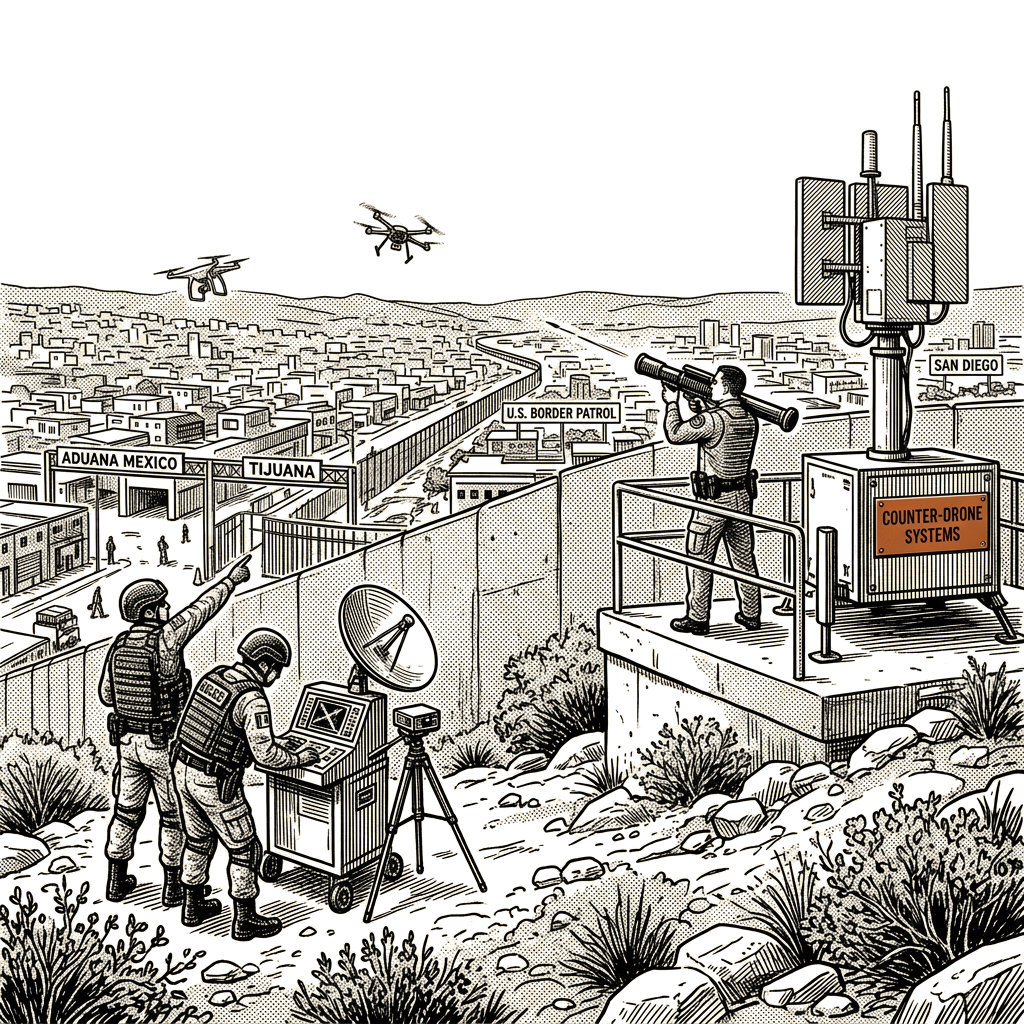
Operation Águila Alta went live the morning of August 31 along the Tijuana-San Diego corridor and runs through September 21. Mexico’s Defense Secretariat and the U.S. Joint Task Force-Southern Border are running “mirror” patrols on either side of the line — armed forces coordinating surveillance of criminal drone traffic while each side’s sovereignty stays intact on paper. The Mexican side says it won’t disclose troop counts, system counts, or which U.S. agencies are along the line, and they have not yet reported any disabled-aircraft tallies from this corridor. A similar operation ran along the Ciudad Juárez-El Paso corridor from March 17 through March 31. This is the second joint Mexico-U.S. counter-drone deployment in six months, and the contractors who build the systems are already looking at a third.
The numbers tell the operating tempo. Mexican military officials estimate as many as 1,000 cartel-operated drones cross the border each month. The U.S. military neutralized more than 300 unauthorized drones in 2026 — more than 100 in August alone. The Army’s AMP-HEL — Army Multipurpose High Energy Laser — downed three aircraft on the nights of August 25 and 26, as Northern Command confirmed late last month. In June the Army awarded a $13.8 million contract to expand detection and mitigation in Laredo and the Rio Grande Valley. The recipient of that contract hasn’t been disclosed in the public reporting. But the contractors who compete for these awards are the same prime defense firms — Lockheed Martin, RTX, Northrop Grumman, Boeing, General Dynamics — and the newer defense-tech shops that have carved out the counter-drone lane. The men who write the requirements are often the same men who rotate into the firms that fulfill them.
The man running the U.S. side of this is Maj. Gen. Curtis Taylor. He called the drones “hostile” because, he said, they supported activities that posed a physical threat to military personnel and Customs and Border Protection agents. When a two-star general uses the word “hostile” for a $500 commercial quadcopter, he is asking the military to treat the border as a theater of operations. A $500 commercial quadcopter is not a hostile platform. It is a surveillance tool with a camera and a battery. Treating it as one puts soldiers in the posture of war for an economy problem.
That economy problem is the part the political class doesn’t want to talk about at the same microphone where they announce the contracts. The cartel drone threat is real — the cartels do scout Border Patrol agents, do track Mexican military convoys, do steer loads across the line. But the drones are a delivery mechanism for a market that sits in every city in this country where somebody can buy a bag. The U.S. has spent half a century and tens of billions of dollars trying to interdict the supply. Plan Colombia, the Mérida Initiative, the Andean Initiative, the Caribbean interdiction operations, the armed CBP, the National Guard deployments, the counter-drone lasers. Each round of escalation has bought time — time for the demand to remain unaddressed, time for the contractors who build the tools to sell the next round.
Now, I’m just a simple man, but I have run a shop for thirty years and I know what a recurring service contract looks like. The cartel buys a better drone. The contractor sells a more advanced laser. The cartel buys a drone the laser can’t lock. The contractor sells a next-generation system. The drug war is the gift that keeps giving — to the contractors. The appropriators on the House and Senate defense subcommittees vote the funds. The men and women operating the AMP-HEL and the counter-drone systems do not vote the funds. They execute the orders. That gap is the same gap I sat inside when I was twenty-two years old and a tank crewman in the 3rd Infantry Division rolling through Iraq in 2003. The men sent to do the work are not the men whose fathers write the appropriations.
I want to say something about who lives this policy on the ground, because the soldiers are not the only ones. The migrants being trafficked through these corridors — the people the drones are scouting for — are running from economies the U.S. has spent decades destabilizing through the same interdiction policies. They pay the smugglers because the legal crossings are closed to them. The smugglers buy the drones. The drones get shot down. The migrants get rerouted through the desert. The border-town families on both sides — the Laredo mechanic, the Tijuana market vendor, the kid in the colonia — live under a permanent surveillance operation that does not stop the smuggling and does stop a teenager from walking to the corner store without a CBP helicopter overhead. And the rank-and-file troops — the twenty-two-year-old specialist who wired the sensors, the staff sergeant who logs the neutralizations, the warrant officer who calibrates the laser — are doing the job their country asked them to do, and they will do it well, and the contractors and the appropriators and the generals move on to the next round while the soldiers carry the deployment home with them.
Phase two of Águila Alta, which began this week, is the real work — personnel and counter-drone equipment on the line. Mexico’s Defense Secretariat has not disclosed how many troops or systems are committed, has not named the participating U.S. agencies, and has not yet reported any disabled-aircraft tallies from the Tijuana-San Diego deployment. That opacity is the only thing in this operation that deserves criticism, and even that is smaller than the criticism the contractors and the appropriators and the generals deserve.
The Army is firing lasers at cartels because the contractors need a customer and the political class needs a metric. The men with the lasers are doing their jobs. The migrants on the trail are not the enemy. The border-town families under the surveillance are not the enemy. The cartel scouts flying the drones are a symptom of an economy that nobody in Washington wants to talk about at the same microphone where they announce the contracts. Now do it across the full 2,000 miles — and ask, while you’re at it, what the lasers are actually for.