
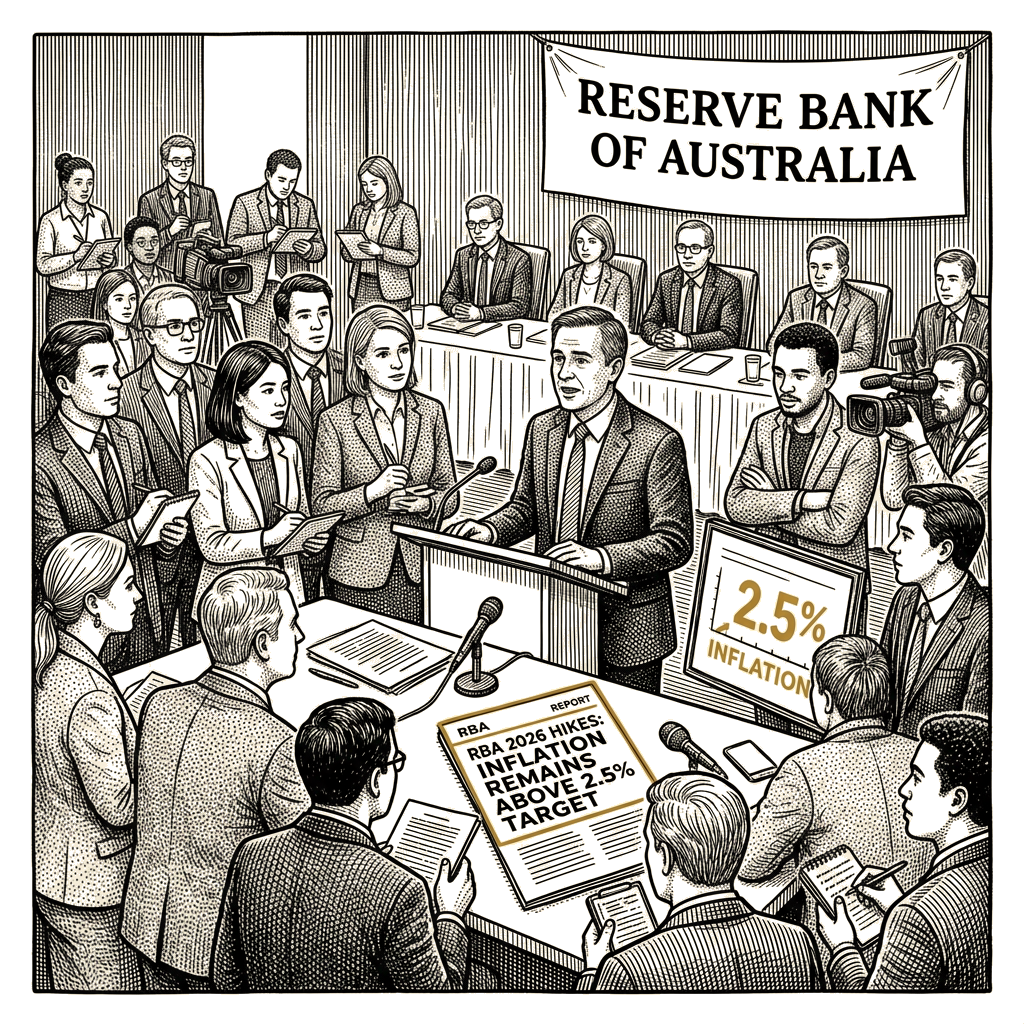
RBA has let inflation steal five years of Australian wages and called it employment policy.
Three numbers tell the story of the Reserve Bank’s five-year inflation fight.
The first is the target: 2.5 per cent, set by the RBA itself. The second is the outturn: annual inflation has been above 3 per cent every year since mid-2021 except one. The third is the action: three interest rate hikes in 2026 alone, with financial markets pricing a better-than-70 per cent probability of a fourth on 29 September and the chance of a fifth before year-end not ruled out. The August pricing had this probability already running high; it has not receded.
Three rate hikes against an inflation problem higher rates do not solve.
Deputy governor Andrew Hauser acknowledged as much on the ABC’s 7.30 report on Tuesday. “People are furious about inflation,” Hauser said. “Inflation has been above target for a long period of time and at some point we will have to say, ‘That is long enough.’” He framed the alternative on the table in the plainest terms: “We could no longer take seriously the full employment part of our objective [and say] we’re gonna bring inflation down come hell or high water.” He named the tradeoff the board has been making: “The reason as a board we have decided to take it slowly is to preserve as many jobs in this country as we could.”
The framing is precise, and it is on the record. The board did not stumble into the five-year overshoot. It walked in with its eyes open.
Five years of above-target inflation is a transfer — and the transfer is not symmetrical. On the paying end: renters, wage earners whose contracts reset at inflation-plus-nothing, and retirees whose term deposits have lagged the cost of living. On the receiving end: mortgaged homeowners whose real debt burden has shrunk, equity holders, and anyone whose assets are denominated in nominal dollars that inflation has cheapened. The mechanism does not need a theory. It runs on arithmetic. The dual mandate, in operation, has been a redistribution from real wages and future mortgagors toward current asset holders — and the Reserve Bank has been running it for five years.
Conventional monetary tightening works by reducing aggregate demand — total spending across the economy. Higher borrowing costs slow household consumption, cool investment, and bring the economy back toward target through what economists call demand destruction: the deliberate creation of enough economic slack (unused capacity, including unemployed workers) to remove pricing pressure. The mechanism presumes demand is the source of price pressure.
That presumption does not hold against the inflation drivers identified in this week’s news.
The first driver is oil. The global benchmark has crossed $US100 a barrel for the first time since July, on the complete breakdown of the US-Iran ceasefire and the escalating strikes on tankers and infrastructure around the Strait of Hormuz. Australian fuel prices are tracking higher: unleaded approaching $2.10 a litre, diesel past $2.50. None of this responds to the Reserve Bank’s cash rate — its main policy interest rate. The supply is constrained by geopolitics; the price reflects that constraint; the RBA’s instrument has no purchase on the cause.
The second driver is datacentre construction. Reporting this week confirms “this year’s sudden explosion in datacentre investment” pressuring a construction sector already straining to deliver housing, roads, and rail. This is real-economy demand for materials and labour bidding up costs. Higher rates do slow some of it. They do not slow it efficiently: the binding constraint — the limit that actually blocks further output — appears to lie with the supply of materials and skilled labour rather than cost of capital, with the willingness to build running ahead of the system’s ability to deliver. A rate hike raises the cost of capital for the datacentre project; it does not loosen the supply of materials or train another electrician. The RBA cannot print welders. It cannot print switchgear.
The third driver is flat productivity. “Australia’s productivity performance — the thing that could make it easier for the economy to grow without pushing inflation up — remains flat.” A flat productivity line means new demand translates into price increases rather than absorbed output. Higher rates do not improve productivity. They do not retrain workers. They do not move more materials onto construction sites. The interest-rate lever does not reach.
What higher rates do, against this configuration, is impose demand destruction on Australian households. Mortgage payments rise. Credit tightens. Households cut consumption. Unemployment rises as employers adjust. The board’s chosen slow path has been a choice to defer those costs — and to transfer the cost of patience onto mortgagors through future tightening, while workers absorbed the inflation that the slow path tolerated.
Neither shock responds to the interest-rate path. They are supply-side. They are also the kind of shock a central bank with credibility should be able to look through — because the credibility the Reserve Bank has spent five years losing is precisely the credibility it now needs to absorb them.
Mainstream central bankers will respond that expectations are the bridge — tighten hard enough, anchor the path, and supply shocks do not become embedded in price-setting. The Australian record runs against the channel. Five years of tightening, an inflation target continuously missed, and a board that has itself conceded the gap is not closing on the path it set. Expectations have been unanchored long enough that the textbook mechanism is the one the RBA has demonstrably failed to operate. Another hike on 29 September will run the policy that has produced the result on the page, not the policy that produces the textbook result.
The pattern is not unique to Australia. The US Federal Reserve’s preferred PCE inflation measure (the Personal Consumption Expenditures price index, the Fed’s preferred gauge over CPI) ran at 3.7 per cent year-over-year in July, well above the 2 per cent target, after a rate-cutting cycle that had to reverse when supply-side pressures proved durable. The same configuration recurs across jurisdictions: central banks raise rates against supply-side shocks, fail to reach target, then face the choice between accepting the inflation they cannot fix or inflicting the demand destruction they can.
A credible disinflation will require more than one hike. The path that works is a committed one wage earners and price-setters can plan against, not intermittent hikes that follow, rather than lead, the inflation print. Markets have been moving this way for months; the board has been moving more slowly.
Monetary policy cannot bring down oil prices. It cannot staff a datacentre. It cannot lift productivity. Those require fiscal policy, structural investment, training pipelines, and a construction sector that can deliver the housing and infrastructure pipeline Australia is running short of. The Reserve Bank has spent five years asking monetary policy to do work it cannot do. Asking it to do more will not change the answer.
This was a choice. The choice is on the record. The costs have been paid by the people the framing does not name.