
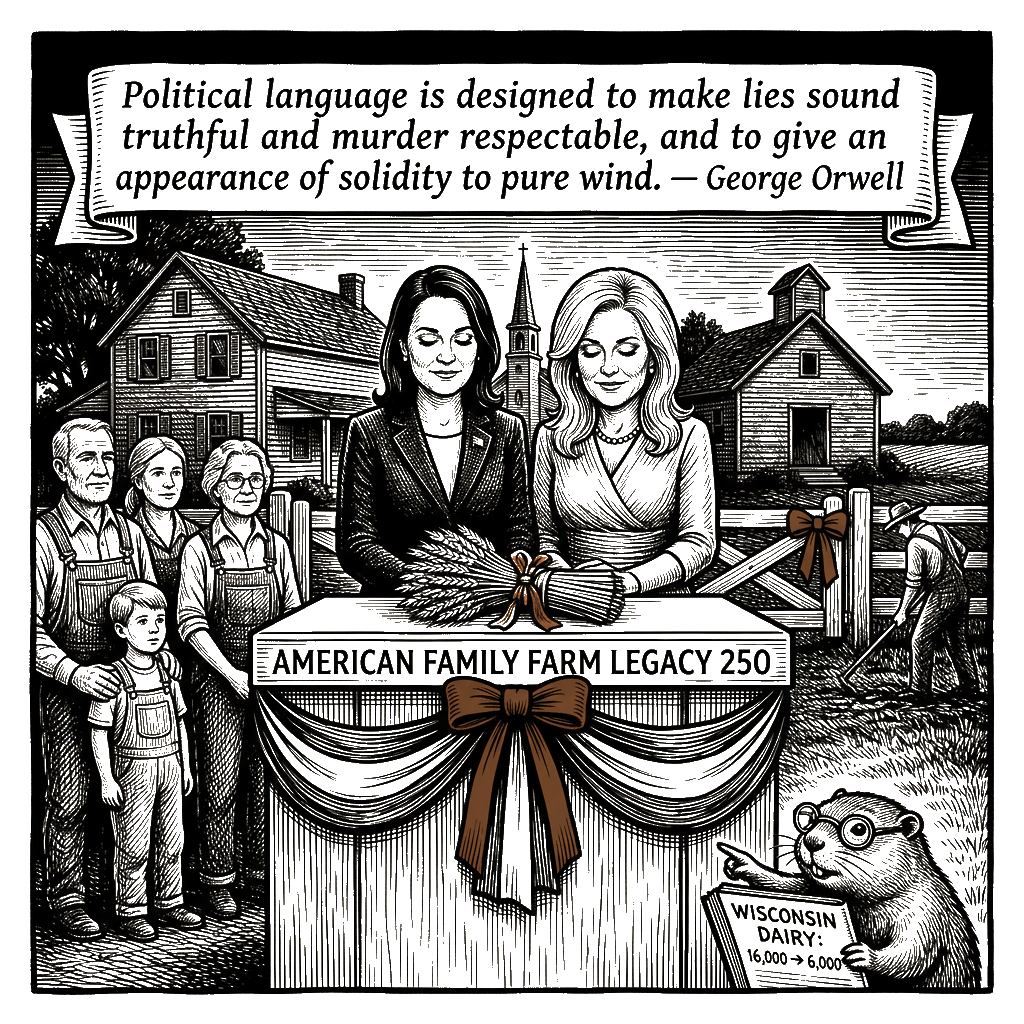
The administration that is killing the family farm has decided to celebrate it. Secretary of Agriculture Brooke Rollins and Ambassador Monica Crowley, writing in America’s Family Farms Have Kept Us Strong for 250 Years, want to put a bow on the thing they are signing the death certificate for. Their new American Family Farm Legacy 250 Program publicly recognizes multigenerational farms from 100 to 250 years of continuous operation — Round Swamp Farm in East Hampton, nine generations of Lesters, Carolyn Snyder still growing and selling on the original parcel — and places these families at the wellspring of American virtue: faith, family, patriotism, civic responsibility, the long view of the country. They quote Jefferson on the cultivator of the earth as the most valuable citizen. I will not grant them — and no conservative with a memory and a county behind him can grant them — the right to wave that flag while their own administration’s policies put the family farm in the ground.
I will grant them the values language; it is at least honest about what the thing is. The Lesters and the families they put on the Mall this summer are the real thing, and I will not hear a word against them. The family farm, in the sense Rollins and Crowley mean it, is what it has always been: an institution generations built, a parcel passed down with a name attached, a household and a parish and a school and a co-op all woven into one another. It is the sort of thing Burke meant when he called society a partnership between those who are living, those who are dead, and those who are to be born. To be against the family farm is to be against continuity itself. I am not against the family farm. I am against the people who celebrate it in the morning and accelerate its funeral in the afternoon.
But the gesture is a funeral march. By the USDA count, Wisconsin had just over sixteen thousand dairy farms in 2002; twenty years later it had about six thousand. The average herd went from fifty-six cows to two hundred and three. In the next county over, Heartland Farms — five generations removed from a Polish-immigrant founding, headquartered in Hancock in this same central Wisconsin sand country — runs roughly twenty-seven thousand irrigated acres across several counties, with thousands of those acres in potatoes under contract to Frito-Lay. That is what the family farm becomes when the language outlives the operation. The name stays. The household is gone. The cousins have moved to other jobs in other counties. The kids aren’t in the school. The names aren’t on the church council. Every farm that disappears is a parish that thins, a school that loses a grade, a co-op that loses a member, a table at the diner that goes empty. The family farm did not lose to a free market. It lost to the rigged market the right built — and it is that market the right now tells us to trust.
I used to trade these very crops’ futures on a Chicago desk, before either was in the ground. I left that building and now run a farm cooperative in Adams County, in the sand country of central Wisconsin. I know precisely how little the men in that building think about the men in the field. The arithmetic of consolidation is not a moral mystery. It is a balance sheet. When the trade war raised the tariffs on soybeans and the price fell, the small operator took the loss. When the biofuel mandate subsidized industrial corn, the diversified farm could not compete. When the consolidated meatpackers captured the cattle market, the rancher lost his bargaining power. The bailout checks were borrowed. The families that took them took them because they had to, because there was no other buyer for the beans, and because the alternative was the auction block. That is what the celebration looks like from the family’s side of the fence: a ceremony on the Mall, and a check that has to be cashed because the policy that sent it is the same policy that ruined the year.
I should say what I am not saying. I am not saying the men and women of this administration wish the family farm ill. I am saying their policies do, and that what they wish is beside the point. A trade war is a choice. An enforcement raid on a dairy or an orchard is a choice. Cutting the conservation programs and the local-meat-grant infrastructure and the county offices the small operator actually relies on is a choice. Each choice, taken alone, has a justification. Taken together they are a strategy: a strategy that favors the consolidated operator over the family operator, the contract grower over the independent grower, the line of pivot-irrigated acres feeding a snack-food plant over the diversified farm feeding a town. The consolidated operator can absorb a tariff. The diversified family cannot.
I want to say one more thing about who pays the bill, because the men and women on the receiving end of these policies include strangers to this country who came here to do the work, and I will not hear them blamed. The agriculture workforce — in dairy, in orchards, in the specialty crops no American-born workforce is sufficient to harvest — is overwhelmingly immigrant. When that workforce is hunted instead of recognized, the family farm that depends on it does not become more American. It goes under. The language of the family farm and the language of the raid cannot both be true. One of them is the costume. The other is the policy. The fire belongs on the power that profits from making the labor precarious; it does not belong on the stranger in the field.
The honest answer is not a new agency in Washington. It is not a tribute program on the Mall, however sincere the families it honors. The honest answer is what we have been building in this country since long before either party remembered we existed: the cooperative. I run one. The members sit across the table from me. They elect the board. One member, one vote. The surplus returns to them, not to a shareholder in another state. That is the Rochdale principle, written by twenty-eight flannel weavers in Lancashire in 1844, and it is still the truest description of a just business I know. Our farm co-ops are lawful under the Capper-Volstead Act of 1922, which gave agricultural marketing co-ops a limited antitrust exemption so farmers could collectively bargain against concentrated buyers without being prosecuted as a cartel. A Republican Congress passed it. Calvin Coolidge signed it. The cooperative is not a left-wing idea. It is the right-wing idea that the right forgot.
The proof is everywhere, and it predates any of us. The Rural Electrification Act of 1936 — another Republican idea, in its substance — financed member-owned electric co-ops that lit the countryside the investor-owned utilities had decided was uneconomic to serve. The largest rural electric cooperative in Wisconsin is headquartered two miles from my own desk, in Friendship, in this county — Adams-Columbia Electric Cooperative, tens of thousands of member-owners across the central-Wisconsin counties it serves, governed by a board the members themselves elect. It does not answer to a faraway shareholder. It answers to a farmer in Colburn and a cabin-keeper on Castle Rock Lake. Mondragon in the Basque Country is a worker cooperative federation employing over seventy thousand people. Land O’Lakes does more than sixteen billion dollars in annual sales. Organic Valley, headquartered up the road in La Farge, unites more than sixteen hundred organic family farms. None of these is a tribute program. All of them are the thing the tribute program is decorating: a working counter-model to the consolidated operator, the contract grower, and the absentee owner who has never set foot on the land and treats the family that lives on it as a cost to be trimmed.
Here is what I would say to the Secretary, if she cared to hear it from a man who used to price her farmers’ crops before they were in the ground and now tries to market them after. Stop honoring the family farm. Start building one. That means a cooperative-development program that actually reaches the next generation, a right-to-repair law that lets the independent producer keep his tractor, a trade policy that does not turn the export market into a roller coaster, a labor policy that recognizes the workforce instead of hunting it, and an antitrust line that takes the consolidated operator seriously as a threat to the institution generations built. The family farm does not need a ceremony on the Mall. It needs a government that means what it says when it says the word family. Until then, the tricolor bunting and the Jefferson quotation are exactly what the Founders would have called them: decoration over a sepulcher. The work that actually saves the institution is not in Washington. It is at the co-op table in Friendship and La Farge, in every county seat where members still elect their own board and price their own crop, in the structure the country once built on purpose before either party remembered we existed. Build that, and the family farm does not need a tribute. It needs only to be left alone long enough to be itself.