Pauline Hanson erases Indigenous history to win votes.
In a September 2025 podcast first reported by News24, the 72-year-old One Nation leader called Indigenous Australians “the most primitive race on Earth” and said they had “achieved nothing.” The recording resurfaced this week, and the country received the familiar sequence: condemnation, spectacle, refusal, reset.
The words were not an accident. They were the old colonial judgment stripped of its parliamentary wrapping. A people who have cared for this continent for thousands of generations become primitive because the speaker refuses to see what they built, protected, remembered, and still practice.
Three Indigenous senators answered her.
Indigenous Affairs Minister Malarndirri McCarthy, a Yanyuwa and Garrwa woman, called the comments “totally outrageous” and told Hanson to apologise to the Aboriginal and Torres Strait Islander constituents she represents as a Queensland senator. McCarthy pointed to the Great Barrier Reef, Cape York, and the dance, song, and story carried through the country Hanson claims to represent.
Jacinta Nampijinpa Price, the Coalition’s Indigenous affairs spokesperson and the public face of the Voice-to-Parliament “no” campaign, said some issues Hanson raises are serious debates. Then she named the evasion. Hanson had “dragged the conversation into appalling territory,” Price said. Her question — “What the hell have they done in this country?” — was “a demonstration of wilful ignorance” and a “complete failure to understand Australia’s First Peoples.”
Independent senator Lidia Thorpe put the history back where Hanson had removed it. First Peoples, Thorpe said, have “for thousands of generations” cared for the continent, developed sophisticated systems of lore, knowledge, agriculture, land management, science, and art, and maintained living cultures that continue today. She called for the Albanese government to implement the national anti-racism framework and include anti-racism provisions in the digital duty-of-care plan. Hanson, Thorpe warned, would continue spreading “nasty, poorly informed and harmful ideas to rally her base and divide this country.”
Hanson’s answer was posted to social media: “The media is in a tailspin again today about comments made a year ago on this podcast. Have a look. You be the judge.”
Yes. Judge her.
That is the part that connects Australia to Adams County. I have watched our own public memory do its honest work and its dishonest work. The Adams County Historical Society keeps the records of the place: the railroad that built Adams a mile south of Friendship, the two governments that became one community, the county fair held since 1859, the Leola drainage district that dug forty miles of ditches and then watched drained peat burn and fail. Those records matter because they tell a household why the road is where it is, why the school was placed halfway between the two towns, why the land still holds water where somebody once promised it could be made productive.
The Adams-Friendship school district was deliberately placed between the rival towns. That was not decoration. It was a working settlement between people who could have spent another generation treating the other side of the county as an enemy. Families sent their children to the same school because the institution carried a memory larger than either town’s grievance. Civic trust is built that way — not through a slogan, but through a building, a bus route, a board meeting, and the knowledge that the public place belongs to both sides.
Erase that history and the practical loss is not abstract. Parents lose confidence that the school belongs to their children. Neighbors stop trusting the records kept by the county. Every public decision begins to look like somebody else’s private deal. The household pays in longer drives, thinner institutions, and the steady feeling that no one is keeping the whole place in mind.
Hanson’s question performs the same erasure at a national scale. It treats a continent as empty until the people now holding office arrive. It turns the absence of recognition into proof of absence. The harm is not only to the people insulted. It damages the public record that everyone must use to decide what obligations they have to one another.
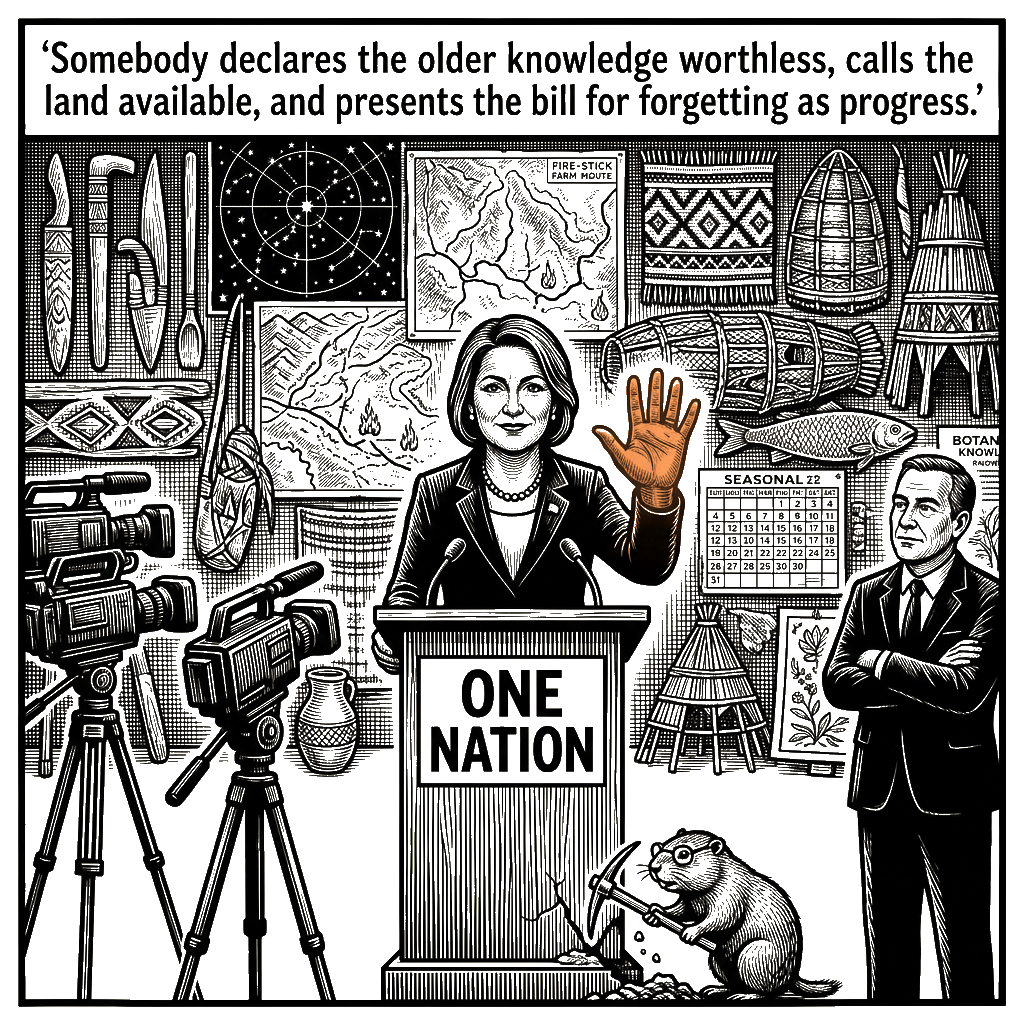
The Leola story is not the Australian story. The peoples, histories, and injuries are not interchangeable. The mechanism is recognizable. Somebody declares the older knowledge worthless, calls the land available, and presents the bill for forgetting as progress. In Adams County, the bill came due in failed drainage, burned peat, lost farms, and public restoration. In Australia, Hanson wants the country to forget the people who managed the country before her political career existed.
Hanson has been here before. She has spent three decades making a career from the dare: call me offensive, call me racist, call me outside the respectable boundary, and then watch my vote rise. She is not a fringe figure pretending to be mainstream. She is mainstream pretending to be a maverick.
The separate fight involving Liberal MP Andrew Hastie makes that plain. After his party demoted him for taking Hanson on, two weeks of “slanging matches” inside the Liberal party room turned her politics from a Coalition embarrassment into a question of who leads the Australian right. A senator who calls the world’s oldest continuous civilisation “primitive” is helping decide the future of the opposition.
That is the actual news. Not that Indigenous Australians have been insulted again. They have heard versions of this since 1788. The news is that a major party still bargains with the person saying it as if she were a normal participant in normal politics.
Price is the test case. She is the Indigenous voice the Liberal-aligned right has been waiting for, and she has told Hanson that this is “appalling.” McCarthy, Price, and Thorpe do not share a platform or a political program. They share a verdict: the insult is an act of historical ignorance, not a contribution to public debate.
The same political currency travels across oceans. At an American rally, JD Vance called a Democratic candidate “very, very evil.” At a Texas Republican convention, an elephant urinated on the convention floor and the spectacle became the message. In both cases, the room was invited to treat basic judgment as tribal entertainment. The loudest person makes the claim; the establishment shrugs; the audience is told to judge for itself.
That is how moral language gets worn down. “Primitive,” “evil,” and every other word that turns a person or a people into a threat becomes another piece of campaign equipment. The target’s dignity becomes the cost of admission. The people holding power call it provocation, and the people paying the cost are told not to be so sensitive.
Hanson’s “you be the judge” is not humility. It is a refusal to accept the public meaning of her own words. She wants the reach of the insult and the shelter of ambiguity. She wants the vote produced by the wound without carrying responsibility for the wound.
The pattern is sickeningly familiar. The slur surfaces. The chamber erupts. The cameras roll. The word “gaffe” arrives to make the act smaller than it is. The vote ticks up in Queensland. The cycle resets.
The Adams County Historical Society does not preserve our past so that we can admire old buildings. It preserves the evidence of decisions, failures, compromises, and obligations. That record tells us who moved the courthouse, who built the railroad, who drained the marsh, who paid when the scheme failed, and which institutions survived because people chose to share them. Remove the record and you remove the public’s ability to judge what happened or who owes repair.
Australia’s history deserves no less care. Indigenous Australians do not need Pauline Hanson’s permission to have achieved something. The country needs an honest account of what they have always done.
Hanson has done it again. The answer, on the evidence of thirty years, will be: as many times as she likes.