
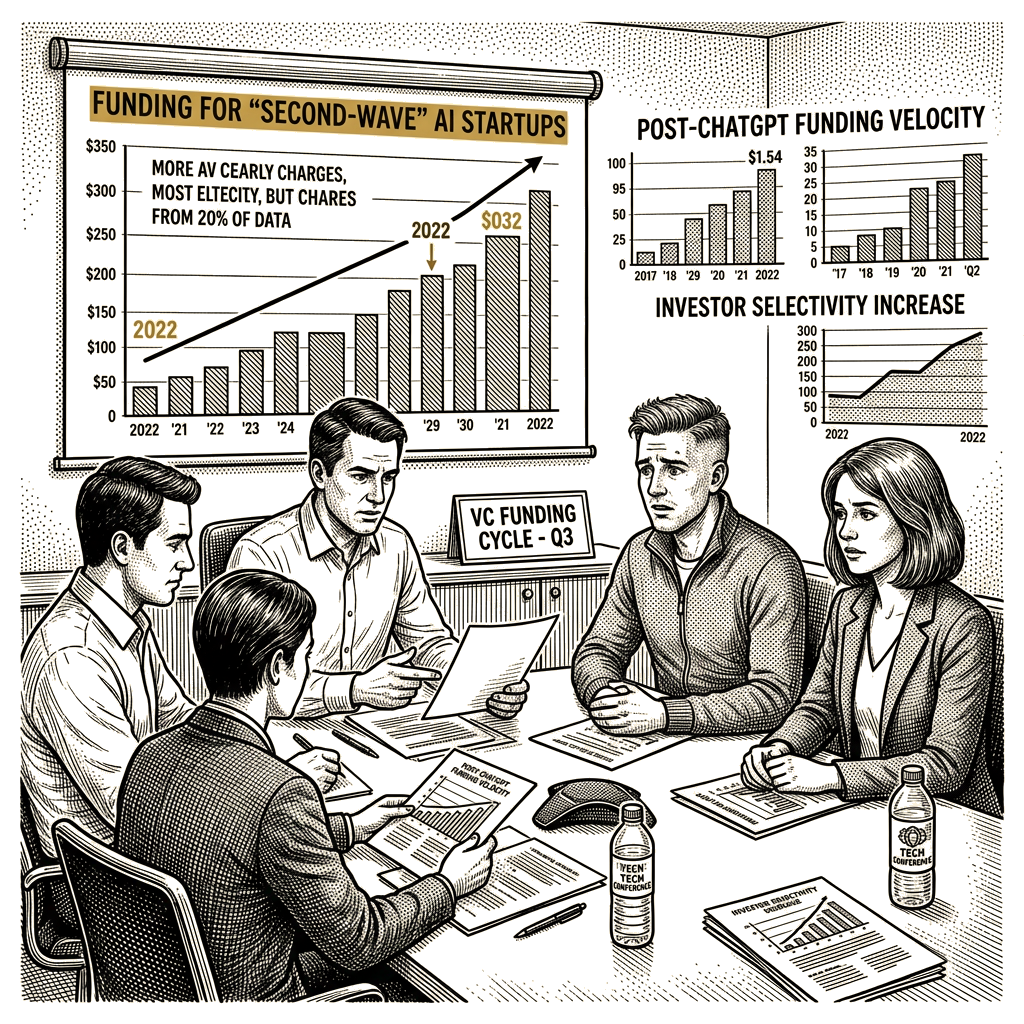
The ChatGPT generation of AI startups did not fail; the venture-capital industry funded too many of them on pure hype, yanked away the middle rung when the euphoria cooled, and is now pretending its own panic is the startups’ problem.
The numbers tell a familiar story of collective delusion. AI first financings in the United States rose from roughly 2,150 in 2022 to nearly 3,400 in 2023, an avalanche of capital deployed by investors terrified of missing the next great thing. The venture industry prides itself on contrarian conviction. When the paradigm shift arrived, it did what it always does: threw money at everything that moved and promised to sort it out later.
Later is here.
The sorting is brutal. As Ethan Kurzweil of Chemistry described it, the middle ground in venture has collapsed into a failure mode. Companies that once moved from promising startup to viable middle tier to eventual maturity now face a binary: become the next trillion-dollar juggernaut or die. The people who built that binary are the same people now expressing surprise that it exists.
Kaidi Gao at PitchBook is right that the bar is higher and investors are more selective. The Wall Street Journal’s “AI anxiety” passage is right to point to the ballooning stock market, the unregulated precipice, and warnings from inside the companies themselves. The mounting warnings about an AI bubble and the comparisons to the dot-com era are not imaginary.
But that account is true only as far as it goes. The part it misses is the part that matters more.
The venture industry is not discovering that most AI startups were overvalued. It is discovering that it cannot stop overvaluing them. One prominent venture capitalist wrote publicly about the “Trilicorn,” the trillion-dollar pink elephant every investor cannot stop chasing. He called it “a self-fulfilling prophecy among us VCs for VCs.” That is an extraordinary admission. The industry already knew the application layer would contain expensive mistakes. It funded the mistakes anyway, because every fund needed to believe it was writing the check to the next OpenAI.
The pink elephant is a coordination failure dressed up as strategy.
When every investor calibrates for a trillion-dollar outcome, a company that might realistically grow to $500 million or $1 billion in revenue becomes a failure—not because it failed, but because it succeeded at the wrong scale. The venture model once sustained a portfolio of moderate successes alongside a few enormous wins. It has lost its appetite for moderate. As the bubble warnings have mounted, capital has concentrated even more aggressively at the top, starving the companies that might have been durable at a smaller scale.
The venture class has talked itself into a very expensive kind of blindness.
Now the same firms that poured money into thousands of AI companies in 2023 and 2024 describe their own exuberance as an industry-wide phenomenon, as though the mania were weather and not a sequence of checks written by identifiable people. The “expensive mistakes” are not being acknowledged by the startups that made them. They are being acknowledged by the venture capitalists who financed them.
And yet the ChatGPT generation may not need venture’s permission to survive.
Nick Candy of J.P. Morgan put the quiet truth plainly: AI-native businesses can have better margins. Built with the new tools, some startups can reach profitability without the perpetual fundraising treadmill that defined the last decade’s startup playbook. The second wave Kurzweil writes off as a casualty of the vanishing middle tier may simply stop caring about the tier system altogether. When a company’s costs are 40 percent leaner than those of a pre-ChatGPT competitor, failure to raise a Series B begins to look less like death than an awkward conversation with the cap table.
Some of these companies will endure precisely because they were forced off the venture teat before the industry’s collective psychology curdled.
The dot-com comparison also flatters the comparison-makers more than it illuminates the facts. The dot-com bust wiped out companies with no revenue model and negative gross margins. The ChatGPT generation has better margins, lower capital intensity, and a foundation-model layer that keeps becoming cheaper and more capable with each release. The analogy may be useful as a warning about speculation. It is not a warrant for pretending every application company is a Pets.com with a chatbot.
Meanwhile, the Silicon Valley Bank report points to something the Trilicorn-chasers are too busy to notice. The expected SpaceX listing, alongside public debuts from Anthropic and OpenAI, could generate another wave of founders flush with paper wealth and conviction that the AI revolution still has room to run. But those listings would not merely produce more competitors for the second wave. They could produce more customers, more API consumers, more distribution partners, and more acquirers. A rising ecosystem can lift boats that cannot get a meeting with a growth-stage partner.
The venture industry’s favorite trick is that the exit creates the entrance. The firms that made fortunes on the first wave recruit the next wave, and the cycle begins again with a new cohort of founders convinced their timing is better than the last cohort’s.
Some of them will be right.
The application layer is real. Companies that build durable products on top of foundation models may capture enormous value. But the structure of capital available to them has been warped by the frenzy that created them. The venture industry has not learned from the ChatGPT generation’s growing pains; it is already moving on to fund the next generation’s growing pains, armed with the same binary logic that turned the middle of the market into a wasteland.
Some founders wish it were 2023 again. They should not.
2023 was the year when it was easy to raise money and hard to build something durable. 2026 is the year when the noise has been priced out and the quiet thrivers—the companies with real margins, real product-market fit, and no dependency on the next round—can use AI to outrun the old rules of venture math entirely.
OpenAI’s own path toward a public listing is a reminder that even trillion-dollar dreams must navigate lawsuits, leadership gaps, timing, and the ordinary resistance of the real world. The rest of the generation gets to build.
The ChatGPT generation did not arrive at the wrong time. It arrived at exactly the time the venture industry demanded: the peak of an irrational boom. Now that industry is cataloging the wreckage in the detached language of analysts and market trackers, as though the whole thing happened to someone else.
It did not happen to someone else. It happened because they funded it.