
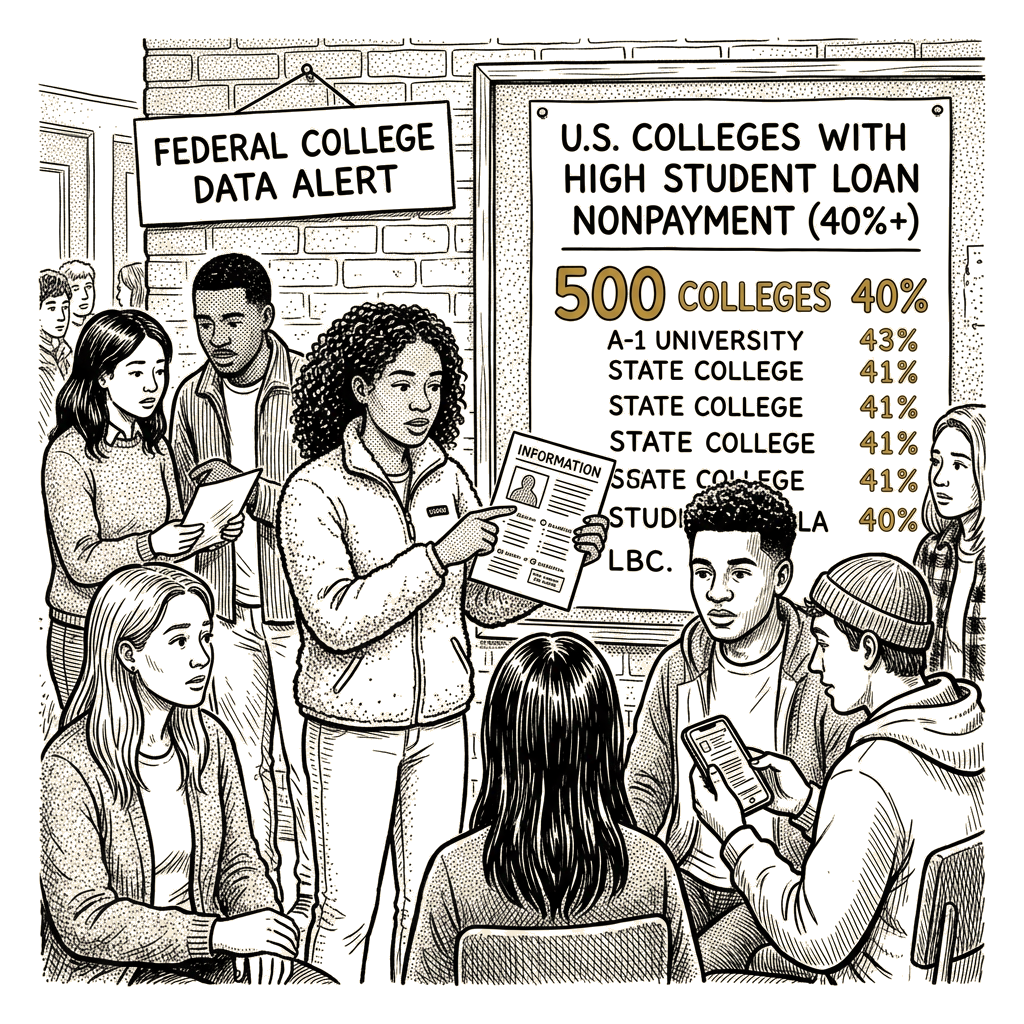
The Education Department is financing predatory colleges that drown low-income borrowers.
Lisa Collenbaugh enrolled at UEI College’s Los Angeles campus in 2015 to become a computer systems technician. She paid $19,500 for a program the school later admitted was not working, including an externship she could not afford to reach across Los Angeles. She did not finish the certificate. She still owes the federal government $10,389.47.
That is one borrower. The Education Department has just named 500 schools carrying versions of the same business model.
Roughly 17 million borrowers entered repayment between January 2020 and May 2025. At each of those 500 institutions, at least 40 percent were not paying back their loans. The list is not a statistical curiosity. It is the federal government’s own indictment of the colleges it continues to finance.
Four hundred and twenty-four of the 500 schools are private, for-profit institutions. Just 15 are public. Public and private nonprofit schools average nonpayment rates of roughly 15 percent. The for-profit sector averages around 33 percent, and the schools on this list are at 40 percent or higher.
That is a category.
UEI, a 22-campus chain mostly in California, has roughly 32,000 borrowers and a nonpayment rate around 55 percent. Federal aid supplies between 79 percent and 85 percent of its revenue. Miller-Motte College has about 37,000 borrowers, with barely half paying, and receives nearly 86 percent of its revenue from federal sources. American InterContinental University System gets 89 percent. Tulsa Welding School has nearly 20,000 borrowers, most of whom are not making payments. At Legends Barber College in Texas, 81 percent of 100 borrowers are not repaying.
The federal government sends the money. The school takes the money. The student receives low-quality training, a balance sheet full of debt and no reliable path to repayment. Then the taxpayer absorbs the failure.
This is not a mystery. It is a business model.
A private lender looking at a school with a 40 or 50 percent delinquency rate would stop lending. Preston Cooper of the conservative American Enterprise Institute has made that point plainly. Eileen Connor, director of the Project on Predatory Student Lending, makes it harder: “If the federal student loan program did not exist, these schools would not exist.” Awarding loans where near-certain default is built into the model, Connor says, “is the definition of predatory lending.”
She is right.
The federal government is not merely being fooled by these schools. It has constructed a closed loop in which federal aid keeps institutions alive that private capital would reject. These colleges market aggressively to low-income students, charge tens of thousands of dollars for short-term certificates, collect federal aid and leave the borrower with the bill.
The 90 percent federal-revenue threshold is supposed to be the line. A school that receives more than 90 percent of its revenue from federal sources can lose access to aid. Almost every school on this list hovers just below it. They are not pretending to be independent private enterprises. They are running federal programs with corporate logos on the doors and recruiting departments aimed at people with the least room for error.
The taxpayer funds the school.
The student carries the debt.
The school survives the wreckage.
The history is worse than the spreadsheet. The Obama administration pressured major for-profit chains such as ITT Tech and Corinthian Colleges, and some operators closed. The model did not. The sector consolidated, rebranded and resumed. The federal data now ties tens of thousands of failed repayments to the same kinds of schools. The closure of a few incumbents cleared space for the next wave.
Florida Career College, owned by the same parent company as UEI, lost access to federal aid in 2023 after an investigation found it violated enrollment rules. It shut down. Its former students still owe on roughly two-thirds of 28,000 unpaid loans. Nothing fundamental changed. The brand moved one corporate entity over.
That is not reform. It is corporate relocation.
The pandemic payment pause briefly hid the damage. Borrowers stopped hearing from servicers, lost track of what they owed and heard years of vague promises about mass loan forgiveness. When the pause ended, defaults jumped by 4.2 million borrowers. The crisis had not disappeared. It had been held underwater.
Now the bill is coming due.
The cohort default-rate test, the long-standing federal accountability tool, has been dormant since the pandemic because borrowers technically could not default. It is set to return. A school can lose access to aid after three consecutive years with a default rate of 30 percent or more, or after one year at 40 percent.
The new nonpayment data suggests hundreds of schools are already above those lines.
For years, the bar was high enough to protect the industry it was supposed to police. The data has now made the evasion visible. The test is coming back online, and the federal government already knows where to look.
The One Big Beautiful Bill Act added another tool: the “do no harm” earnings test. Beginning in early 2027, the Education Department will calculate whether graduates of particular programs earn more than workers who never attended college. The first low-earning-program designations are scheduled for the 2028-29 award year. Programs that fail lose federal aid eligibility.
That test is useful. It is also incomplete.
Jordan Matsudaira, the Biden administration’s inaugural chief economist at the Education Department and now a professor at American University, has identified the hole: some programs can clear the modest earnings threshold while leaving graduates with debt they cannot repay. Earnings are not debt. A program can produce wages barely high enough to pass the test and still be a financial disaster for the student.
A credential can technically raise income and still ruin a life.
The federal government needs to make the earnings test account for debt and make the cohort default-rate test fire when the evidence says it should. The 500 schools on this list are not going to reform themselves. They have already demonstrated what the federal money is buying.
This is the generation told that education was the safe investment, then handed a loan for a credential that could not pay for itself. Anne Helen Petersen’s human-capital frame belongs here: students were sold the idea that they could turn themselves into marketable assets, while the institutions extracting the money were protected from the consequences of selling a bad asset.
There is no personal-responsibility lecture that makes $19,500 for a failed program a good investment. There is no “adult paying her bills” morality tale that turns a federal financing decision into Lisa Collenbaugh’s character flaw. The borrower is the last person in the chain with power and the first person left holding the balance.
The Education Department has the list. It has the repayment data, the default-rate test, the earnings test and the revenue records showing which schools are federal programs wearing private-sector costumes.
If it declines to enforce the cohort default-rate test, waters down the do-no-harm rule, or lets the 90 percent threshold remain the only meaningful check, that will not be an accountability failure. It will be a policy choice. It will mean the federal government has decided that predictable numbers of low-income borrowers can be sacrificed each year to keep a politically connected industry alive.
The receipts are public. Lisa’s balance is public. The schools’ revenue dependence is public. The rules already exist.
The only missing line is the one Washington keeps refusing to enter into the spreadsheet: who gets cut off first?
Not the borrower. The school.