
Donald Trump called concerns about artificial-intelligence dangers a “hoax” on Monday, and the facts behind the argument are less complicated than the conference circuit would like. AI investment accounted for more than a third of U.S. economic expansion in the second quarter of 2026, according to the forecasting firm ING. Chips, data centers, and the infrastructure behind the technology are reshaping the economy. That is real. So is the risk that “safety” becomes a polite word for letting the largest firms write the rules.
Let me concede the strongest case. AI can break a labor market. It can concentrate surveillance, concentrate power, and hand dangerous tools to governments and corporations that already have too many. Those are serious questions. They deserve evidence, not the slogan that “robots will be marching into our cities and getting rid of us all.”
But the public argument is not about those concrete risks. It is about whether the people who already own the machines should also own the rulebook.
Trump said, “We’re leading China in AI, and frankly, I want to keep it that way, because whoever wins AI wins.” Correct question, bankrupt answer. The United States should not surrender technological leadership to Beijing. It also should not surrender the technology to a handful of firms and call the result freedom. Those are not the only two choices. They are merely the two choices most useful to people who already have a seat at the table.
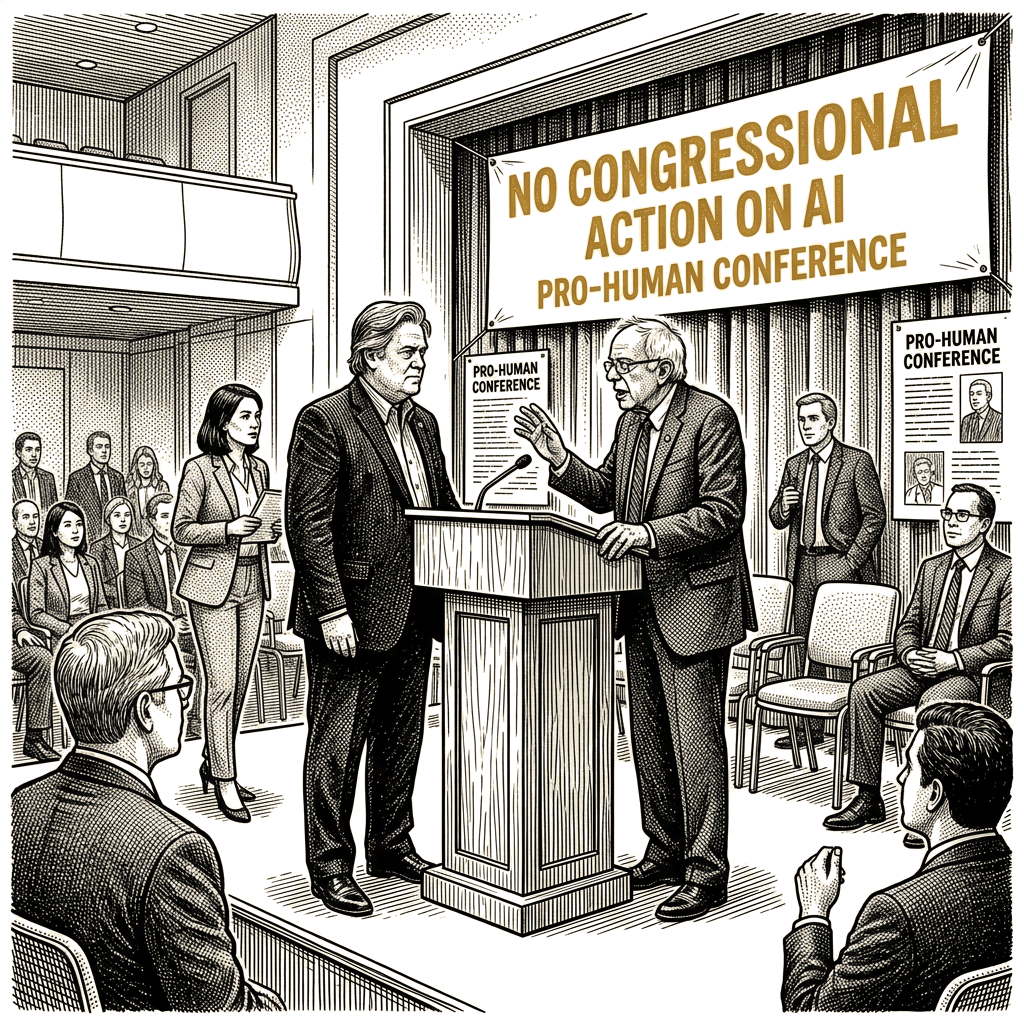
Steve Bannon told a “pro-human” conference that the industry should not receive “a carte blanche” because “there’s been no debate.” Bernie Sanders appeared at the same event, called Congress “asleep at the wheel,” and called Trump’s “ignorance regarding this issue is truly embarrassing.” A man who thinks the New Deal was socialism and a man who thinks it didn’t go far enough, both saying the same thing, is not a sign of political confusion. It is a sign that the question has gotten so obvious that even people who normally can’t agree on the weather have noticed it.
Meanwhile, the men who will build the machines were already at the table. Elon Musk, Mark Zuckerberg, Jeff Bezos, Sam Altman, Tim Cook, and Dario Amodei all occupied prominent places in the political and corporate orbit around the administration. Their views on regulation differ. Their ownership position does not. They are building or financing the systems that will decide who gets hired, watched, paid, and replaced.
That is not proof that every warning is corrupt. It is proof that the warnings cannot be dismissed as mere hysteria because a president finds them inconvenient.
David Sacks, Trump’s informal AI adviser and co-chair of his Council of Advisors on Science and Technology, said, “I think this is becoming a panic.” He is right about one thing: fear is a campaign product. So is technological euphoria. The usual American ritual is to pretend that one emotion is propaganda and the other is common sense. Panic says the future is too dangerous to build. Euphoria says the future is too profitable to question. Both ask ordinary people to sit quietly while someone else decides who receives the gains and who absorbs the losses. And both, conveniently, reach the same conclusion: hand the decision to people who already have power.
The slogan “pro-human” is especially tidy. It implies that anyone questioning the speed or ownership of AI is against humanity. That is the oldest trick in the oligarch’s playbook: wrap a contested policy in a moral universal, then make opposition sound monstrous. The people asking who pays for the transition become enemies of progress. The workers whose jobs are redesigned become obstacles to the redesign.
The central risk is not that a machine will become a demon. It is that a company will become a private government.
A firm can use AI to reduce dangerous drudgery, improve medicine, or help a worker do a difficult job. It can also use AI as leverage: cut the staff, break the union, monitor every movement, and call the resulting insecurity “innovation.” An AI cannot do your job. But an AI salesman can convince your boss to fire you and replace you with an AI that cannot do your job. That is not a sci-fi scenario. That is a bargaining problem. And bargaining problems have bargaining solutions.
The answer is not a regulator’s permission slip or a presidential permission slip. It is a worker-majority deployment board.
The idea is concrete. A company above a certain size — say, 250 employees or any firm whose AI systems directly affect hiring, scheduling, compensation, or termination — must allow its employees to elect a worker-majority board with binding authority over AI deployment. Before any AI system affecting jobs or working conditions goes live, the board reviews it with access to independent technical analysis. It can approve the deployment. It can reject it. Or it can set conditions: no job losses without retraining and placement guarantees, no surveillance expansion without worker input, no automated discipline without evidence the system is accurate.
The technology keeps moving. The workers get a say in how it moves.
This is not industry consultation. It is not an advisory committee that management can ignore. It is binding authority at the point where automation meets a human life. The idea already exists in a more limited form: Germany’s co-determination model puts worker representatives on factory supervisory boards. Some American cooperatives already give members veto power over major operational changes. The mechanism is not novel. The application to AI deployment is the new step — and the one that would actually change who decides.
Concede the feasibility question: this requires legislation or regulatory action that the current Congress, Speaker Johnson having backed away from his earlier openness, is unlikely to deliver. It requires a political constituency that does not yet exist. It requires overcoming the combined opposition of a president who wants the authority himself and a tech industry that wants the authority for itself.
But notice the opposition. Both Trump and the Silicon Valley safety crowd agree that the decision should be made by elites — his elites or theirs. The one thing that would actually disrupt the arrangement — democratic governance at the point where technology meets labor — is the one option neither side is discussing.
That is the tell. The real fight is not between regulation and deregulation. It is between two flavors of private control and one public alternative. The public alternative is not a slogan. It is a board with a vote, a budget for independent experts, and the power to say no.
The legislative path may be dead for now. Matt Calkins, the head of Appian, said, “This is the most prominent debate in the entire industry and has been since the beginning. We knew it would spill into politics at some point because it had to.” Correct. The question is not whether it spills into politics. The question is whether the public gets to shape the terms after the industry has already shaped the machine.
The United States can beat China without turning every American into a test subject. It can build quickly without confusing speed with wisdom. It can let firms compete without letting them become private governments. The question is not whether AI should exist. The question is who owns the thing, who governs it, and who gets the gains.
The panic merchants are wrong that every warning is a hoax. The boosters are wrong that every guardrail is sabotage. The machine is not the weather. We built it. Now build the counterpower too.