
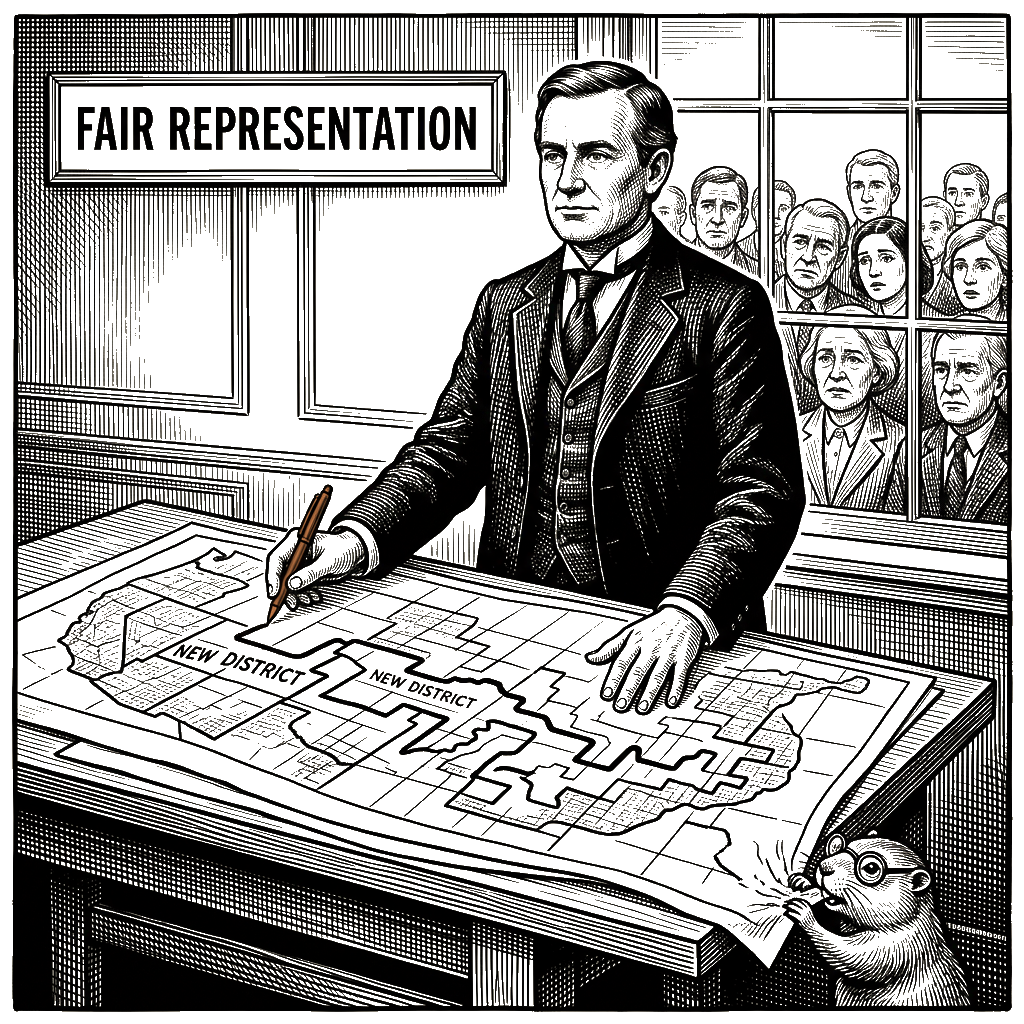
Trump-aligned Republican mapmakers are using mid-decade redistricting to entrench Republican power.
Protect Democracy has now put a number on the damage: 34.8 million Americans—roughly one in ten—live in a congressional district different from the one they inhabited during the 2024 election cycle. Another fifth of the country lives in a district where more than a quarter of the voters are new since that cycle.
That is not a margin adjustment. It is a redistribution of political power.
The mid-decade redistricting fights President Donald Trump helped initiate last year were presented as contests over representation. The beneficiary is more specific than that language allows. Trump-aligned state legislatures and Republican mapmakers are redrawing the electorate to improve the Republican Party’s odds of holding House seats. The public is told that the lines are technical. The outcome is political: voters are moved, constituencies are broken apart, and the party controlling the map gains another layer of protection from the voters it claims to represent.
Every time a district shifts, a Republican mapmaker’s phone rings. Every time a community is divided or a familiar constituency is folded into a new district, the party that controls the line-drawing process gains another opportunity to choose its voters before the voters choose their representatives. This is not an abstraction called “partisan advantage.” It is a mechanism for entrenching the party that drew the lines.
Ben Raderstorf, a policy advocate at Protect Democracy and a co-author of the report, said the trend raises the question of whether elected officials represent their constituents anymore “or if the voters are being randomly picked by mapmakers to squeeze out partisan advantage.” The sentence is more precise than the official language usually permitted around redistricting. The voters are not random. The power is not random. The people drawing the lines are making a choice about which voters belong together, which communities lose a district of shared interest, and which party receives the advantage.
MSI’s coverage tracked the same operation in real time, from the reporting on how Republican redistricting reshaped congressional maps to the account of how the redistricting war accelerated winner-take-all political combat. The new Protect Democracy figure supplies the scale. Thirty-four-point-eight million people are not watching a distant statehouse dispute. They are living inside its consequence.
The Republican Party benefits twice. First, favorable maps can improve its electoral position. Second, the constant remaking of districts weakens the relationship between a representative and an actual community. A representative can claim a mandate from a district assembled for partisan purpose, while the people inside that district are still learning who their neighbors are and what interests they share. The map creates instability, then the beneficiaries of that instability point to the resulting confusion as proof that ordinary people are disengaged.
That is the trick. The public is invited to treat representation as a matter of geography, as if a district were merely a shape on a screen. But a district is a political relationship. It determines which voters can recognize a common interest, which communities can organize around a candidate, which incumbent can build a record, and which people must begin again after a mapmaker has moved the ground beneath them.
The public framing says the maps are about winning seats. The cui-bono trace says who gets the durable advantage: the party and officeholders whose power is strengthened when voters are rearranged faster than they can hold representatives accountable. The cost is distributed across everyone else—voters who lose a familiar district, communities whose political voice is diluted, and citizens forced to spend another election cycle learning a new set of boundaries designed by someone with a partisan interest in the result.
This is why the mid-decade timing matters. Redistricting is ordinarily tied to a census and a predictable public process. Moving the lines between those moments turns the electorate into a permanent construction site. The people with the money, lawyers, legislative majorities, and institutional access can keep rebuilding the map. The people who live inside it are told to adjust.
Republican-controlled legislatures may call that strategy. They may call it legal. They may call it the ordinary roughness of electoral competition. None of those labels changes the beneficiary. A lawful mechanism can still be designed to weaken equal political voice. A procedural process can still serve a concentrated partisan interest. And a party that repeatedly changes the electorate to improve its own odds cannot then pretend the result is a neutral expression of public will.
The Republican Party is not merely participating in a redistricting fight. Its mapmakers are using the machinery of representation to make representation less accountable. They are not asking voters whom they want to govern; they are rearranging voters until the answer is safer for the party already holding the pen.
The map thieves are winning because the lines remain easier to see than the power behind them. That must end. The indictment is not that politics is competitive. The indictment is that Republican power is using the map to make competition less real, then presenting the engineered result as democracy.
A tenth of the country has been moved on paper. The party that moved it should be made to answer for what it bought with that movement: not representation, but insulation; not accountability, but advantage; not a government chosen by the people, but people sorted for the government the mapmakers want.