
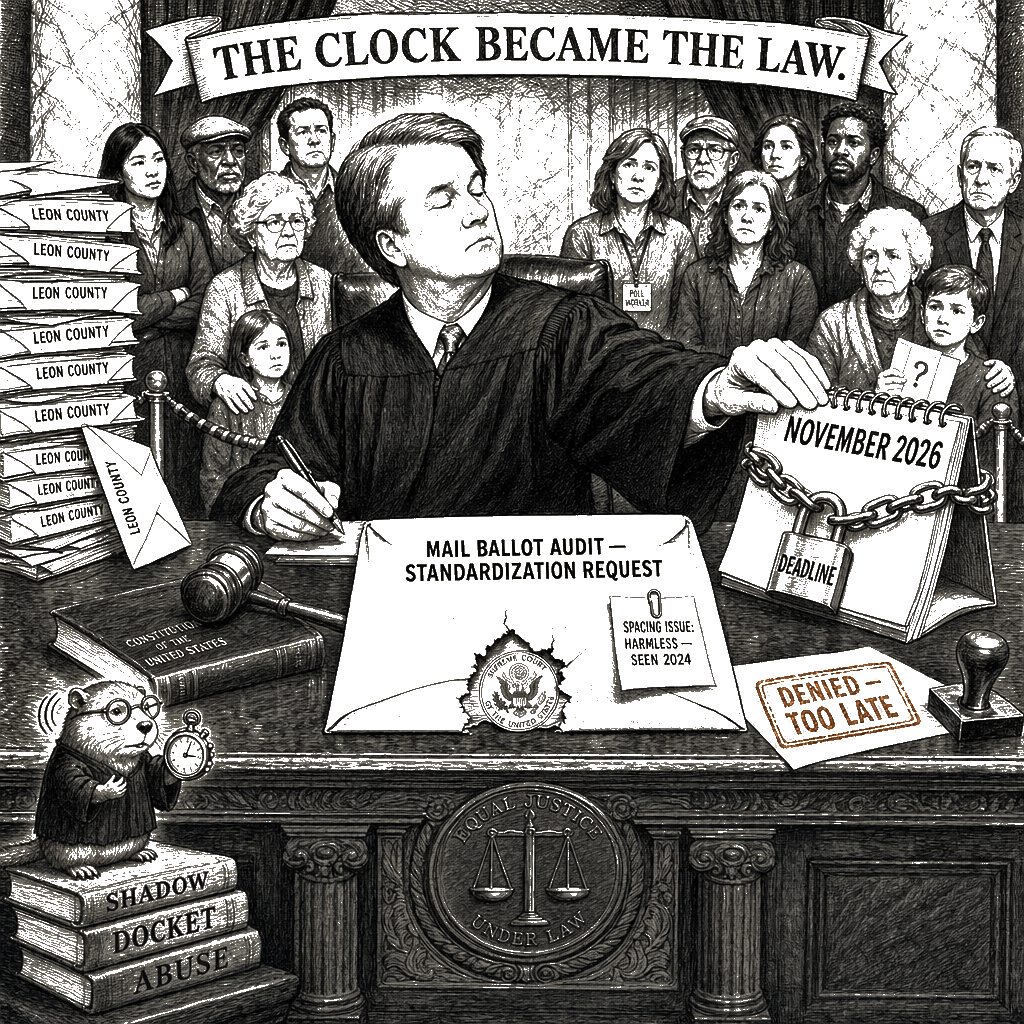
The Supreme Court surrendered a basic mail-ballot audit to partisan panic.
A voter deserves to know where a ballot goes, whether the envelope is identifiable, and whether the state sent it to a real voter. That is not a partisan demand. It is the English-language description of a functioning election.
On Monday, the Court refused to revive President Trump’s effort to give the U.S. Postal Service a limited role in standardizing mail-ballot procedures. The unsigned emergency opinion left the lower-court injunction in place and declared the administration “unlikely to succeed on the merits.” Justice Brett Kavanaugh, writing separately, conceded that there was “at least a fair prospect” that the Postal Service was exceeding its authority.
Then he folded.
Kavanaugh blamed the calendar. “State and local election officials do not have sufficient time to reasonably implement the rule,” he wrote. North Carolina was already mailing ballots. Other states were close behind. The practical objection is real. Election officials cannot redesign, print, and distribute materials overnight.
That is the strongest case against the administration’s position. The Court had to decide whether a late-stage federal intervention would create more confusion than it cured. An emergency order is not a merits opinion, and a genuine election deadline can matter. The justices were entitled to ask whether the Postal Service had identified a lawful authority before attempting to impose a nationwide procedure.
But the calendar became the law.
The administration’s rule was modest. One provision would allow the Postal Service to review and standardize ballot-envelope designs. Another would require states to provide full lists of voters receiving mail ballots. The Postal Service expressly disclaimed responsibility for eligibility, voter rolls, and counting: “The Postal Service will not play any role in determining voter eligibility, maintaining voter rolls, or counting ballots.”
That is not federal control of an election. It is a paper trail.
The rule asked states to show what they were mailing and to whom. It did not authorize postal workers to decide who could vote. It did not transfer ballot counting to Washington. It did not erase state election law. The Democratic plaintiffs, the trial court, and five justices treated envelope review and recipient lists as the thin edge of a federal takeover while leaving the underlying administrative record largely untouched.
The Leon County episode shows what the Court left in place. The Florida county submitted its ballot envelope for Postal Service review and learned on September 2 that the design contained a minor spacing issue. A county official told the local paper, “There is not enough time, even for a rush request, to have these envelopes corrected and produced.” The same envelopes had been used in 2024 without incident.
Perhaps the spacing problem was harmless. Perhaps the Postal Service’s review was legally unauthorized. Those are contestable questions. But the institutional response should have been verification, not panic. The complaint became the story: do not ask us to change anything, even when the proposed change is a correction measured in the width of a gap between words.
Multiply that across hundreds of counties. More than a third of ballots in 2024 were cast by mail. The country has built an election system in which envelope design, mailing lists, signature procedures, receipt deadlines, and counting rules vary from jurisdiction to jurisdiction. That decentralization can protect elections from one centralized failure. It can also make a single national audit difficult.
Decentralization does not prevent fraud. It prevents a single audit.
The Court’s emergency docket now supplies the missing mechanism. An unsigned order can change the operating conditions of an election without full merits briefing, oral argument, or a durable explanation. Stephen Vladeck’s shadow-docket critique applies here in its simplest form: the Court has used emergency procedure to settle a rights-affecting question while postponing the reasoning that ordinary procedure would require.
Justice Samuel Alito and Justice Clarence Thomas dissented. They understood the institutional consequence. An emergency answer becomes a precedent even when the majority declines to call it one. The next trial judge can cite the order. The next election official can invoke the deadline. The next challenge can arrive after the ballots are printed, when correction is no longer possible.
That is how a rule disappears: not through a holding that it is unlawful, but through a schedule that makes lawful review impossible.
The political reaction exposed the same collapse from the other direction. President Trump called the ruling an “open field” for “cheating by the Radical Left.” He then attacked his own appointees: “These are not the people I interviewed to serve on the United States Supreme Court. They are merely a shell of their original selves.”
Trump went too far. He is usually ruder than he needs to be. But the substance of his complaint was sound: the Court’s own appointees recognized a serious question about federal authority and then refused to preserve the mechanism that would have tested the question in public.
Senator Chuck Schumer answered by calling it “Trump’s MAGA Supreme Court,” even though the Court had just delivered the result he wanted. He described the Postal Service plan as an attempt to “rig the November elections” and “smother the voices of millions of Americans.”
Read that again. The same political apparatus that treats mail-ballot administration as untouchable now treats review of mail-ballot administration as voter suppression. The Court’s order did not resolve that contradiction. It rewarded it.
Vice President Kamala Harris supplied the slogan at a rally last month: “They are trying to cheat, and we have got to turn out in big numbers and be too big to rig.” Cheating is not a partisan curse word. But a political system cannot survive when every procedural dispute becomes proof that the other side is stealing the election.
The manufactured crisis over ICE agents at polling places belongs in the same file. Border czar Tom Homan said Sunday, “This is another fear tactic. I want to put that to bed: There is no plan to sweep polling places looking for illegal aliens.” Take him at his word. There is no evidence in these materials of such a plan.
But notice the asymmetry. The same political world that spent years insisting that undocumented immigrants could not vote at any meaningful rate now presents federal verification as an imminent threat to lawful voters. In-person Election Day voting accounted for roughly a third of ballots in 2024. Mail voting accounted for more than a third. The remainder came through early and other voting procedures. The point is not that every mail ballot is suspect. The point is that a system this dispersed requires documentation strong enough to survive accusation.
The country does not need a president who declares every adverse ruling proof of a stolen election. It does not need a Senate leader who declares every audit an attempt to silence voters. It does not need a Court that recognizes the legal question and then uses the calendar to avoid answering it.
The Court should have stated the limits of Postal Service authority, addressed the rule’s envelope and list provisions separately, and explained what election officials could reasonably implement before ballots went out. If the rule was unlawful, the justices should have said so. If the rule was potentially lawful but too late for this election, they should have said that without converting the deadline into a permanent barrier.
Alito and Thomas understood the danger. The unsigned majority did not merely preserve the status quo. It told election officials that the safest course is to resist verification until verification becomes impossible.
The election may not be stolen in November. It will be weakened by inches, in counties nobody watches, through procedures no voter can inspect, under orders no justice has to sign.
The Court did not save democracy on Monday. It told the country, in advance, who gets to lose it.