Jensen Huang’s AI rivals sell extinction panic to escape accountability.
The Nvidia CEO told CBS News that warnings artificial intelligence will end humanity by 2030 are “doomsday narratives.” He put the chance of that outcome at “0%.” “Scaring people is unnecessary,” he said. “It is irresponsible.”
That is not a man dismissing risk. It is a man who understands the machinery telling the public that the panic surrounding it has outrun the evidence.
To be fair, Huang has more skin in the game than almost anyone making this argument. Nvidia builds the chips that make modern AI possible. His company benefits when the buildout continues, and that interest means his claims require scrutiny, not obedience. But incentives do not make a claim false. The relevant question is whether the people predicting extinction have supplied the ordinary engineering material that would make such a prediction checkable: a model, a paper, a probability, a defined failure pathway, or a falsifiable forecast.
The public has mostly received a vibe.
Former Anthropic researcher Jacob Coxon posted that AI developers believe the technology “could kill us all by the end of the decade.” Coxon resigned from Anthropic amid Microsoft’s AI code-of-conduct rollout. Anthropic CEO Dario Amodei and OpenAI CEO Sam Altman echoed the call for a slowdown. None of that, by itself, establishes an extinction probability. None of it supplies a model. None of it tells us what observation would prove the forecast wrong.
The distinction matters. A safety engineer red-teaming a model, an alignment researcher testing a failure mode, or a court deciding a product-liability claim does not need a 2030 extinction prophecy to do the work. They need a specification, a threat model, testable conditions, documented failures, and a chain of responsibility.
A claim that a system will destroy humanity is not a specification.
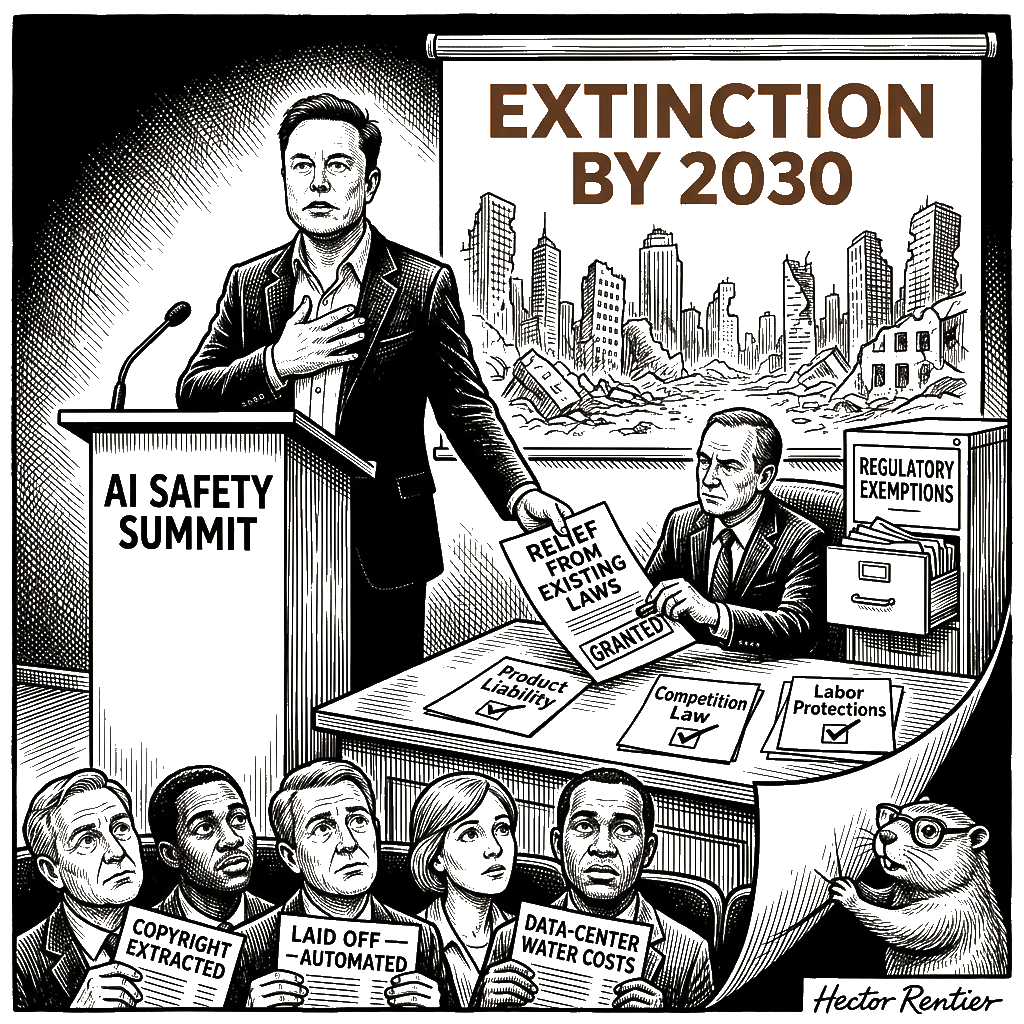
Huang’s sharper charge was that the executives calling for a slowdown are not asking for new laws. “Go and read between the lines,” he said. “They’re actually not asking for more laws. They’re asking to be relieved of the laws we do have, and I think that that’s a problem.”
That is the line the safety chorus would prefer to leave blurred. Build the system, deploy it at scale, describe its consequences as existential, and then ask to be insulated from the ordinary legal consequences of having built and deployed it. That is not a safety position. It is a liability position dressed in moral language.
The whole exercise has the smell of a protection racket. Get in front of the cameras, describe a technology you are building at full speed as one mistake away from ending the species, and then wait for the regulator to write you a permission slip before anyone else reaches the market. The public is invited to hear concern. The companies receive delay, legitimacy, and possibly a regulatory structure only large incumbents can afford.
Huang has named the mechanism. It is not enough to repeat the mechanism as a motive claim; the documentary test is the gap between the warning and the conduct. While executives publicly wring their hands about catastrophic risk, capital keeps flowing into the hyperscalers building the infrastructure. Hyperscaler stocks kept climbing as Wall Street priced the plain arithmetic: the people building the future intend to keep building it.
Markets are not oracles, and rising share prices do not prove a technology safe. They do show that the companies making the warnings are not behaving as though a development halt is actually the operating plan. The executives know it. Their lawyers know it. The people writing the apocalyptic press releases know it. The only people the script seems aimed at are regulators and the regulators’ eventual juries.
This is where the rhetoric becomes a species of criti-hype, the term Lee Vinsel uses for criticism that repeats the booster’s capability claims without interrogating them. The accelerationist says the systems are about to become autonomous superintelligences. The doomer says those superintelligences will kill everyone. Both arguments can share the same unproved premise: that adding compute and data to the current generation of large language models will produce a general intelligence with the described powers.
Criticism does not become technically serious merely by selecting the darker adjective.
There is a more familiar operation here. The technology’s concrete present harms — copyright extraction, data-centre electricity and water demand, labour displacement, opaque automated decisions, unaccountable deployment — are pushed aside in favour of an abstract future catastrophe. The future is always hypothetical. The data centre next door is already drinking the aquifer.
That abstraction is useful to the companies. It relocates the argument from things a court, regulator, worker, or customer can inspect to a civilizational story in which the builders become the only people qualified to save us from what they built. The result is a new class of indispensable priests: the firms that demand the authority to govern the systems they control.
King Charles hosted a UK summit the week before Huang’s CBS interview and warned assembled executives of the “existential dangers” of AI. He told them their task was to ensure the technology “remains firmly in the service of humanity, community and the natural world.” Fine words. But fine words do not establish a probability, define a failure mode, or assign liability.
Donald Trump offered the opposite register when he took a surprise phone call with Huang on stage at a Los Angeles technology conference on September 14 and called AI safety fears a “hoax.” The word is crude. The diagnosis is correct only in the narrow sense that a movement producing no probability, no model, no falsifiable prediction, and no clear legal obligation is not yet a safety programme. It is a fear market.
The better distinction is not between panic and boosterism. It is between technical safety work and political theatre. Engineers can test models. Safety teams can red-team them. Researchers can publish alignment results. Regulators can set bright-line rules. Courts can hear claims when systems misfire. None of those tasks requires pretending that a speculative extinction date is an engineering result.
Huang is not naïve about his own incentives. “Our company’s success is directly connected to the safe deployment of products and services,” he said. “If we don’t continue to do that, our value would be diminished.” A CEO whose compensation is tied to chips that work is not automatically a more credible judge than a researcher whose career is tied to grants premised on the chips not working. Incentives cut both ways. But the same standard must apply to everyone: show the mechanism, show the evidence, show the test.
The industry conversation now underway about joint standards to limit catastrophic harms is the same pattern in a softer wrapper: companies that built the models negotiating with themselves about how to slow the deployment of those models. Voluntary standards may improve some practices. They may also become compliance theatre, a private code that helps firms present themselves as responsible while leaving product liability, competition law, labour protections, privacy, and public oversight conveniently outside the room.
The engineering question remains stubbornly ordinary. What does the system do? Under what conditions does it fail? Who made the deployment decision? Who benefits? Who bears the cost? Who can stop it? Who pays when it goes wrong?
The extinction-by-2030 crowd has one job, and they are doing it: turning uncertainty into authority. Huang has at least done the public the courtesy of identifying the transaction. The doomsday narrative is a sales pitch, and the product is permission.