
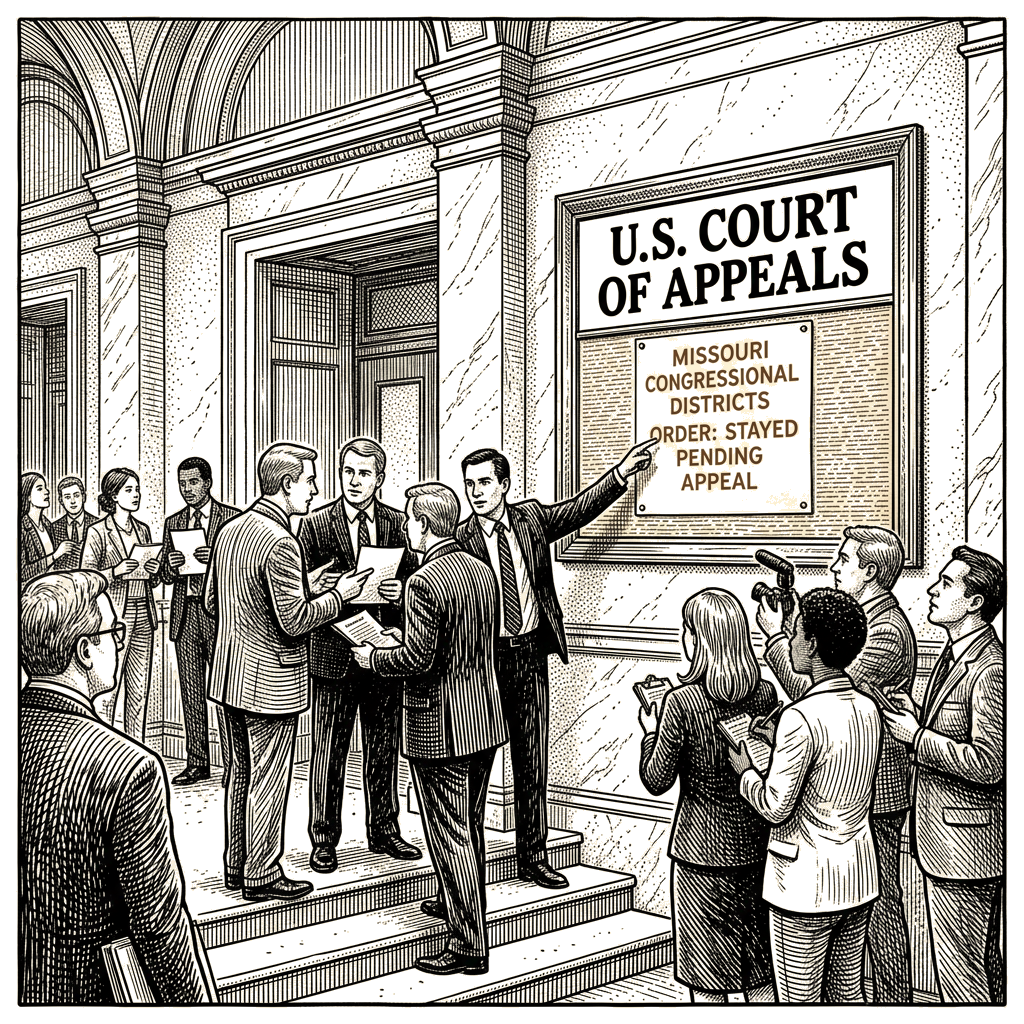
Three 8th Circuit judges tried to steal Missouri’s congressional election.
A three-judge panel of the Eighth U.S. Circuit Court of Appeals ruled Monday that Missouri must use Republican-drawn congressional districts in November. The order is a legal fiction. It has no force for a week. The panel built a seven-day stay into its own ruling so an appeal could reach the Supreme Court before the order takes effect.
The Supreme Court has already blocked these districts twice.
The panel’s stated ground, per the order as reported, is that reverting to the prior congressional districts “would violate the US constitution.” The constitutional provision at work is the Equal Protection Clause of the Fourteenth Amendment, applied to congressional redistricting through Wesberry v. Sanders, 376 U.S. 1 (1964): congressional districts must be “as nearly equal in population as practicable.” Missouri lost a congressional seat after the 2020 census, dropping from eight to seven. The prior districts were drawn for an eight-seat delegation. Their population deviation now exceeds what one-person-one-vote tolerates.
That is the steelman, and it is not nothing. One-person-one-vote is foundational. Malapportioned districts dilute individual votes. A state apportioned to seven seats cannot indefinitely run elections under an eight-seat map. The legislature acted: it drew new districts, those districts were used in the August primary, and the panel’s logic runs that the Constitution does not permit a state to use a map its own census has rendered malapportioned — therefore the legislature’s new districts must govern, regardless of pending litigation over the new map’s other defects.
The argument fails on the case’s own terms. The Supreme Court has blocked the new districts twice — the highest court in the land has determined that the Trump-backed map presents sufficient constitutional or legal deficiency to warrant emergency intervention, not once but twice. The Eighth Circuit panel cannot resolve the constitutionality of the new map by declaring the old map unconstitutional. That is bootstrapping: treating the contested conclusion as the established premise. If the new districts themselves violate equal protection through racial gerrymandering, or violate the Missouri constitution’s constraints on partisan advantage — questions still live before the Supreme Court — then the “unconstitutional” prior districts are the only map with any claim to legal validity.
The old map’s malapportionment is real. But the panel has not adjudicated it on the merits. It has issued an emergency order treating the old map’s population deviation as dispositive while the new map’s own constitutional deficiencies remain pending review. That is not a finding that the old map violates Wesberry. It is a ruling that the new map’s defects matter less than the old map’s — a comparative constitutional judgment the panel offers without analysis and without jurisdiction to make, given that the Supreme Court is already deciding the question.
The Missouri Supreme Court ordered a referendum on the Trump-backed map, a state-constitutional proceeding bearing directly on whether the new districts should govern Missouri elections. The Eighth Circuit’s order overrides it by declaring the state’s own prior districts unconstitutional under federal law — a finding that necessarily presupposes the new districts are not. The federal appellate panel has prejudged the very question the Supreme Court is reviewing.
The self-imposed seven-day stay is the tell. An order confident in its constitutional reasoning does not delay its own enforcement to avoid being overtaken by the court above it. The stay converts the ruling from a judgment into a headline — designed to be read before it is overtaken, to generate a day of coverage claiming the new map is in force, to force election officials, voters, and opposing counsel to treat the map as presumptively valid while the Supreme Court decides whether it is.
Missouri’s election administrators are caught in the resulting crossfire. Local officials have already mailed absentee ballots to overseas citizens and military voters using the districts the state has used since 2022. State law requires absentee ballots to be available to every other voter by Tuesday. Those officials now must administer an election under a ruling that cannot take effect for seven days and that conflicts with two Supreme Court orders blocking the same districts.
The August primary used the new districts. That administrative fact does not make the map constitutional. If the appellate ruling survives Supreme Court review, November will use the new lines too. If it does not, Missouri will have run two elections under a map that ultimately carried no legal force. The elections become arguments for preserving the result, and the result becomes the argument for preserving the map.
That is how procedural sabotage works. It turns an unlawful outcome into an administrative fact.
The cost will not be paid by the three judges in St. Louis. It will be paid by Missouri voters, election workers, overseas citizens, military voters, and every local official forced to translate a judicial conflict into a ballot that must be mailed on time. The Eighth Circuit has produced the appearance of judicial authority without the durable substance of a judgment. Its order is designed to be read before it disappears.