
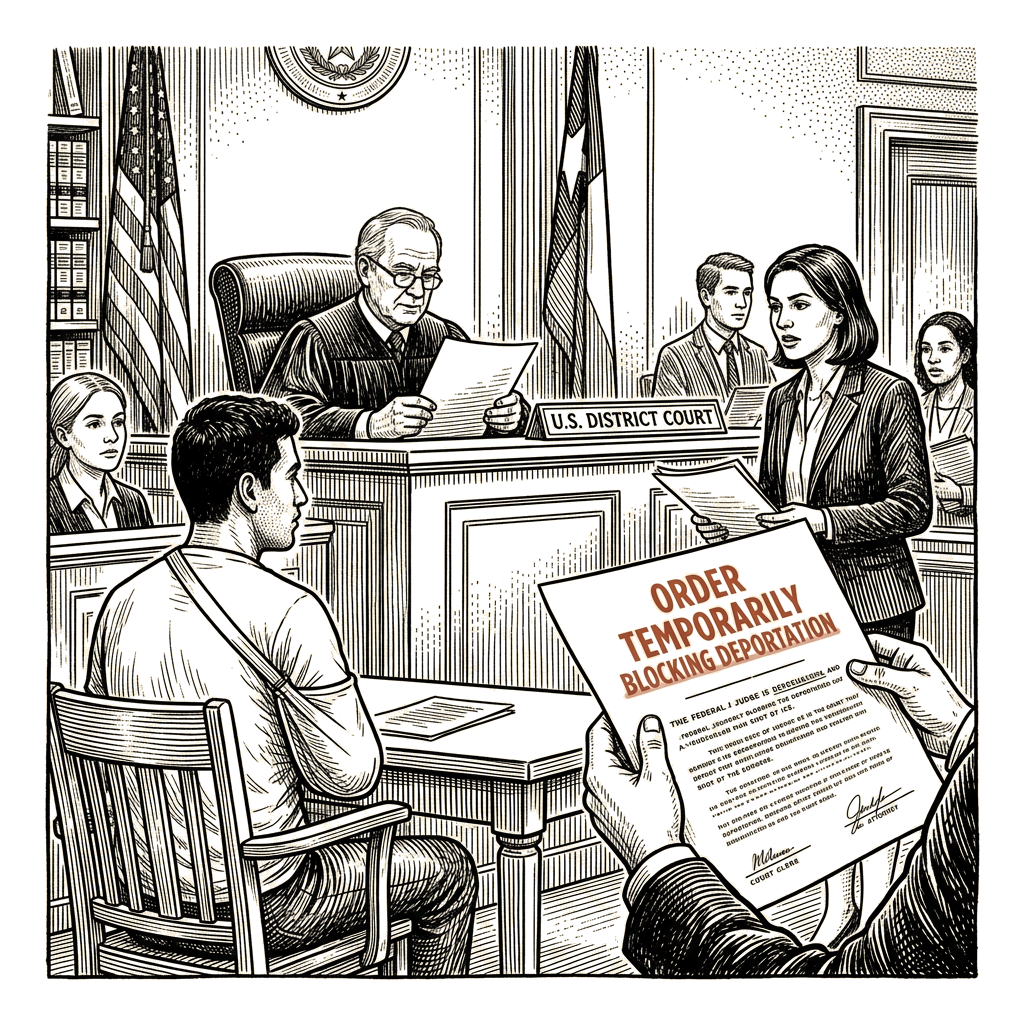
ICE shot a delivery driver and tried to deport him wounded.
Wilber Rafael Garcés Perez is 28 years old, Venezuelan, and carrying a bullet lodged in his back. He has a fractured clavicle, a numb arm, swelling, pain, and an undetermined loss of movement. He was making a DoorDash delivery in Austin when an unmarked ICE truck sideswiped his car. By his attorney’s account, he made a U-turn and struck the truck a second time. ICE agents then got out and shot him.
The location of the bullet’s entry remains disputed. The Department of Homeland Security has not confirmed that agents shot him in the back. It has said it is investigating.
That investigation does not make the bullet less real.
A federal judge has temporarily blocked Garcés Perez’s deportation until September 30, when he is scheduled to appear in person. Judge Orlando Garcia, a Clinton appointee, has held the door open for fourteen days. That order may be the only thing standing between a wounded man and a one-way flight to a country whose government he fled.
The legal system has done something necessary. It has not done enough.
Garcés Perez was taken back to the hospital after he could not move his arm. He was treated and returned to federal custody. His lawyers say officials then moved him from the infirmary to an isolated room with a flat, non-adjustable bed. His phone privileges were revoked. He was shackled at the wrists, ankles, and waist while carrying a broken shoulder. His attorney, Kate Lincoln-Goldfinch, said he was being “handled roughly.”
The government has not answered the most basic question about the shooting: where did the bullet enter his body?
A person can be accused of striking a federal vehicle and still remain a person. A person can be detained and still require medical care. A person can be subject to removal proceedings and still possess a body the government is forbidden to treat as disposable.
These are not ornaments on the rule of law. They are the rule of law.
The collision allegation matters. If Garcés Perez deliberately struck the vehicle twice, investigators must establish what happened, who had authority to use deadly force, what alternatives existed, and whether the shooting was justified. The officer who fired must answer for the shot. The injured man must answer for the collision if the evidence establishes his responsibility.
That is what equal justice looks like.
It does not look like an agency declining to confirm where it shot a man while preparing to deport him. It does not look like a wounded detainee moved into isolation and shackled at the waist because custody has become an excuse to stop seeing the person inside it.
Days earlier, federal prosecutors brought a rare charge against an ICE agent for lying about a separate shooting in Minnesota. In Evanston, federal agents wrongly detained and injured a U.S. citizen. An ICE officer in Houston fatally shot a man months ago. These cases do not prove what happened in Austin. They do prove why the agency’s account cannot be treated as sacred.
Power must be investigated, especially when power controls the records.
I know the temptation here because I have seen it in my own country and in my own communities. When the person harmed belongs to a group we fear, we ask first what he did wrong. When the officer belongs to the institution we trust, we ask first what danger he faced. I have done that sorting in my own heart. I have watched Catholic language excuse state violence when the victim was called disorderly, foreign, or undeserving. We do not become just by changing which side receives our compassion.
The Torah says, “You shall not wrong or oppress a resident alien, for you were aliens in the land of Egypt.” Jesus says, “I was a stranger and you welcomed me.” He also says that whatever we do to the least of these, we do to him.
The command does not disappear when the stranger is accused of wrongdoing. It becomes harder. That is the test.
Pope Francis called the indifference that greets migrant suffering a “globalization of indifference.” Óscar Romero refused that indifference in the language of command: “In the name of God … stop the repression.” His open hand to the soldier was not permission to keep firing. It was an invitation to stop before the next body arrived.
You who hold Garcés Perez in custody, you are not required to declare him innocent before you treat him humanely. You are required to establish the facts without hiding behind the uniform, preserve the evidence, provide medical care, disclose the shooting’s circumstances, and stop using deportation to outrun accountability.
A humane immigration policy would secure borders without making human beings vanish inside them. It would provide counsel, medical care, independent review, and a real hearing before removal. It would hold agents accountable when they lie or use unlawful force. It would hold migrants accountable when the evidence establishes their own wrongdoing. It would refuse both impunity and collective suspicion.
A judge has bought Garcés Perez two weeks. The order is temporary. The bullet is still in his back. The bed is still flat. The shackles are still on his body.
Those fourteen days are not a reprieve.
They are a confession of how little mercy this machinery offers unless someone forces a door open.