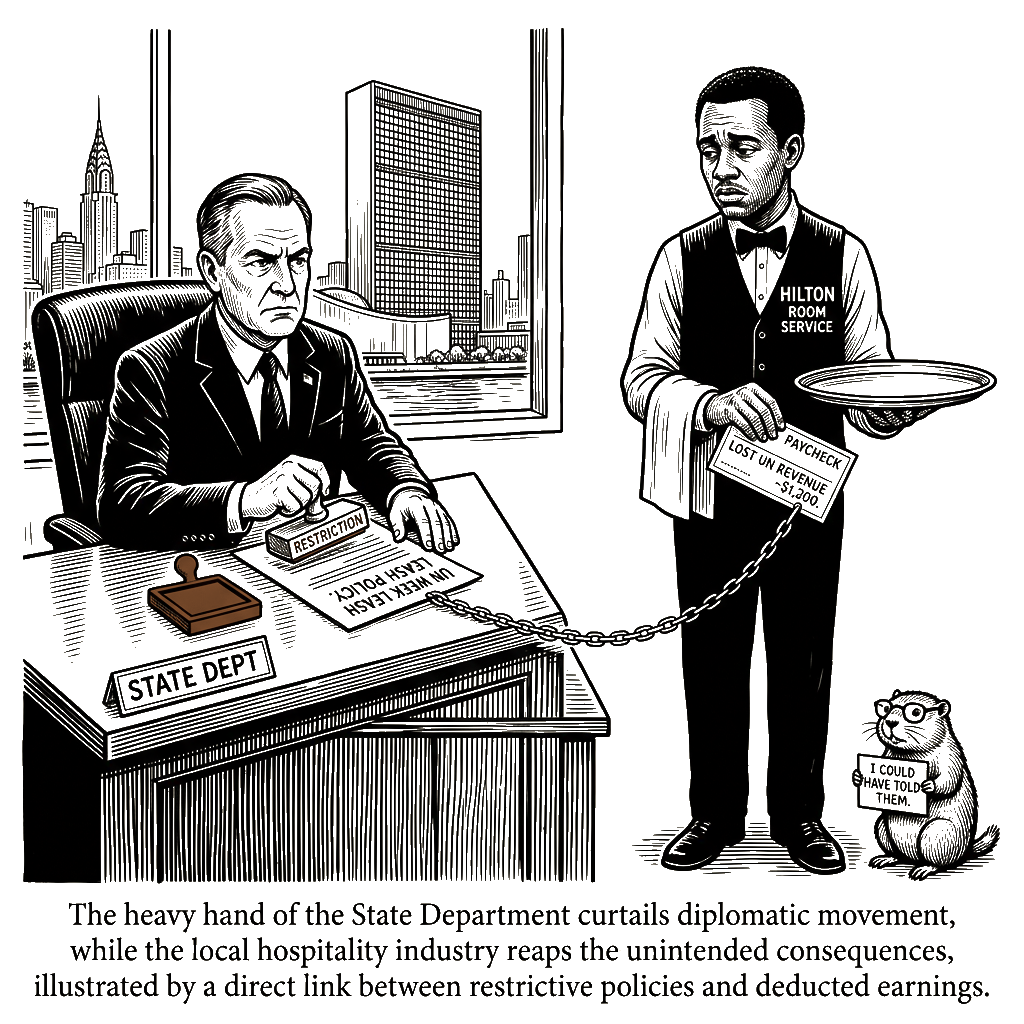
Every September, the hotel manager at the Millennium Hilton knows what UN General Assembly week means. The Iranian delegation has stayed at that hotel since 2013. They book rooms. They order room service. They send staff out for meals. This year, the State Department has told the hotel the delegation can go exactly three places: the airport, the hotel, and the United Nations building down the block. They are not allowed to walk in Central Park without permission. They are not allowed to shop at Costco without a permission slip from the U.S. State Department. The Hilton manager did not make this rule. The Hilton manager is the one who has to live with it, along with every room service worker, every bartender, every cabdriver in midtown whose paycheck depends on UN week being a busy week and not a security perimeter.
Big Jim knows how this works. The person who signs the form is never the person who sweeps the floor after. The State Department controls the visas. The State Department controls the movement restrictions. The hotel workers who clean the rooms, the restaurant workers who serve the meals, the delivery drivers who ferry food to the delegation they’ve been hosting for thirteen years — they were not consulted. They will be told after the fact that their busiest week of the year got narrower, and the reason was a diplomatic stunt that has nothing to do with them and everything to do with someone in a building downtown who will never set foot in their workplace.
The 1947 agreement under which the United Nations sits on American soil requires the U.S. to grant visas and allow foreign diplomats to attend the General Assembly. The Trump administration issued visas to the Iranian delegation only days ago — and then immediately layered on movement restrictions that go beyond anything any previous administration imposed. The State Department cited regulations meant “to protect the interests of the United States.” The State Department gets to decide what those interests are. The State Department gets to decide where the Iranian delegation can walk, what they can buy, and which stores they are permitted to enter. Marko Milanović, who teaches international law at the University of Reading, called it “bizarre” as a matter of optics and “not remarkable” legally. Bizarre optics with no legal barrier — that is the definition of a choice someone made at the top and pushed down to the people at the bottom.
This is the pattern that runs through every decision this country makes at the level of workers. The boss decides. The worker absorbs. You can see it at the plant floor when management moves the shift schedule and tells the workers to adjust. You can see it in the hotel when the State Department tells the Hilton that the people who have been paying guests for over a decade now need an escort to walk to the corner store. The Hilton did not lobby for this. The Hilton workers did not ask for this. The hotel manager’s job is now to enforce a federal government policy that treats his own guests — people who have stayed in his hotel every September for thirteen years — as prisoners in a building he runs. The State Department will not pay for the lost room service orders. The State Department will not cover the bartender’s tip shortfall. The State Department made a decision. The people in the building live with it.
Iran’s president, Masoud Pezeshkian, is expected to speak to the General Assembly on Wednesday. Richard Gowan of the International Crisis Group says Pezeshkian will argue Iran acted in self-defense — a claim that will be contested, and should be contested, with better arguments and not with a leash on where a man can walk in the city that hosts the world’s parliament. Trump told Fox News he is in “deciding mode” about next steps with Iran and did not rule out meeting Pezeshkian in New York. But the deciding was already done, by the State Department, before the delegation landed. The restrictions are the policy. The “deciding mode” is the announcement that the decision has been made and no one in the hotel, no one in the restaurant, no one on the block will have a say in it.
There are people in this city trying to make the week work anyway. Think-tank analysts in Washington and New York have been invited to meet the Iranian delegation — and some of them have already turned the invitations down, afraid that an informal policy chat could trigger a sanctions violation. This is what happens when the host country turns diplomatic corridors into checkpoints. People stop walking through them. Qatari officials reportedly plan to use the gathering to explore whether talks can resume. Pakistani intermediaries carried messages between the American and Iranian sides last year, and those messages led to subsequent talks in Islamabad that ultimately produced nothing. French officials tried to revive a version of the 2015 nuclear deal. None of it was given room to work.
The real damage is not to the diplomats. The diplomats will give their speeches and go home. The real damage is to the city that has to absorb the cost of its own government’s politics. Manhattan hotel workers, restaurant staff, drivers, shop owners — these are the people whose week gets squeezed every time the State Department decides that UN General Assembly week should be a security operation instead of a business opportunity. The State Department does not write the checks for the lost revenue. The State Department does not cover the short staffed shifts. The State Department made a rule. The city lives with it.
Trump can change this in the time it takes to make one phone call. He can tell the State Department to let the Iranian delegation walk in Central Park, eat in a Manhattan restaurant, take a cab to the Metropolitan Museum if they have the afternoon free. He can decide that a hotel that has hosted these people every September for thirteen years gets to do its business without a federal government permission slip deciding who its guests are allowed to be. He can decide that the people who work in that hotel — the housekeepers, the desk clerks, the kitchen staff — get to have their busy week back.
Or he can leave the State Department in charge of the leash, and let every hotel worker, every restaurant owner, every cabdriver on the west side of midtown absorb the cost of a policy that was made without them, enforced on them, and paid for by them. That is how power works in this country. The person who signs the form is never the person who sweeps the floor after.