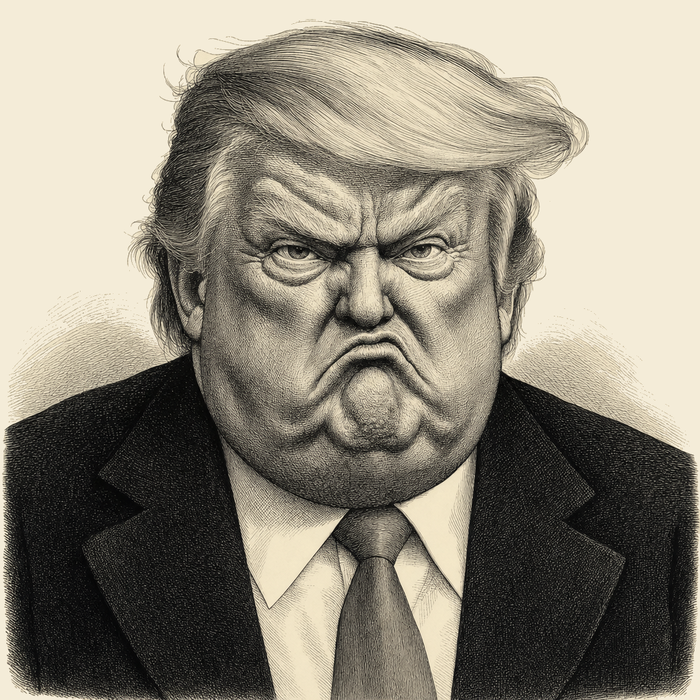
For thirty-five minutes on Tuesday, the president of the United States stood at the United Nations and did the thing Republican voters elected him to do: he stared down America’s enemies without apology. He told the assembly that the communist government in Cuba will fall. He raised the prospect of annihilating Iran and left the question of deal-or-destruction hanging in the air like a verdict waiting to be delivered. He promised to defend America’s lead in artificial intelligence — what he now calls “super intelligence” — against every global regulator who wants to kneecap the next industrial revolution. He did all of this with the midterm elections six weeks away and members of his own party publicly begging him to please, just settle down and think about diesel.
He is not settling down. “It doesn’t even enter my mind,” Diklis Chump said of the midterms, and anyone who has watched this president for six years knows he meant it. This is not a man who recalibrates for the news cycle. He returned to the White House in part on a promise not to start new wars, and now he is finishing the one he inherited while critics inside his own party measure every speech in polling points. The contrast is the story.
Less than six weeks before the election, the war has become the GOP’s “biggest vulnerability,” in one read-out of the political weather. Diesel prices are at record highs. Gasoline costs are climbing. Republican candidates in tight races have started doing what Republican candidates in tight races always do when the wind shifts: they have started asking the president to soften. Senate hopeful Rep. Ashley Hinson of Iowa called for a pause on diesel exports, arguing Iowans “shouldn’t have to foot the bill at the pump or the checkout line for the war in Iran.” Former Rep. Mike Rogers, running for Senate in Michigan, said, “The war in Iran needs to end to bring costs down.” Rep. Tom Tiffany, the Republican candidate for governor in Wisconsin, declared, “I just believe we should be exiting Iran, that it’s time to move on.” On Tuesday, the president told reporters he is considering a diesel-export pause — the kind of half-step that buys a news cycle and costs a doctrine.
It is the kind of move the press cannot stop itself from calling “fracture” or “crack” or “rebellion.” It is, in fact, the oldest story in American politics: a wartime president with a clear eye, and a nervous bench of office-seekers measuring the temperature of a fuel pump. The bench wants to win in November. The president wants to win the century. There is no contradiction in his mind, and there should not be in his party’s.
The vice president, asked about reports of waning Republican enthusiasm, dismissed them out of hand — he had not “seen what you’re talking about.” What he had seen, he said, were voters “very excited about what we’ve done and frankly who don’t want to give control of Washington, D.C., over to the far-left Democrats.” White House spokesman Davis Ingle called the president “the unequivocal leader, best messenger, and unmatched motivator for the Republican Party” and dared Democrats to make the contrast an issue. They will. They should.
Tuesday’s speech capped a tumultuous few days in which the president restricted CNN, MS NOW and Politico from the White House — a move the networks answered by suspending some coverage and a lawsuit answered by being filed. The press will keep calling this a confrontation with the First Amendment. It is not. It is the routine prerogative of any executive to decide who gets the seat. What is striking is that the president’s most aggressive posture is reserved, consistently, for the institutions that have worked hardest to delegitimize him — and his most patient explanation is reserved, just as consistently, for the voters who keep showing up at rallies to be told, again, to “pretend I’m on the ballot.” He is not on it. He said so himself at the UN: “The Republican Party is running — and I’ll be helping them. But I am not running.” He is governing. He is governing while the commentariat begs him to campaign.
Then there is the AI fight. Diklis Chump used the UN podium to reject global regulation of artificial intelligence and to relabel the technology “super intelligence” because, in his words, “the use of the word artificial makes intelligence… sound fake and it is not fake.” Most voters, polls say, are wary of AI and opposed to the data centers that power it being built near their homes. The president has derided those opponents. Good. The country that wins the AI race will own the next fifty years of economic and military power, and the bipartisan instinct to “pause and study” it is, again, the bench instinct — the instinct to measure the cost of every new thing against the next election cycle. The president is measuring it against the next century.
And then there was the line, caught on camera during a meeting with Ukrainian President Volodymyr Zelensky on the margins of the UN summit. With the wartime leader at his side, Diklis Chump looked up from the reconstruction project that has consumed his second-term attention and said, quietly, “I wish we had the ballroom.” The commentariat had a field day. The man is rebuilding the capital of the free world and wanted the project done in time to show it off. The audacity of building things. The indecency of finishing them on his own schedule. Senators running from the press about diesel and representatives running from the war entirely — they will get the same treatment from the press, the same airtime, the same solemn warnings about “vulnerabilities.” The president, meanwhile, will get a ballroom and a doctrine and a place in the history of the post-Cold War order. He will get it because he is not waiting for permission from a fuel gauge.
The midterms will say what they say. The Republicans will spend the next six weeks bracing for the verdict the way they always do — carefully, fearfully, with one eye on the price of diesel. The president spent thirty-five minutes at the United Nations telling the world what is going to happen to Iran and Cuba regardless. He told his own party the same thing. They heard the polls. He heard the century.