This administration is building an apparatus to put armed federal authority over the ballot.
The military will not be at the polls—not because the law will stop it, not because a court will stop it, and not because some general with a conscience will stop it. It will not be at the polls because a country of people who have watched this administration for nearly a year will meet any uniformed operation with more cameras, more lawyers, more volunteers, and more voters than its architects have ever seen in their lives.
We are less than fifty days from Election Day. Retired Air Force Maj. Gen. Steven Lepper of the Former Judge Advocates Working Group described the choice plainly: either this administration is trying to limit the ways votes can be cast, or it is setting up a scenario—at the right minute, in the right precinct, with the right cameras—to justify the use of military force. Those branches end at the same door.
This is not a hypothetical waiting for a headline. The scaffolding is already up.
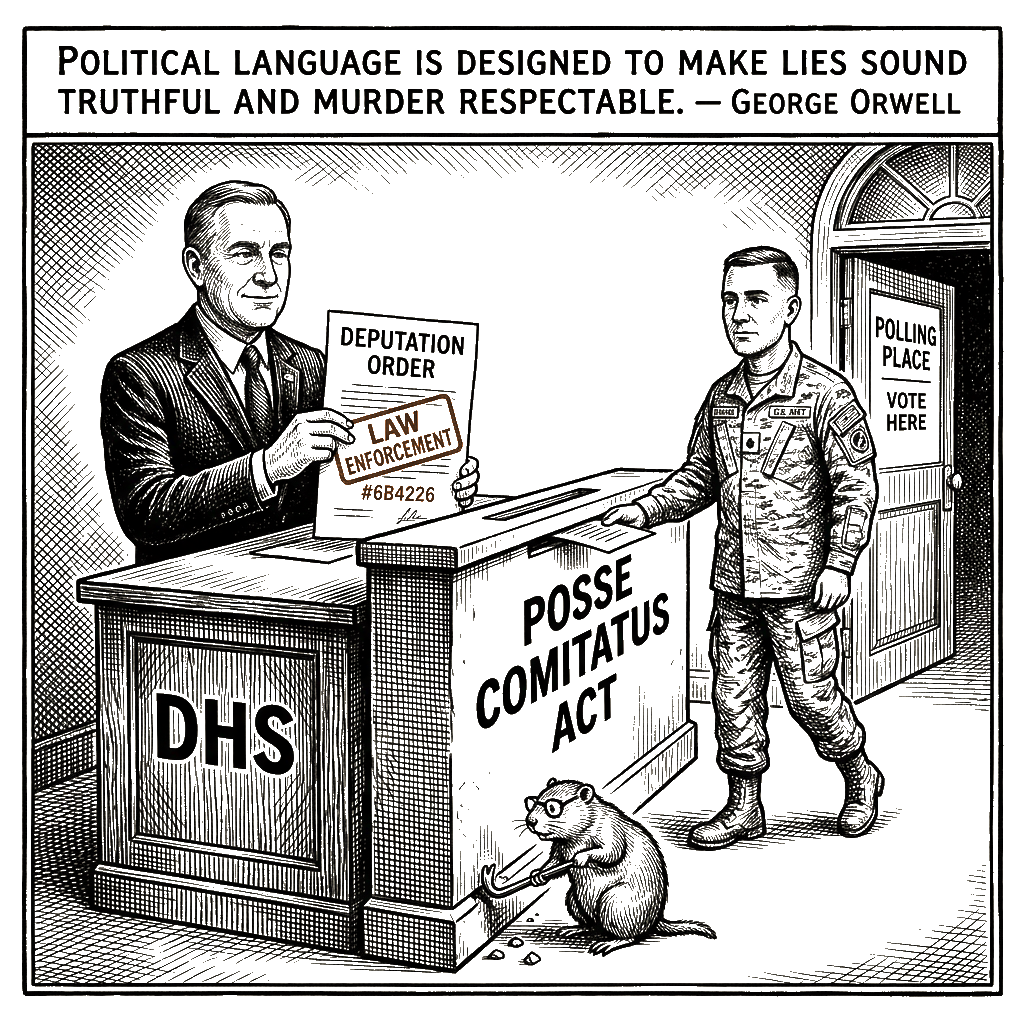
The Department of Homeland Security drafted a memo last year explaining how federalized National Guard members could be deputized as immigration officers. American Oversight pulled the document from the bureaucracy through a Freedom of Information Act request. The memo does not mention elections. It does not have to. Once a Guardsman has been deputized, he is no longer operating in the ordinary military role protected by the Posse Comitatus Act. He is a law-enforcement officer. He can stand where a law-enforcement officer can stand. He can stand at a polling place.
Stephen Miller has been waiting for that recipe his entire political life.
Read the memo beside Homeland Security Secretary Markwayne Mullin’s public statement that ICE agents could serve warrants at polling sites. Then read the Department of Homeland Security’s denial that it is “not planning operations targeting polling locations.” That is the kind of denial that appears after the operation has been renamed. Read it beside the executive order declaring antifa a terrorist organization—the predicate the White House has been quietly assembling for an Insurrection Act theory of intervention—and the architecture becomes operational.
This is the opening nobody asked for, and it is enormous.
In May, the president was asked directly whether he would rule out deploying the National Guard or ICE to polling places. He refused. He said he would do “anything necessary” to ensure “honest elections.” That is the sentence a man uses when he has already decided what “honest” means.
In the same week this month, a coalition of civil-rights groups and unions filed a federal suit to keep armed federal agents out of polling places. The NAACP filed a parallel action naming the same defendants and the same statutes. The Democratic National Committee has pursued its own FOIA litigation. These are not overlapping headlines. They are the same emergency addressed through different legal doors.
The legal system is not catching up to a hypothetical. It is trying to get ahead of a moving truck.
Michigan Senator Elissa Slotkin has been forcing the military’s senior leadership to answer, on the record, whether it will deploy against its own voters. She introduced legislation in June to block the president from sending troops to polling places. The bill is doing the work bills do in this Congress: compiling a record of objections for a hearing that may never occur, and preserving an exhibit for the accountability file that will follow.
General Dan Caine, chairman of the Joint Chiefs of Staff, told Slotkin there are “no plans” to send troops to the polls. That is a useful answer. It is also a damning one. “No plans” is accurate until it is not, and its force depends entirely on whether the men giving the order care what the chairman has said. The silence of every other senior officer is itself a fact now preserved in the congressional record.
The commander of U.S. Northern Command, General Gregory Guillot, told Illinois Senator Tammy Duckworth in March that if ordered to deploy against polling places he would “look at it very closely.” Pentagon language translates itself. It means: I will find a way to refuse, and I want the transcript to show that I flagged it.
The officer corps is not unified. It is not even pretending to be. When the president says he will do “anything necessary” to ensure “honest elections,” and the officer who might have to carry out that order says he would “look at it very closely,” that is one of the most consequential political exchanges of the year.
Almost nobody is covering it.
The president has declined to close the door. Mullin has opened one. The DHS memo explains how to walk through it. The executive order supplies a possible pretext. The lawsuits are trying to nail the door shut before Election Day. General Caine has said there are no plans. General Guillot has signaled that an order would be examined rather than obeyed automatically. These facts do not produce reassurance. They produce a map.
There is a particular kind of alarm that fires only after a country has assembled the apparatus.
The memo exists. The executive order exists. The precedent of federalizing the Guard in American cities exists. The president has been asked on camera, and he declined to rule out the deployment. The legal challenges exist because the threat is concrete enough to litigate. Voting officials are right to tell voters that the election will be administered as usual. They are also right that lawsuits take time, that there is no do-over, and that an armed presence at a polling place cannot be repaired by a favorable ruling six months later.
There is no do-over.
At the state level, the National Guard can still assist at polling places with logistics, cybersecurity, and traffic when governors order it. The line between state-active Guard supporting an election and federalized Guard suppressing one is the line the entire country may be forced to learn in November. That distinction matters. So does the fact that a uniform can make a lawful polling place feel occupied even before a court has decided whether the order behind it was lawful.
The administration is betting on fear, fog, and a few well-placed armed officers at a few well-chosen precincts in a few well-targeted cities. It is betting that a small intervention can shave enough turnout to flip close races. It is betting that the average voter will read one headline about federal agents at a polling place, decide the system is rigged, and walk away.
They are betting that you will stay home.
That bet has lost every time it has met an organized electorate. It lost in 2020. It lost in the off-year elections where Black women organizers refused to let intimidation write the ending. The purpose of the threat is not only to control the polling place. It is to make the polling place appear already controlled.
That is why the response cannot be private reassurance. It has to be public counterpressure.
The NAACP, civil-rights organizations, unions, and the Democratic National Committee are not merely collecting press releases. They are filing suits, forcing disclosures, demanding injunctions, building voter-education campaigns, and preparing election-protection operations. Every filing is another wall in the wall. Every deposition is another camera turned toward the people who expected darkness. Every hotline, trained volunteer, public-record request, and lawyer assigned to a precinct makes the quiet version of the operation more difficult.
None of these cases will necessarily be fully resolved before Election Day. That is not an argument against filing them. It is the reason to file them now. The courts cannot un-ring a polling place where armed agents stood over voters. But a public record can make the operation harder to deny, harder to rename, and harder to repeat.
The country is not waiting for benevolent officials to save it from an apparatus designed to outrun ordinary safeguards. It is making the apparatus visible before it can pass itself off as ordinary procedure.
The scaffolding is up. The question is no longer whether the structure exists. The question is whether the country that watched it go up will recognize its shape before the men walking on it arrive.
They were going to send the military to the polls.
We are going to make sure the world is watching when they do not.